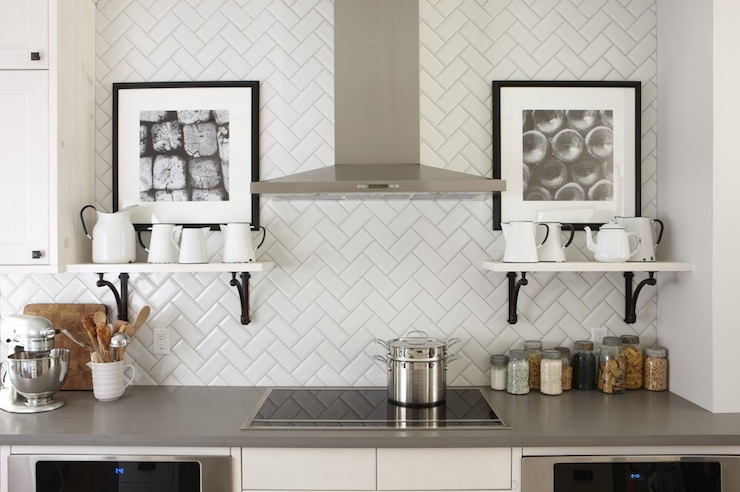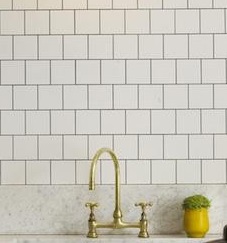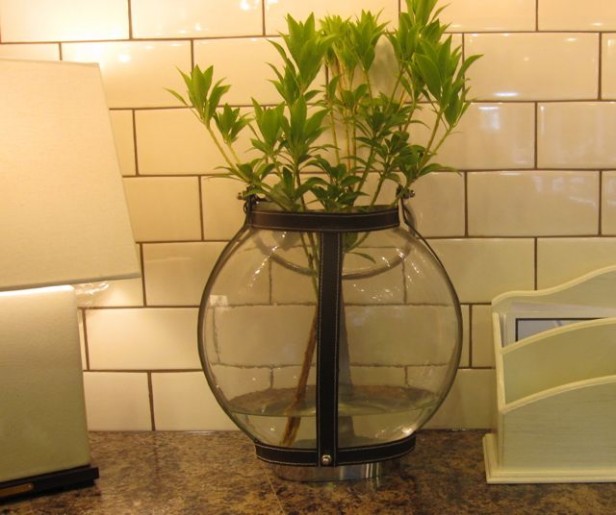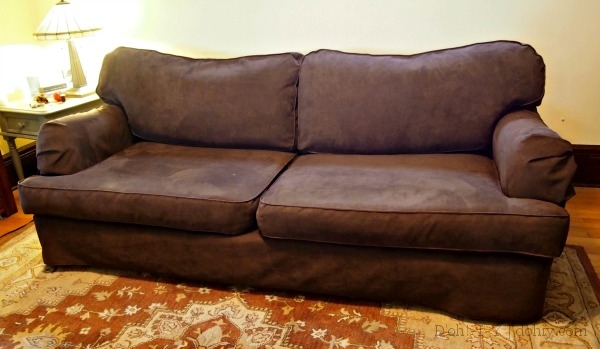
Grout. Grout.

Let it [all] out!

– Reverend Lovejoy

Did you know that the song “Shout” by Tears for Fears is about primal scream therapy? Or at least that’s one theory. You know what makes me want to give voice to my own primal scream? Grout color cards.

These are the things I can do without.

These are the things I can do without.

I don’t know why grout companies even print color cards. By most accounts, they bear little relation to how the product actually looks. Most advice on the internet instructs the would-be grouter to buy a bunch of different grout colors and make a sample board.

Wait. Do you suppose the grout companies are seeding that idea online so that people will buy lots of unneeded grout? It’s the grassy knoll of tiling, people!

Conspiracy or not, I tested a bunch of grout so you don’t have to — assuming you are interested in a light-coloured grout by TEC. TEC is widely and cheaply available locally, so I decided we would use one of TEC’s colors. I don’t own TEC stock — this is strictly a limiting exercise so I don’t drive hither and yon looking for obscure grout samples for the rest of the year. One of these will do!

Our bathroom has TEC “Standard White” grout with white ceramic subway tiles. I mentioned in another post that I regretted white grout in the bathroom, and that’s partially true. The white grout on the walls is fine. I sealed it, and it has held up wonderfully, even in the shower (although admittedly, we don’t cook in the shower). The problem is with white grout on the floor. That, my friends, is impossible to maintain in its original state. Say no to white floor grout!

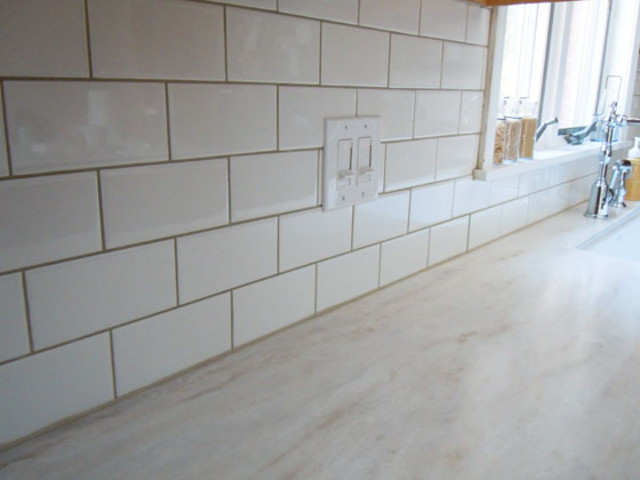
The standard white wall grout is a nice, low-contrast look with white subway tiles. Here it is sealed with about four years on it:

OLYMPUS DIGITAL CAMERA

TEC Standard White Sanded Grout

We wanted to use a neutral grout in the kitchen, but weren’t sure WHICH particular tone. We knew what Standard White looked like, and it’s easy to find photos and reviews of the popular Dove Gray and Delorean Gray online — check out this Gardenweb thread or try an image search. It was harder to find other neutral gray-to-warm-beige colors, so we slopped a few on pieces of scrap tile for your edification! (And ours. Well, mine. The Kev isn’t that bothered.)

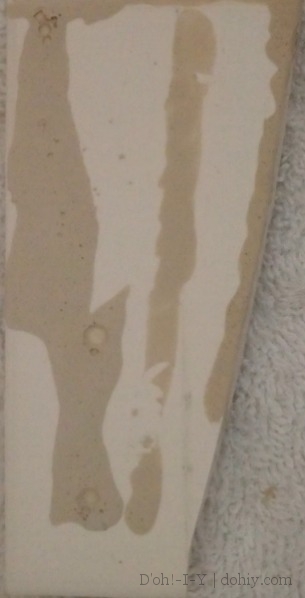
All our pictures here were taken in natural light with no flash on white glazed tile (on a white towel). The grout is fully dry and has been on the tile for at least a week. I adjusted the brightness and contrast by the same amount for all pictures, with a view to making these as close as possible to the colors my eye sees. I zoomed these in for purposes of getting the color, so apologies that the resolution isn’t great.

1. Pearl

OLYMPUS DIGITAL CAMERA

TEC Pearl Unsanded Grout

In artificial light, this one looks off-white to palest gray, but it has a warm cast in natural light. A Gardenweb member posted the following picture of Pearl on white tile, and said that it was lighter in person a few months after installation.
(via)

(via)

2. Antique White

TEC Antique White Unsanded Grout

TEC Antique White Unsanded Grout

This one is more gray and darker than the Pearl in artificial light. Many tile folks and designers around the internet say that any grout maker’s antique white is a safe bet. Some homeowners say it just looks like dirty grout!
Antique white with white tiles (may not be TEC) (via)

Antique white with white tiles (unspecified brand–may not be TEC) (via)

3. Almond

The most colorful grout we tried was TEC’s Almond.

TEC Almond Unsanded Grout on White Tile

TEC Almond Unsanded Grout

Our cabinets are maple and they are stained a warm color — I think it was called “Cider” and I still really like it a decade after the remodel. My concept was that picking up a similar color in the grout would pull the wood cabinets together with the quartz counters and the white tile backsplash and everything would just be super-neat. On the TEC color brochure, Almond is the closest to the cabinet stain. On the tile, it’s fairly orange in artificial light to very pale in lower natural light. I could not find a photo claiming this exact color with white tile, but I suspect it would come out something like this:
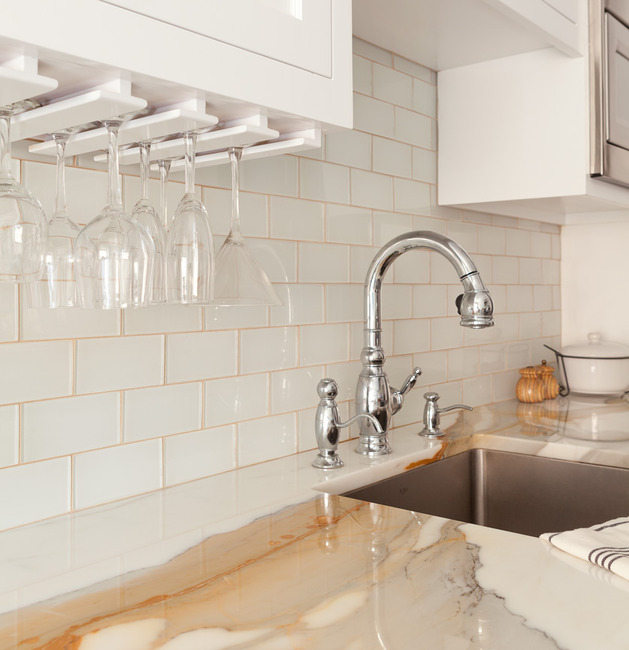
Tan grout matches the marble veining (via)

Tan grout matches the marble veining (via)

…or this:
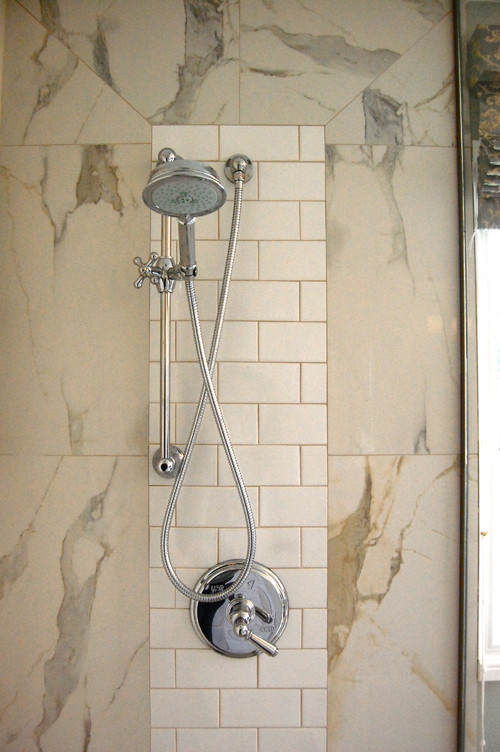
 

Our “short list” includes all of these (Standard White, Antique White, Pearl, and Almond), plus Dove Gray. And our decision…isn’t made yet because I have yet to corner Kev on the issue. Any input welcome!
Posted in Decor, Kitchen, Walls & Floors | Tagged , , | 2 Comments

Tile Tile Tiley Tile 2

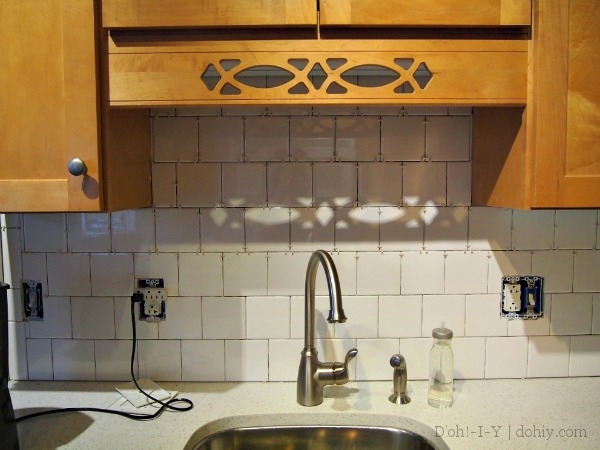
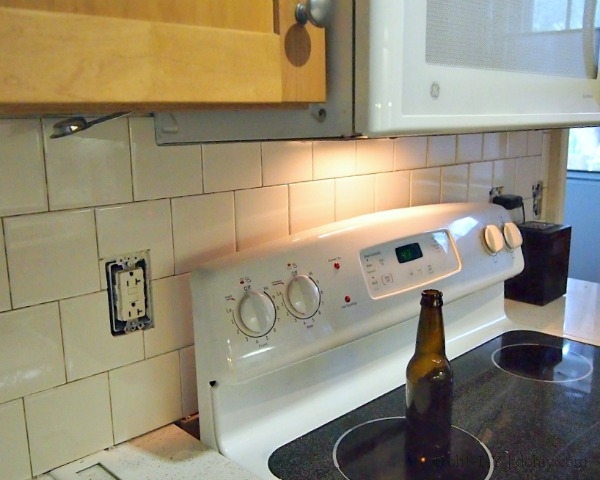
I finished tiling the backsplash.

Beer is an essential tiling tool.

Beer is an essential tiling tool.

OLYMPUS DIGITAL CAMERA

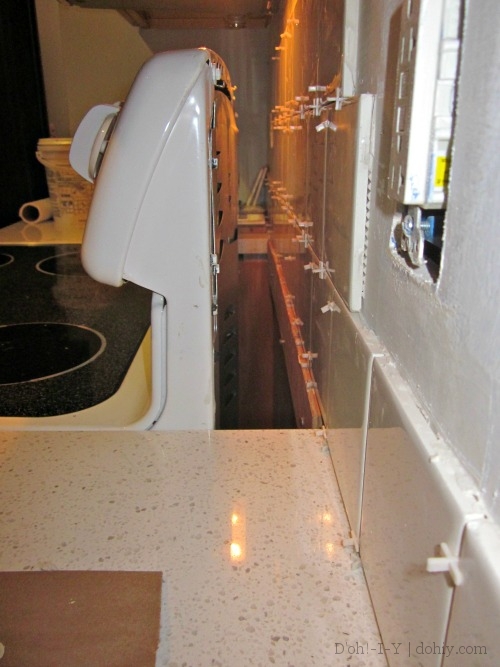
As I previously posted, I generally followed online tutorials for tiling kitchen backsplashes like this one. I started this tile project by tiling the middle of the wall where no tiles needed to be cut, which rendered me overconfident. Based on how far I was able to get with whole tiles, I had this brilliant idea that (a) there would not be all that much cutting to be done, and (b) what cutting there was could be done with tools we already had.

tile shop tile sawSo wrong on both counts! But I found a tile saw on Craigslist, and that made all the difference. A tile saw looks like a small table saw, but the blade has no teeth and runs through a water pan to keep it cool, reducing breakage and dust. The blade really just grinds through the tile rather than cutting it. Our cheapie used saw made cutting straight edges and notches much easier and faster than scoring or using a tile nipper.

If I needed to make a cut with the saw, I would hold up a whole tile and just mark where the cut needed to be. The saw is not super-precise (see: grinding, above), so I’d try to err on the big side. If I had too much tile left, I could cut again or use tile nippers or a whetstone to take off the last bit. I used a Sharpie to mark tiles because marker just wiped off the glazed surface; otherwise, use a pencil.

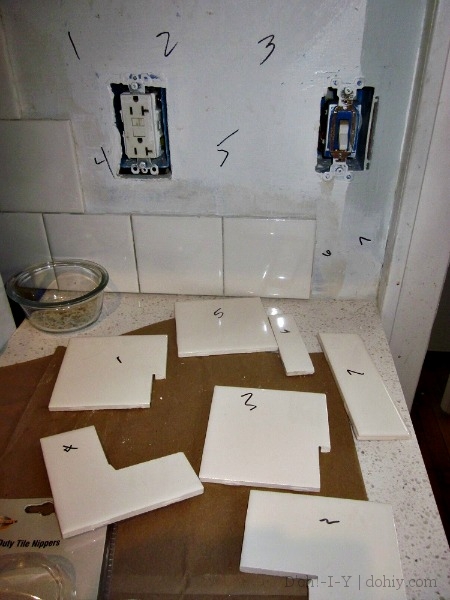
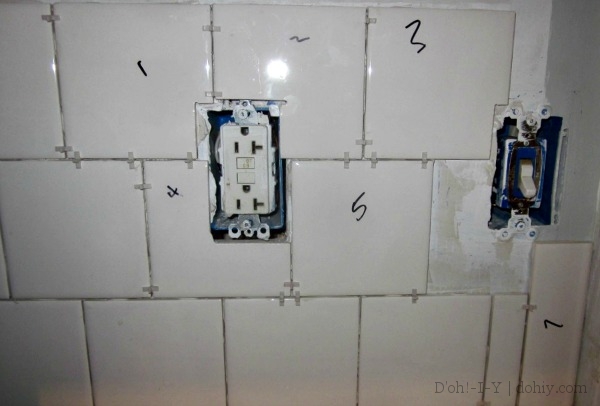
I found another good use for the Sharpie: tracking which cut tile went where. I had the tile saw out in the garage, so I would mark up a stack of tiles and cut them in one trip out there. I started coming back from the garage and finding I couldn’t plug the pieces into the puzzle as easily as I expected. So I started numbering the tiles and their spots on the wall as I marked them for cutting.

tile numbers on wallMy pathetic memory might be a cause for worry, but this technique was a real time saver!

tiles on wall

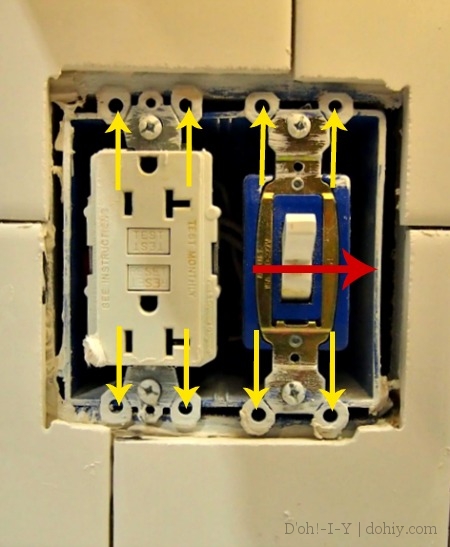
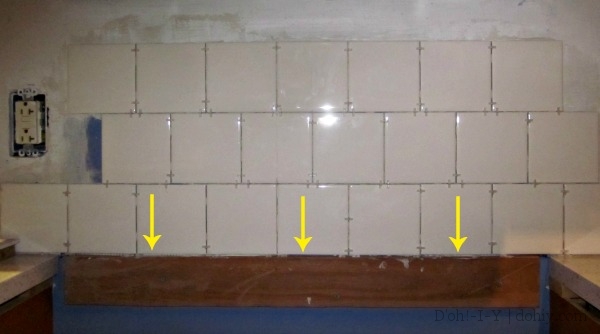
When cutting tile to fit around electrical outlets, make sure to leave the tabs on the switches and receptacles clear. Those might need repair or replacement at some point, so trapping them under tile isn’t advisable. In a perfect world, you would also leave the edges of the electrical box clear, as in this next picture. (That didn’t happen on every box I did.)

Yellow arrows show the tabs and the red arrow shows the edge of the box.

Yellow arrows show the tabs and the red arrow shows the edge of the box.

The outermost tabs on a US switch or receptacle are scored and can be broken off if they aren’t being used. In a couple of instances, I turned off the circuit and then used needlenose pliers to snap off unused tabs rather than recut a piece of tile. 

Left tab snapped off to avoid tile.

Left tab snapped off to avoid tile; right one still intact. The switch is secured through the upper middle hole, so these tabs are extras.

Do not remove a screw to snap off a tab — loose outlets are an electrical fire risk, even under a wall plate. So don’t do that.

I was planning to put the tile saw, the nippers, and the leftover tile adhesive on Craigslist as a package deal for the next local backsplash hero, but we decided we’re not quite done yet. There’s a little piece of wall between the window and the window seat that is constantly scuffed when we set groceries and boxes there, so I’m going to tile that, too. But not today! This weekend saw enough tiling for anyone — my hands and neck are aching!

Other than expanding the tile area, next up is choosing grout and wall plates…

Posted in Decor, Electrical, Kitchen, Walls & Floors | Tagged , , , , | 2 Comments

Things That Go D’oh in the Night

Captain McAllister: ‘Twas a moonless night, dark as pitch, when out of the mist came a beast more stomach than man.
Homer: Hey!

– The Simpsons

The other night, Kev was out and I came in late, but an insane mouse came in with me. I was looking forward to falling down in bed, but instead I spent the better part of an hour unsuccessfully calling off the cats while trying to trap and relocate this rodent. Instead spending his last minutes being stalked by cats before being eaten, the poor thing spent that time being stalked by cats and a shouting woman before being eaten anyway.

Sorry, little guy (via).

Sorry, little guy (via).

The following night, we were settled in bed, when BEEP! And less than a minute later: BEEP! It was a damned smoke detector indicating that its battery was going. We stood in the hallway trying to figure out which unit so hated sleep, and it was, of course, the one awkwardly located over the stairs. Some craning on tiptoe later, the Kev got it unplugged, replaced the back-up battery, and reinstalled it. Back in bed: BEEP! This time, I uninstalled it and took the battery out. A minute later, it magically beeped. That’s when it magically ended up in the yard.

These events left me weary and predisposed to lash out at whatever next disturbed my angelic repose. About 2:00 yesterday morning, Kevin discovered that the doorknob on our bedroom door had ceased operations. I don’t recall the actual conversation we had about the issue, but the Kev reports it went like this:

Me: zzzzzzzzzzzzz

The Kev: *rattlerattlerattle…rattle…rattlerattle*

Me: WHAT THE HELL ARE YOU TRYING TO DO?!

The Kev: Just trying to leave the room, dear.

Older doorknobs can loosen up over time. A loose doorknob can’t move the latch, which can trap you in your bedroom with a full bladder and an irrational spouse.

itsatrap

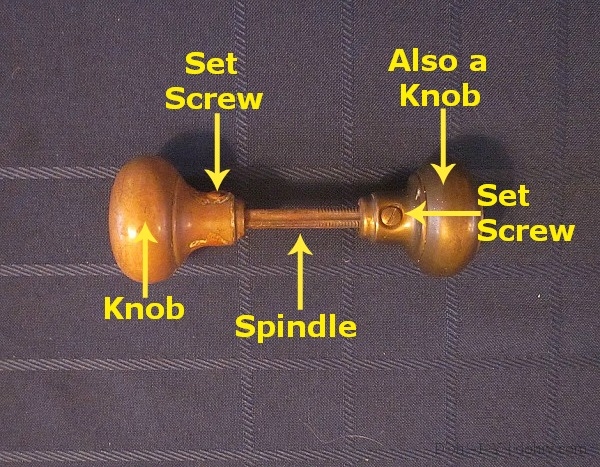
Ideally, you’d check the knobs from time to time to make sure they were staying spry. If you get trapped like the Kev, though, it’s easy to break out (or, you know, fix it) if you understand how the thing works. Here’s a diagram of a spindle knob set:

Antique Doorknob Diagram

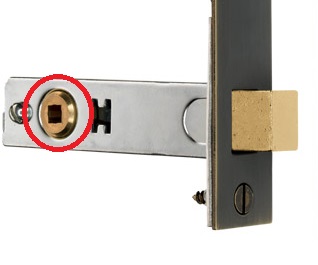
The squared-off spindle threads through a square hole in the latch mechanism. The knob is connected to the spindle via the set screw. When you turn the doorknob, it turns the spindle in the square hole (part of the latch mechanism), and the latch is pulled back to open.

door latch

The square hole for the spindle inside the door (via)

But if the set screw has worked itself loose, the doorknob will spin, but it won’t move the spindle, so the spindle won’t turn, the latch mechanism won’t be engaged, and the latch won’t open. The set screw is the weak link in this system–just ask the Kev! (This is why newer doorknob sets don’t use them.)

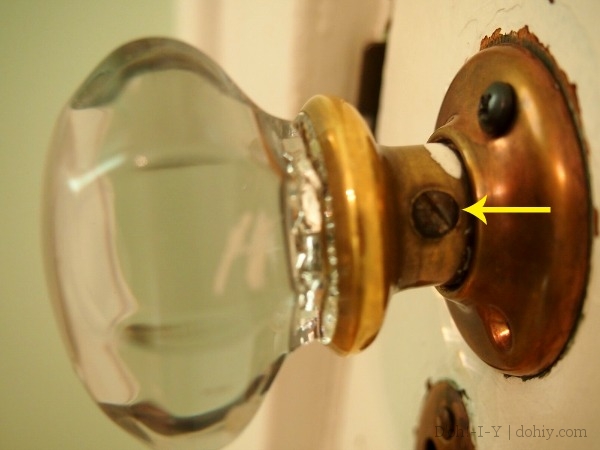
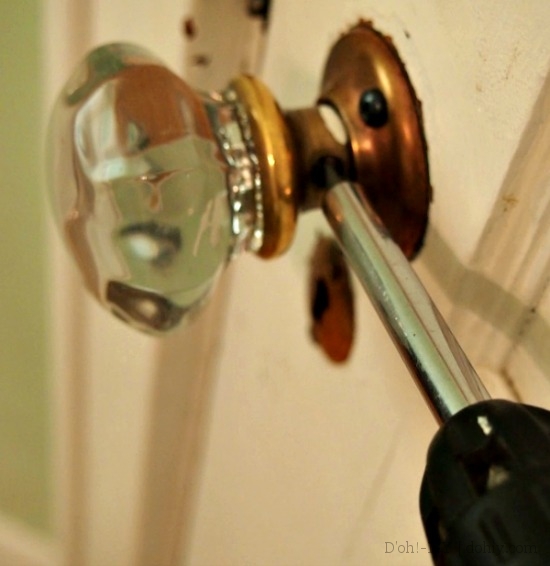
While the set screw is the weak link, it’s also an easy fix. Usually, the set screw is still in place, and it’s just a little loose.

There it is! It might not be on the side, though--look underneath if you don't see it.

There it is! It might not be on the side, though–look underneath if you don’t see it.

Fortunately, that’s what happened with our doorknob. In that case, just use a blade screwdriver to tighten that puppy up. Jiggle the knob a bit to make sure the latch is extended first, and push or screw the doorknob onto the spindle until it’s firmly in place. Then, tighten the set screw. Check the set screw on the other side, and tighten it if necessary. After tightening, try it a few times (from both sides) to make sure it’s working.

It's just this easy! On another topic, close-ups make me realize we really need to strip and repaint this door.

It’s just this easy! But we really need to strip and repaint this door.

Sometimes, though, the screw will have fallen out entirely. You really don’t want to try to replace these (set screws were not standardized, and you might not be able to find another), so mount a search. They are small, but fortunately, they can’t go far (unless CATS). It helps to remember that a set screw might just be a threaded cylinder with a slot at one end rather than a traditional fastener.

Like this, but much smaller (via)

Like this, but much, much smaller (via)

If you have old knob sets like these, it’s probably a good idea to keep a screwdriver in rooms that might otherwise become traps. It could even be decorative!

Also, be careful who you choose to get stuck with in the middle of the night.

Posted in D'oh!, Repair & Maintenance, Romance, Windows & Doors | Tagged , , , | Leave a comment

The Upstairs That Wasn’t

You know, Moe, my mom once said something that really stuck with me. She said, “Homer, you’re a big disappointment.” And God bless her soul, she was really onto something.

– Homer Simpson

Fixing up an old house is fun, invigorating, frustrating, and enraging by turns. Right now, we’re in a frustrating phase with regard to a major project for Chez D’oh. We’ve yapped quite a bit about our potential upstairs remodel, but to summarize:

  • We live in a story-and-a-half bungalow.
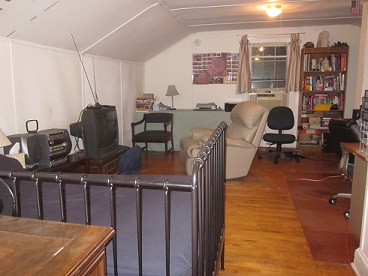
  • The upstairs half-story is semi-finished as one big room.
  • The insulation and natural light up there leave much to be desired.
  • The main goal is to convert this loft space into a bedroom and office area with a small bathroom.
  • The area is very closed in, so another goal is to have sight lines to the outside (potentially by adding a dormer, but possibly by just adding roof windows).
  • We want to do this work concurrently with replacing the roof, which needs doing soon.
Loft

One view of the fabulous loft as seen last autumn.

We hired an interior designer to make up plans for the big transformation. We like this person, and worked with her before on our kitchen, where she showed great insight and helped us transform the space. We highly recommend working with an interior designer, and still do…but it didn’t go perfectly this time.

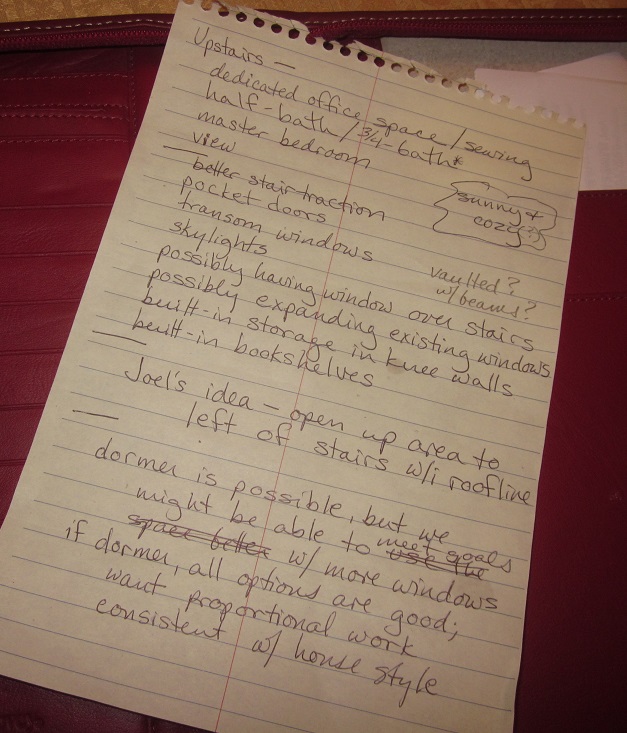
The Kev and I spent substantial time refining our remodeling goals to make sure they were reasonable and easy to understand. We also made a list of our ideas to run past the designer.

Notes

A draft of our notes for the designer meeting.

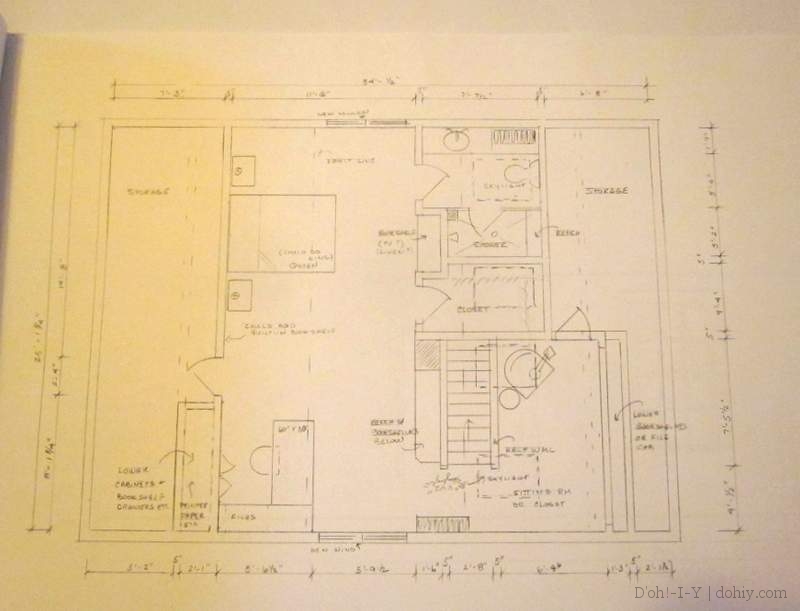
The designer brought back plans that stayed within the existing envelope of the house, but did manage to include a work space, bedroom, and bath. Skylights were added, but they did not achieve the goal of having a view to the outside. The skylights were also mainly in less-used space–inside the bathroom and the closet. But the plans tapped into some attic space to give us an appealing small library at the top of the stairs.

Plan complex

Over the winter, we had several builders come by to bid on the project. The first three all found fault with the plans. Specifically, each one independently said that the library area wasn’t possible because the existing roofline was too low (unless it was a crawling library, which honestly would not be the worst thing imaginable), and that the bathroom would not work as planned for a variety of plumbing and roofline reasons. Two mentioned HVAC issues. All three steered us toward a dormer.

Adding a dormer is a bigger project, and therefore in a builder’s interest to sell! But I was concerned about the consistency of the issues that were raised about the plans. I went back to the designer with the comments and asked for her input. She said she would be happy to adjust the plans with our chosen builder, and suggested that I contact a couple of construction companies she had worked with in the past.

We met with these guys and thought both companies were good options. But both of them had the same problems with the plans. One of them, though, had some interesting ideas for how to adapt the plans, including adding a smaller dormer than we had considered. He was willing to work with our designer, or to have someone in his office modify the plans; he would provide us with an estimate we could break down in several different ways. He was thoughtful and thorough and gentlemanly.

Then he rang the next day to offer his regrets that he would not be bidding on the project because his other job sites this season were on the other side of town.

morpheus

We needed to take a step back. I went back to the designer and worked with her to negotiate a fair fee for the value of the work she’d done (in other words, less than what she invoiced), received copies of all the plans and measurements, and closed the file. We left the relationship on good terms, but we did leave.

So. We have plans we can’t really use, no designer to fix them, and no builder in any event. I’ve been shopping our homeowner’s insurance, and that’s teaching me that this roof needs to be dealt with, at least from an actuarial perspective.

homer-doh

It’s disappointing to be no further along. We’d waited a very long time to address the upstairs because we wanted to get it right. We were READY TO GO, but we’re back at square one.

It can either be a buzzkill, or it can (also) be a learning experience.

  1. Psyching Ourselves Out. We talked ourselves into liking the plan we received because it met most of our goals. Instead, we could have asked the designer to go back and do another iteration that satisfied all of our requirements. We might be further down the road that way, even if there were other problems with the plan.
  2. Deferring Deferred Maintenance. Although our roof is not in dire shape (no leaks, for instance), we should have started earlier on the planning if we wanted to coordinate maintenance with another project. It’s going to be tricky if we start having a roof problem before we can pull the trigger on skylights or a dormer.
  3. Building a Network (of Builders). We used a shotgun approach to find the builders who bid on the project. Ideally, we would have been gathering personal recommendations and maybe meeting a few people far ahead of the need for a quote.
  4. Communicating Goals. The way I remember it, we were very clear about what we wanted out of the design, but judging by the outcome, we weren’t clear enough about the need for more light and views in the plan. In future, I’ll remember:

Tell them what you’re going to tell them

Tell them.

Tell them what you just told them.

Some good lessons there. It’s mainly a buzzkill, though!

Posted in Construction, D'oh! | 4 Comments

Winter’s Harvest

 This doesn’t look easy. But I bet it is!

– Homer Simpson

Every year, I plant seeds at the coldest time of the year and put them outdoors. Weirdly enough, winter sowing is a great way to maximize seed performance in the cold latitudes without using energy-hungry grow lights. The technique also yields extremely hardy seedlings that don’t need to be hardened off before transplant. But it does involve used milk jugs, so you’ll want to put those out behind your house to avoid the appearance of complete redneckitude.

sowing jugs outside

Classy jugs outside in March

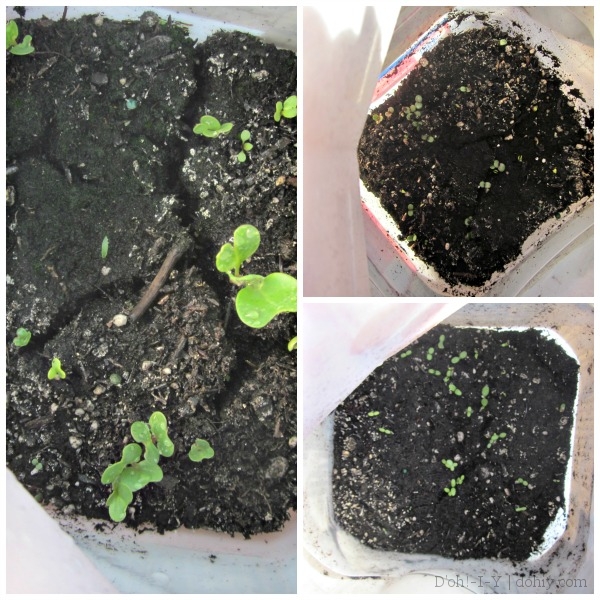
I winter-sow every year, but I had a later start than usual this time. I put my mini-greenhouses out in March. Since this last winter was looooong, the seeds still had plenty of time to do their thing. As of late April, I was seeing some good results:

winter sowing

Here’s how they were looking when I cracked them open this month:

Shasta Daisy (Silver Princess)

Shasta Daisy (Silver Princess)

Coneflower

Coneflower

lifefindsaway

Don’t even start, Goldblum.

Of course, they weren’t all successes. Two are complete losses, and one jug has many seedlings, but possibly not the seedlings I started–they could all be volunteer weeds. In fact, every jug ends up with its share of weeds and grass, so wait for “real” leaves to distinguish your plants. One year, I tenderly nurtured a single seedling for a much-desired plant that turned out to be a weed.

Chagrinned, I was.

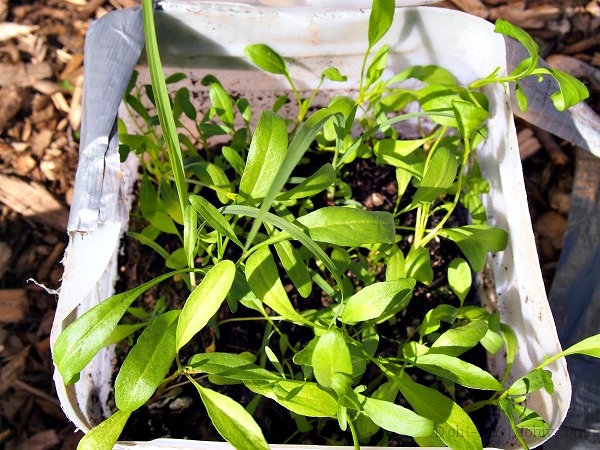
While you do want to wait for identifiable leaves, you don’t want to leave these in the jugs too long once spring comes. There’s not a lot of dirt in there, and young plants yearn to be free!

Coreopsis yearning to be free.

Coreopsis yearning to be free.

This is Mardi Gras Coreopsis, which, with a little luck, will look like this later this summer:

(via)

(via)

To transplant, first decide where the seedlings are going (selecting adequate sunlight and drainage conditions for the plant). You don’t have to dig a deep hole for seedlings–just loosen up the soil a bit deeper than the soil in the jug.

Peel back the tape and crack the jug open. Carefully weed out the grass and unwanted seedlings you can easily reach. If you have a particularly vigorous crop, also weed out the runts of the litter to give the healthiest seedlings more room.

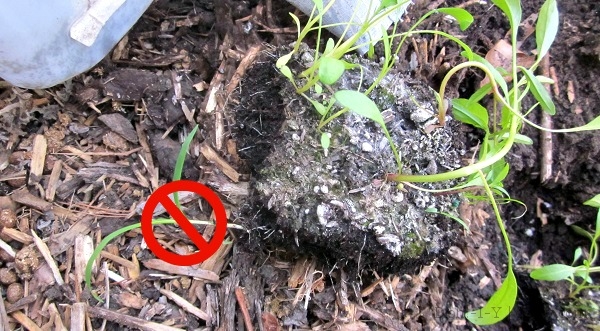
The soil should be moist, but will probably be rooted enough to more or less hold together. Splay a hand over the seedlings and gently invert the bottom of the jug to pop out the seedlings and their root systems.

WS inverted coreopsis

The clump may fall apart into chunks quite naturally, or you can break it up. Depending on how many seedlings you have, you might have ten or more little chunks to plant, or just one (or none if you have a jug failure!).

ws chunks coreopsis

Once you have your chunks, you may be able to do a little more weeding for unwanted plants that were exposed by breaking up the seedlings.

ws weeds in coreopsis

Take each chunk and press it into the prepared area. Gently add soil around the chunks and firm it all up with your fingers or other delicate implements.

ws backfill coreopsis

Water (gently!) to settle everything together.

ws planted coreopsis

Add mulch to protect the new plants. As the seedlings progress, you can thin them down further to promote the strongest plants. Water according to the plant’s needs, and watch your garden grow.

It takes longer to read about than to do. So many healthy plants for so little effort and money–if you live in a cold climate, definitely give winter sowing a try!

Posted in Yard & Garden | Tagged , , , , | Leave a comment

Tile Tile Tiley Tile

All I need is a title. I was thinking along the lines of No TV and No Beer Make Homer…something-something.

– Homer Simpson

I started the backsplash! But first, I spent 20 minutes looking for our notched trowel. When I couldn’t find it, I flounced out to Menards, declaring, “I’m tired of buying tools that we already own!” Other things ticking me off today include my sunglasses being pinchy and David Bowie selling Cadillacs.

(Notched trowels cost $2.46, by the way.)

Aside from the notched trowel, we picked up most of our supplies over the weekend. We’re using “Vivant” 4×4 glossy tiles by Mohawk, currently on sale for $0.11/tile, which puts the whole tile spend on par with dinner at Chipotle. They come in white (our selection), cream, and gray. The white is really more of a soft white or an ivory than a bright white.

Elegant, maybe. Durable, maybe. Inspiring??

Elegant, maybe. Durable, maybe. Inspiring??

We also picked up a tub of tile adhesive and a bag of 1/16″ tile spacers. We haven’t picked a grout color yet, so that’s down the road.

I reviewed several tutorials about how to install wall tile, but the most useful (and concise) overall was How to Install a Tile Backsplash from Lowe’s. It’s very straightforward on the basics and includes a supply and tool list.

Having reviewed this tutorial in detail, I decided to start on the smaller wall. Every tile tutorial on the planet says to start in the center. The smaller wall in our kitchen is where the range lives. I pulled that out and decided to add a temporary ledge to help me level and line up the first row of tiles with the top of the counters on either side. I drew a straight line between the counters, then nailed a handy bit of wood to the wall. An experienced tiler wouldn’t need this crutch. I am not an experienced tiler!

This piece of plywood is only here for the tiling.

This piece of plywood is only here for the tiling.

I checked the level of the row after each and every tile in the first row, but that gave me the confidence that the subsequent rows would also be level. (I still checked after every second or third tile though.)

When setting tile in a running bond pattern (a/k/a brick, offset, or staggered pattern), it helps to mark halfway across the first tile in the next row so you can line that up with a gap in the prior row.

The tiles with the pencil marks halfway across were the first tiles in their respective rows.

The tiles with the pencil marks halfway across were the first tiles in their respective rows.

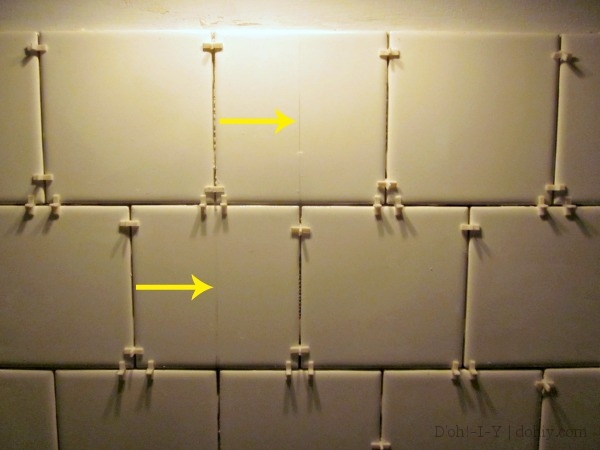
These tiles, like many ceramic tiles, have nubs on the sides that act as built-in spacers. The so-called “lugs” are really small, though. If you want to use a bigger spacer (1/16″ was actually bigger than the lugs, although I think they are supposed to technically be 1/16″), make sure that you place the spacers so they are not on the lugs, which would distort the line. That’s why the spacers between the rows are way out at the edges of the tiles in the picture above.

(via)

Lugs on the edges of tiles (via)

I only finished the center of this wall. I determined that I need to pick up a tile clipper to cut corners out of tiles around outlets. I was going to clip the tiles with implements on hand, but after a few tries, $10 started sounding pretty good for the right thing — plus, we don’t already own this tool!

When stopping in the middle of tiling, make sure you scrape all the tile adhesive off the areas not covered by tile. The adhesive sets up really hard, and it could mess up your installation if you tried to tile over it. I just used a putty knife to shave off the extra. The last step was to wipe any adhesive off the fronts of the tiles before retiring to the sofa for the evening.

It was a good first go! Especially because the stakes were really low: let me show you why this was such a great place to start.

tiles behind cooker

That’s right. Most of  what I just did will be completely covered by the back of the range. It’s a great way to get some practice in before moving to more visible areas.

Posted in Decor, Kitchen, Walls & Floors | Tagged , , | 1 Comment

Hops on Top

Well, dang blast it!

– Grave digger

We are fortunate to live on a great block that includes a pack of children ranging from about six to eleven. Today, a kid’s toy was caught in a tree next door, and the group was throwing balls at it to cause it to fall. After many unsuccessful tries, one of the girls shouted

Holy dang it!

I had to go inside, I was laughing so hard. I told the Kev that this would be my new expression of frustration, but I didn’t expect that I’d use it so often soon afterwards.

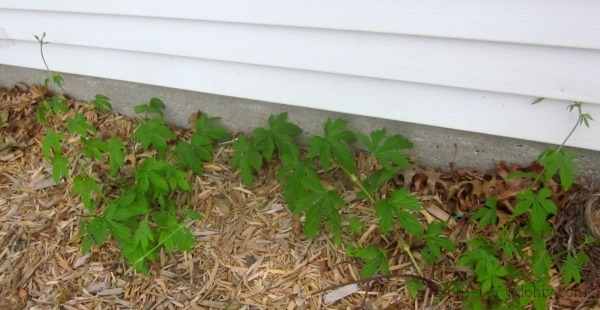
Last summer, we built a raised bed behind the garage and planted hops. The hops came up healthy and ready to go this spring, so we needed to give them something to climb on.

Help! We need to climb!

Help! We need to climb!

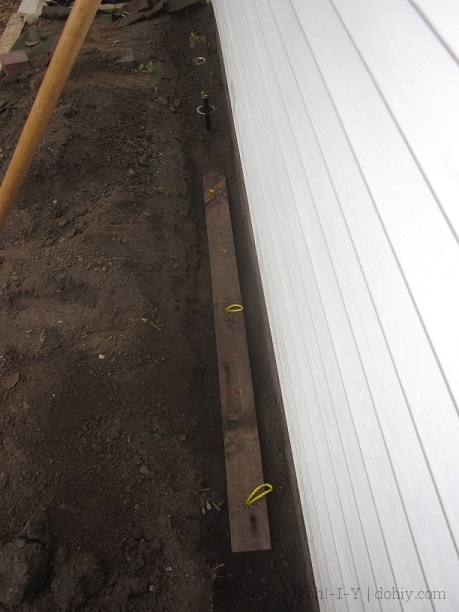
Our plan was to add vertical supports for the hops to climb up this year. In preparation, I dug in a homemade support system last September.

Hops Supports in Trench

I backfilled this trench and marked where the loops were so I could connect ropes to them this year. It seemed like a good idea at the time! And it seems like a good idea now that the ropes are up and solid, but earlier this evening, I was not fond of this idea. I had to dig down quite a ways to get to the loops, which were tight and hard to maneuver, making it dirty and fiddly to thread and tie the support rope. I may have added a few words to my new mantra.
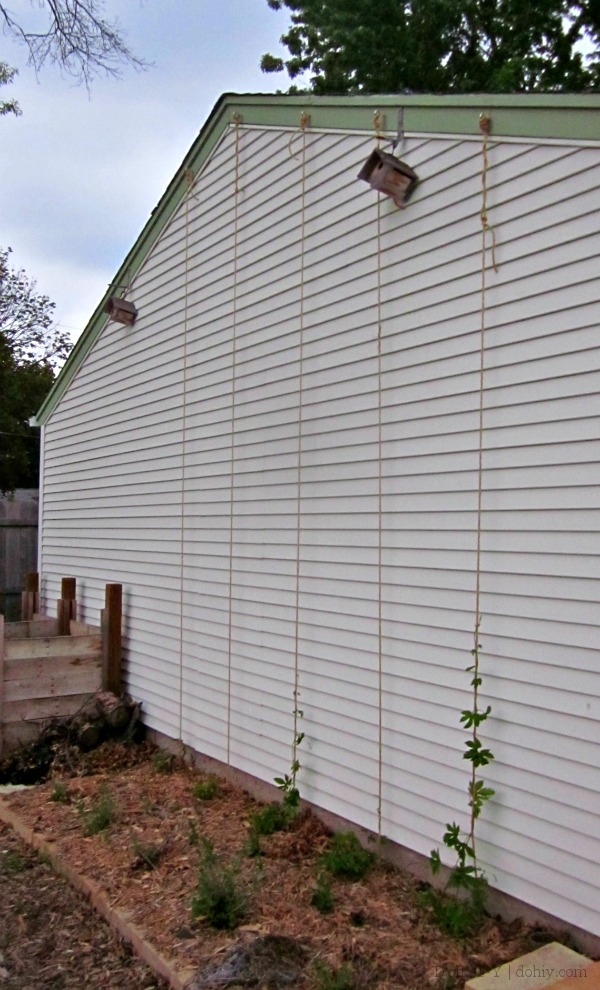
After connecting the rope to a loop, I’d climb the ladder with a plumb line to mark where the eye would screw in near the garage roof. I had not brought a tool belt out with me, so the Kev kept patiently passing me pencils and drills and scissors and hardware and rope ends. I realized that I should stop and get my belt during the first rope, but I didn’t. There are five ropes. Apparently, I was just looking for an excuse for frustration. (I also didn’t wear gloves. Rope burn is for real!)

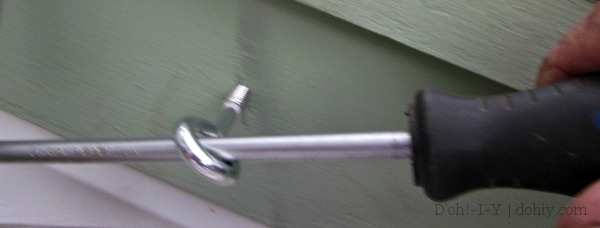
For each rope, I drilled a pilot hole into the back of the garage. I started screwing in each eye by hand, then used a long screwdriver as a lever to tighten it up.

Give me a big enough lever, and I'll screw in this thing so we can grow hops.

“Give me a big enough lever, and I’ll screw in this thing so we can grow us some hops.” – Archimedes

Forgive the blurry picture; I was standing on a ladder holding a drill and a camera while turning a screw. On the upside, I could see my house from there.

We used plain quarter-inch sisal rope (which only last one year, it turns out; see what we switched to). I looked into the best rope for hops, and the consensus seemed to be that hop bines (hops are bines, not vines) will climb pretty much anything you give them. I just used several standard knots (I don’t know any fancy knots) to attach each length of rope at each end.

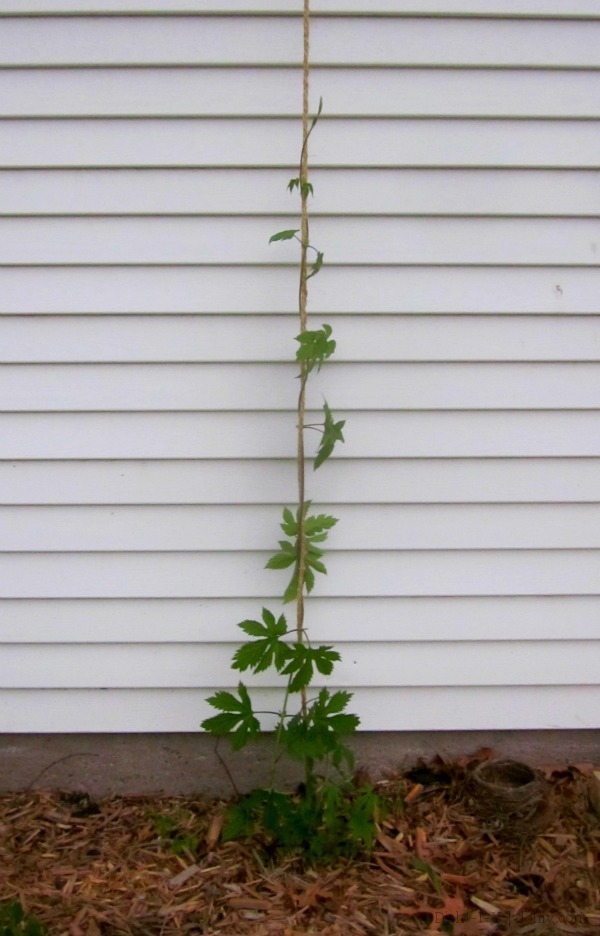
Once all five ropes were up, I wrapped the bines that were long enough up their respective ropes. They stick like velcro!

Finally!

Finally!

I can’t wait to see what they do. We’re hoping they might put out a few hops this year that Kevin can add to one of his beer recipes for a little extra something-something.

hops ropes done

Look out, Tom and Barbara Good.

Posted in D'oh!, Food & Drink, Yard & Garden | Tagged , , , | 1 Comment

Backsplash Short List

Actual odds of winning one in three hundred and eighty million.

– Kent Brockman

Following the May completion of the January slipcover project, I resolved to work on fewer projects at a time. That way, we’d see more projects done more quickly. Concept! We’ll see how that goes.

One of the outstanding projects right now is tiling the kitchen backsplash. After installing the countertops, I repaired the walls damaged by removing the old counters, and did some tile research. The Kev and I looked at many patterns, and one we both liked alternated tile widths:

Alternating Brick Pattern (from the Tilejax Library)

Alternating Brick Pattern (from the Tilejax Pattern Library)

We intend to use white ceramic tile one way or another, and there weren’t stock sizes that would do this pattern. When I mentioned to Kevin that we’d have to cut every other tile, he said, “Forget that!” (or words to that effect). That leaves us with three finalists that involve stock tile sizes to choose from.

1. 3×6 Subway Tiles/Running Bond Pattern

This is such a classic look.

Subway tiles in a staggered brick pattern (from the Tilejax Pattern Library)

Subway tiles in a staggered brick pattern (also from Tilejax)

It’s a popular choice for good reason–take a look at how plain white tiles can be varied just by grout color.

(via)

(via)


(via)

(via)

This would be consistent with the age of the house and lend a tailored feel to the room. My only misgiving here is that the horizontal orientation of the pattern might make the small room feel a little…shorter? Although I’m short myself, and I have been known to wear stripes.

2. 4×4 Square Tiles/Brick Pattern

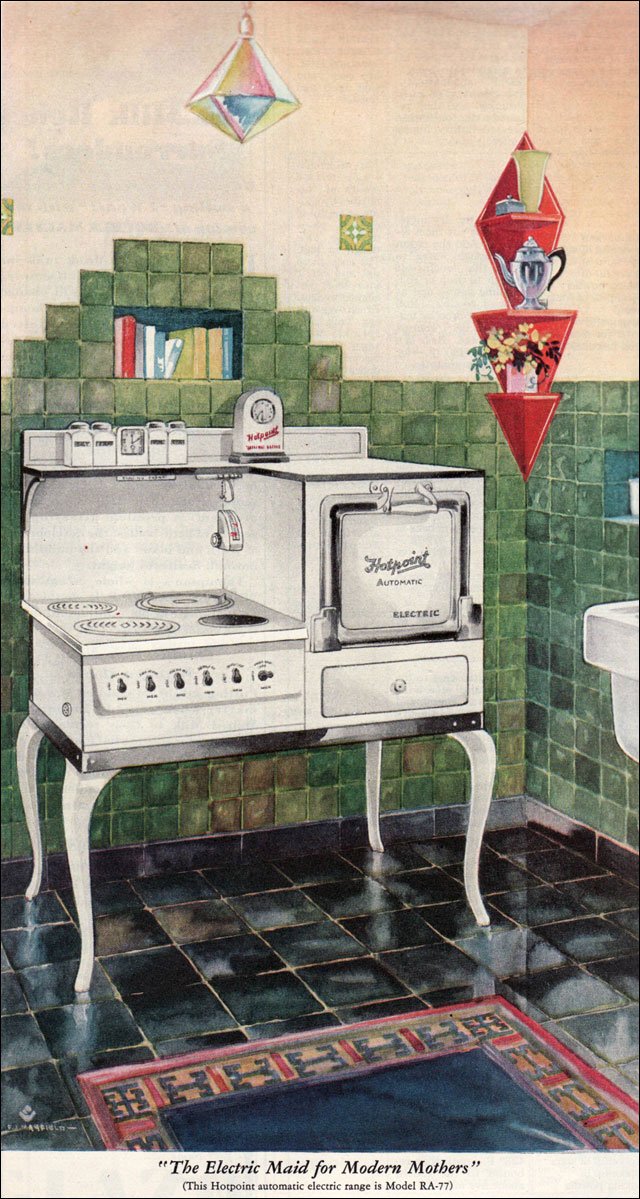
While rectangular subway tiles are very traditional, plain-Jane 4×4 tiles were actually the most commonly used tile in the 1920s, when our house dates from, as well as for the entire 20th century.

Hotpoint ad 1920s

So many levels of fun here. Check out the light fixture!
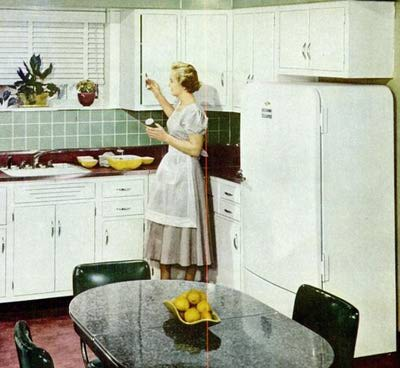
Square 4×4 tiles are sometimes called dated (by fancypants people), but to which date? The picture above is 1920s, and the next one is from the 1950s.

1950-Kitchen

Wow, she looks so happy!!! The fifties were awesome, y’all!
I’m not ready to repeat the 70s or 80s, though!

Just to mix things up a bit, we considered using 4×4 tiles, but in an offset (“running bond”) pattern, a la subway tiles.

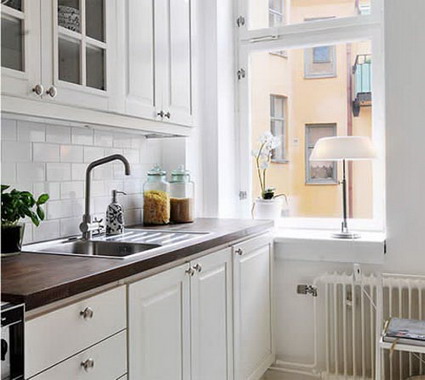
I don’t care for the bare-bulb boobs in the next picture, but I do like the vintage look of the tile with the darker grout.

(via)

Seriously, those lights! Try to ignore them (via).

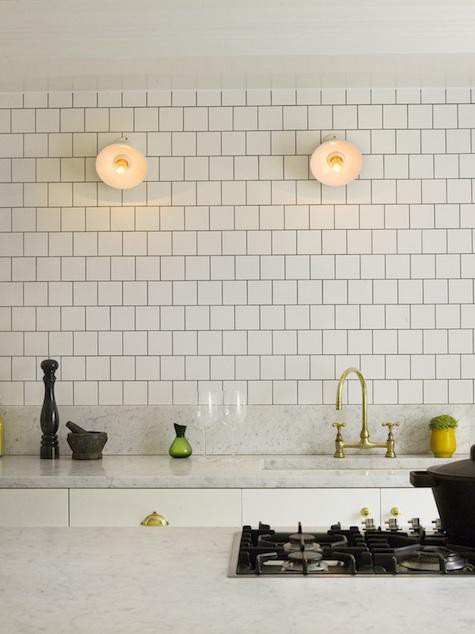
I like this next industrial-styled kitchen, BUT I JUST NOTICED IT HAS SIMILAR BARE BULB LIGHTS. How are those a good idea so near eye level?

(via)

(via)

I like this look, but we’d skip the headlights. I guess I’m not design-savvy enough to understand the appeal!

3. 3×6 Subway Tiles/Herringbone Pattern

Usually, when you see herringbone tile, it’s in a chevron pattern.

Sarah Richardson kitchen tile (as seen all over the internet)

Sarah Richardson kitchen tile (as seen all over the internet and here)

But herringbone can also be “straight”:

"Straight" herringbone (from Tilejax)

“Straight” herringbone (from Tilejax)

This version would involve less cutting than the angled version, and we liked the perpendicular look. And it’s a little different, but no more expensive in terms of tile count.

It also reminds us of the modified hopscotch pattern we ruled out earlier in the process, but without as much visual activity (and there would be much less tile cutting).

AND THE ENVELOPE, PLEASE…

We chose running bond 4x4s (without the lights).

white tile offset detail

Objectionable lights edited out

The examples here both appear to have grey grout. We’re leaning toward more of a brown tone for the grout since we have stained wood cabinets and I’d like to pull everything together. Maria Killam (check out her wonderful color and design blog) used a mocha grout for her sister’s backsplash, and it looks great with the other brown tones in the room.

(via)

(via)

The tiles we are picking up are not a pure white, so they should work with a brown grout, although it will probably be lighter than the mocha shown here.

This might even start happening this weekend! Depending on the weather and whether we get sidetracked into starting a whole different project.

UPDATE: I did do that tiling! To read more:

Posted in Kitchen, Walls & Floors | Tagged , , , | 2 Comments

This Old Couch: Done is Good

I don’t mind being called a liar when I’m lying, or about to lie, or just finished lying. But not when I’m telling the truth!

 – Homer Simpson

No, it’s true! The slipcover is done!

OLYMPUS DIGITAL CAMERA

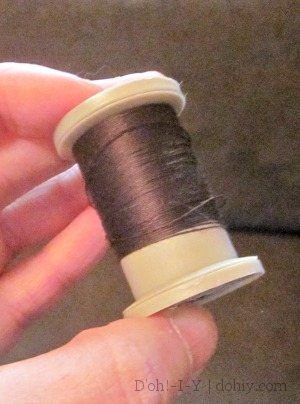
A good thing, too, because this is how much thread I had left:

leftover thread

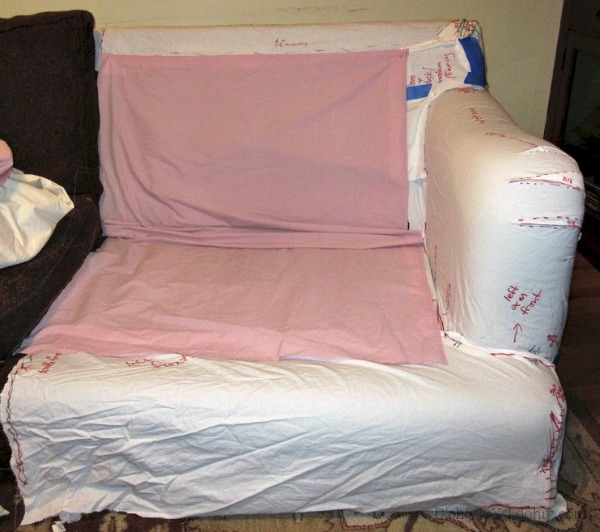
Quite some time ago, I posted about how I made the slipcover pattern, and generally, I followed that plan.

pattern in place

I learned–shock!–that old sheets are more flexible than upholstery fabric! Most of the pattern pieces were fine, but a few of them needed to be simplified to work better with the final material (in the picture, you can see things being way over-complicated in the top right corner, for instance). As a result, the final slipcover was not as tight as my pattern. But it’s a slipcover, it’s ok!

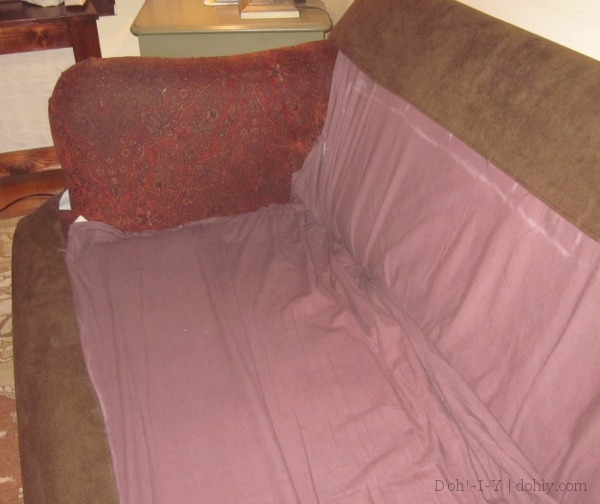
We had a one-piece slipcover that we had been using as a stopgap. I intended to use part of it as the panel for the back (this sofa is up against the wall), but I ended up using it as a base for much of the slipcover for the body of the piece (I did cut off the arms). I attached pieces to the one-piece cover, and ran it as the continuous piece under the cushions. It was a great way to help keep things straight (pinning them to the one-piece first), and provided the needed fabric with elastic for the cushion underlay.

It is comparatively very purple.

Here it is in process. The old slipcover/new undercushion piece is comparatively very, very purple.

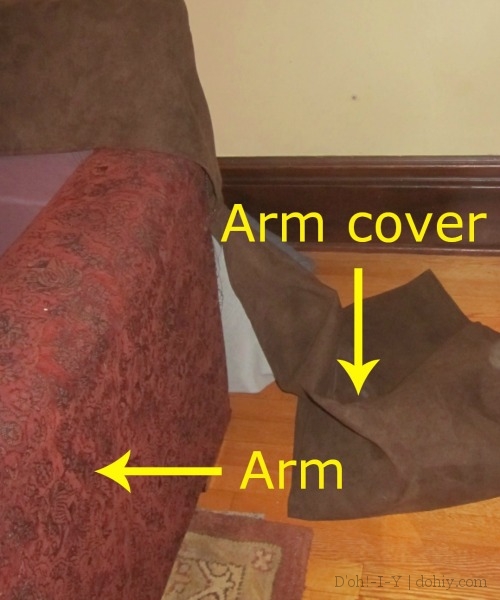
After patterning and even while I was merrily cutting and sewing together pieces of upholstery fabric, I wasn’t completely sure how the cover was going to attach to the sofa. In the end, I went for a model somewhere between an Ikea slipcover and a Rube Goldberg machine. The arms of the slipcover are attached to the back of the cover. They “hinge” and attach last.

The main body is covered first, with the arm covers flapping around on the sides.

The main body is covered first, with the arm covers flapping around on the sides.

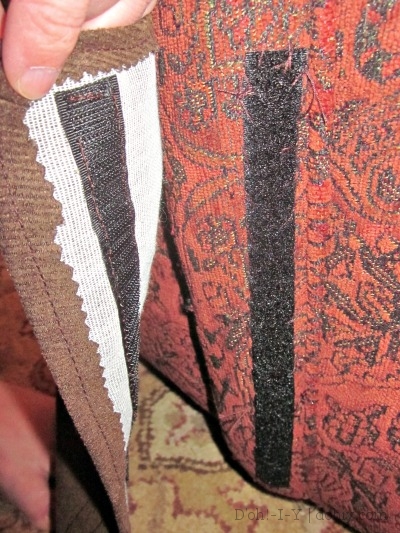
Basically, the cover goes over the back and down the front so that the main body is all covered. Then the sides of the front wrap around and attach with velcro.

The front "apron" of the slipcover pulls around each side and attaches with velcro sewn to the sofa itself.

The front “apron” of the slipcover pulls around each side and attaches with velcro sewn to the sofa itself.

As shown above, the arm covers are attached to the back, so they are just hanging out (literally) while all of this is happening. In due course, they are pulled around and over the arms.

Arm cover on but not yet tucked.

Arm cover on but not yet tucked.

There are hooks and eyes that attach the hanging part of the arm to the front piece that is velcroed to the side, then there’s a flap on the inside of the arm piece that tucks into the sofa between the arm and the springs to tighten it all up.

It’s now a very brown sofa. I recently hit the S.R. Harris fabric warehouse and picked up a bunch of remnant pieces. I’ll turn these into throw pillows to brighten this thing up. I might also put taller feet on this piece too, but that’s a low priority for another day.

And that’s my Rube Goldberg slipcover. Emphasis on the “rube”! Here’s the before:

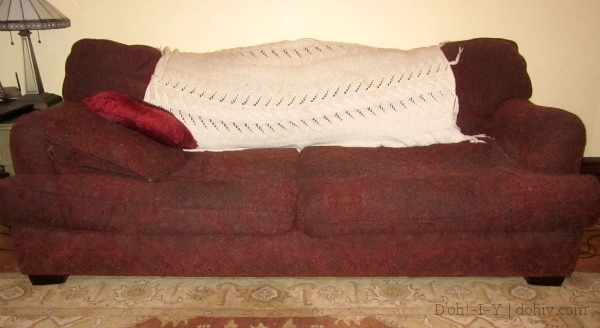
Sofa Before

It actually looks much better in this picture than it did in person.

And the after (with various possible cushion covers):

OLYMPUS DIGITAL CAMERA

My January project is finished! It’s faaaaaaaar from perfect, but done is good. For more on fixing up and slipcovering a sofa, here are links to the other parts of the “This Old Couch” series:

How to Decide if a Couch is Worth Saving

How to Repair a Couch Frame

How to Make a Slipcover Pattern

How to Make Welted and Zippered Cushion Covers

Posted in Before & After, Decor, Furniture | Tagged , , , | 4 Comments

Can’t Leave Well Enough Alone

Ooh, look at me. I can turn sunlight into complex sugars.

– Homer Simpson

Spring is one of the only good times to move shrubs. Of course, the best thing is to plant something where you mean for it to stay. But maybe someone offers you a rosebush or you need to reorganize your garden. Whatever the scenario, you can move small bushes with a good chance of success if you plan ahead.

I'm moving five Happy Chappy shrub roses (via).

In a demonstration of stunningly bad planning, I’m moving five Happy Chappy shrub roses (via).

1. Select and Water the Victim.

You have a good chance of success with a younger and smaller bush. If the intended movee is less than a meter high and skinnier than it is tall, it’s a good prospect. The smaller, the better — the shrub roses I’m moving don’t get above two feet tall, and are smaller now because they were cut back for winter. Even if your target is small, you have to accept that the plant might not make it, so be sure you’re ok with sap on your hands.

A day before moving a shrub, give it a long drink. Water softens the soil for digging and makes the root system more resilient. A long drink is a good trickle of water over an hour or more; just emptying a watering can over a plant is not going to do much to ease shoveling or root shock.

2. Dig the Destination Hole.

I know it seems like you should dig up what you are moving first, but you have to look at this from the plant’s point of view:

WHY ARE MY ROOTS IN THE AIR?!? I AM NOT AN ORCHID! HELP!!!!

Or words to that effect. To minimize time out of the ground, dig a hole where the plant is going. Pick a place that receives the appropriate amount of sun for the variety. When digging, go for roughly twice as wide as the width of the growth above ground and 12 to 18 inches.

I took a picture of a hole, but come on. It's a HOLE.

I took a picture of a hole, but come on. It’s a HOLE.

Once your hole is dug, pour a gallon of water in it and see how it drains. If it gradually filters out over several minutes, that’s good. If the hole just holds water like a bucket, you need to find a different spot or dig out much deeper and line the hole with better-draining soil.

3. Make a Dirt Cone.

Now, partially fill in the hole you just dug, but in a special way. Heap up a pile of soil in the middle of the hole. Go about a third to halfway up the hole.

dirt cone

You’ll drape the roots over the dirt cone when transplanting. Like this:

roots over dirt cone

4. Dig up The Victim Shrubbery.

Now you can dig up the shrub to be moved. Start by slicing straight down with the shovel slightly past the drip line of the shrub (the farthest out its foliage goes). Sink the shovel all the way into the ground (or as deep as possible). Keep going around the shrub until you’ve come full circle.

Re-insert the shovel, but this time, start levering under the shrub. Get as far as possible down before cutting under the root ball. Keep going around like this, rocking the shrub gently out of the ground. It’s actually not all that gentle a process, but try to be as nice as possible to the roots. Keep some shears or scissors on hand in case you need to cut off the last root or two hanging in there.

I was looking for an amusing (to me) picture of one of those opening ceremonies with the enormous scissors to insert at this juncture, and I found this, which cracked me up:

WELL, I SHOULD HOPE SO!

WELL, I SHOULD HOPE SO!

Once you have the poor shrub out of the ground, you can easily remove plants or weeds that have intergrown around the base. These are often hard to remove otherwise, but it’s simple when the root system is exposed. My shrub roses are on the edge of a strawberry patch, and I pulled many strawberry plants from around the crowns of the roses. I also removed dead canes that I’d missed when the roses were in the ground.

5. Plant It!

Drape the roots over the cone you made. You may need to add or subtract some dirt to get the shrub’s crown even with the ground (or you might need to deepen the hole, depending — you won’t know until you see the root ball). Once you’ve got it at the right height, backfill the hole with the dirt you took out. Tamp the dirt down solidly around the base of the plant — I usually stand on the new dirt to settle everything all in.

stacey's shoes

The shoes of me.

Top it off with some compost and mulch.

6. Water It, and Hope for the Best.

Set the water to trickle around the base of the transplanted shrub for a good long while. The water helps the soil settle around the roots and make good contact, helping reduce root shock. Keep the shrub well-watered (but not flooded) according to its needs (a good drink once or twice a week, typically, but check the guidance for your particular plant).

You can do everything right, and the shrub might still bite the dust, so to speak. But don’t despair if the plant mopes for a week or so after transplanting. It’s a big change, and the plant might take a little while to bounce back. Hopefully, these Happy Chappies will just carry on quite…well, happily. Fingers crossed!

Related Posts Plugin for WordPress, Blogger...
Posted in Salvage, Yard & Garden | Tagged , , | Leave a comment