Wanna See Something Permanent?

Fiddle-dee-dee. That will require a tetanus shot.

– Homer Simpson

CM-BASIL-FAWLTY-BANDAGEDToday at work, I showed a co-worker my thumb. “Check out my cool blood blister!” I said. “Doesn’t it look like there’s some sort of weird worm under my skin?”

“WHY ON EARTH WOULD YOU SAY THAT?!” she hollered in response. (To be fair, her response is the answer to that very question.) “Who goes to ‘this looks like a subcutaneous worm’!!?”

Well, me, obviously (I read a lot of genre). The reason it looked like a worm is because the pad of my thumb got pinched lengthwise when I was clamping down a piece of trim on a shelf. It always pays to know the whereabouts of your thumb.

My thumb-worm is the most recent in a spate of DIY-related scrapes and bruises, all of which have been fortunately minor and not really painful. But it made me realize that most of my (fortunately small) scars are from home improvement accidents … and that I am unduly proud of each and every one. I need to find a DIY equivalent for the scar-comparison scene from Jaws!

Between the minor injuries and work (and boasting about minor injuries at work), it’s a little crazy around here, but we are managing to make a little progress with ongoing projects. Including the Neverending Bedroom Project Story. Details to come.

Stay safe out there, people. (And if you want to compare injuries, meet me in the comments section!)

Posted in D'oh! | Tagged | Leave a comment

Sudden Sanding Sense

Make sure it’s squished flat, and crunchy on the outside.

– Homer Simpson

You ever have one of those moments of complete clarity about something you never understood before? I had one of those about sanding. Really!

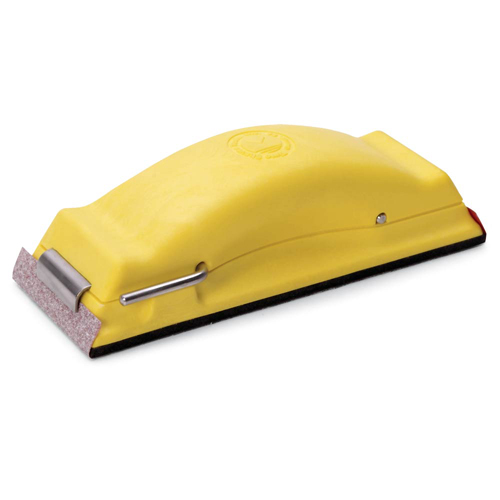
If I’m not using a palm sander, I usually just grab a piece of sandpaper and sand without attaching it to a block. I find sanding blocks a little fiddly to load up with paper, and just grabbing a piece is so easy. Plus, I didn’t really see the point!

"Preppin' Weapon" from Rockler.com

The “Preppin’ Weapon” from Rockler.com

I was reading Young House Love the other day, and Sherry was talking about touching up a wall after applying spackle:

After it dried (I usually wait about 5 hours just to be sure), I got my sanding block again. I prefer a block since it has straight edges which can help you keep your wall straight instead of ending up with something wavy and pitted.

Oh!

THAT MAKES SO MUCH SENSE.

I was blind but now I see! I never thought of that before. So THAT is why they are able to sell sanding blocks, with comic names and otherwise.

So thanks to Young House Love for that insight. It was probably totally obvious to everyone else, so I’m glad to be in on the secret now.

Anyone have something DIY that made no dang sense … until it suddenly made perfect sense?

Posted in Construction, Repair & Maintenance | Tagged | Leave a comment

Lost in the Crafting Market

Smithers: Help…me…
Dr. Nick: Holy smokes! You need booze!

– The Simpsons

I am not crafty. I’ve never felted, scrapped or decoupaged. It’s not that I’m anti-craft(!), it’s just not something I’ve done. But I still find myself wandering aimlessly around hobby shops when I know I need something, but I’m not sure what. (This technique recently resulted in curtain rod finials made of doll heads.)

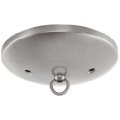
plain canopyMy idea was to dress up a plain ceiling canopy for the light fixture I’m restoring. Fully original fixtures usually have a coordinated canopy. But how to achieve the look??

I started at Goodwill with the brilliant idea of finding deco-styled flatware handles to apply in a ray pattern to the canopy. I sorted through the flatware bins — long and single-mindedly enough that I reckon Goodwill staff thought they had a Very Special Customer in Aisle 3. I found what I was looking for! But…

Imagine just the handles. You see what I was going for, right? RIGHT??

Imagine just the handles. You see what I was going for, right? RIGHT??

I can’t see it ending up looking like anything other than stacks of utensil handles. D’oh!

So I hied myself to Michael’s and Joann’s, where I wandered lonely as a cloud through aisles and aisles of unfamiliar items. What is an embossing folder for, exactly? How are brads used in scrapbooking? Once one uses a rubber stamp, does one not tire of that particular stamp? Won’t someone think of the plight of used rubber stamps?!?

I hoped inspiration would strike, but instead, I found a series of items that appealed to my inner 12-year-old:

woodsies

stiffy

foam

My maturity knows no bounds. And for some reason, whenever I’m having an inner pubescent moment, a chirpy sales associate happens past. I clearly need help (on so many levels), but I just can’t think of a way to tell these nice ladies what I need without admitting my embarrassing level of uncraftiness (“Well, it all started with an idea about spoon handles that went horribly wrong…oh, and this? This bottle of Stiffy is for a different project.”).

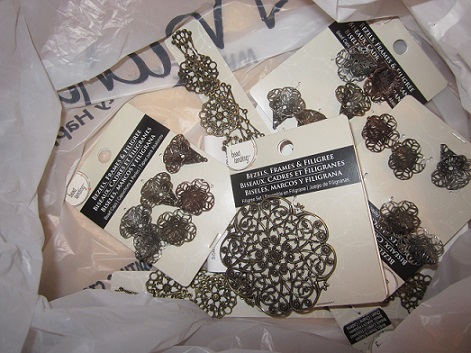
Ultimately, I staggered into the jewelry-making department, where I started throwing anything vaguely filigree into my basket.

It's all so beautiful...must buy it all...

It’s all so beautiful… must buy it all…

I brought my loot home and started playing around. I have some stuff clamped and drying at the moment, so I’ll report back on whether filigree is a winner, or if I should have stuck with spoons.

Aside to Momma D’oh: Wish you were here to explain embossing to me (and to giggle about inappropriate craft product names).

Posted in D'oh!, Decor, Family | Tagged , | 2 Comments

In Which I am Mocked by Paint

I’ll show you some of the tools I’ll be using. This is the scraper. This is the poker. And this happy little fellow is the gouger.

– Dr. Wolfe

They say that a poor workman blames his tools. You know who else does that? People with the wrong tools. They also shout a lot, but I suppose “A workman with the wrong tools blames them loudly” is not quite so pithy or shame-inducing. Just true.

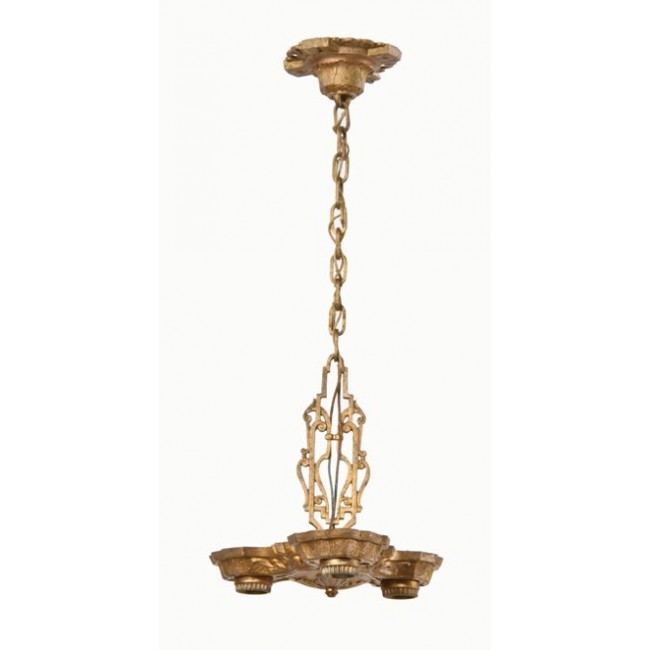
I recently started restoring antique light fixtures. Our house is from 1922, and I like finding fixtures in pieces and figuring out how to use them. I love the old fixtures — we have one original ceiling light and two sconces, and it’s fun to look for more. Here’s some from Urban Remains (great place for house parts, check them out), all restored and in their full glory.

light 2 light urbanremainschicago light3

You either like these or you don’t, and I definitely do. They would not typically be my style, but I like the historical feeling in an old house, as if they’ve been there all along. You can find excellent deals on fixtures for restoration (or already restored) on eBay and Etsy. Search for deco, 1920s, Victorian or vintage in combination with light fixture or ceiling fixture, then sort by price. I used this technique to find my most recent project.
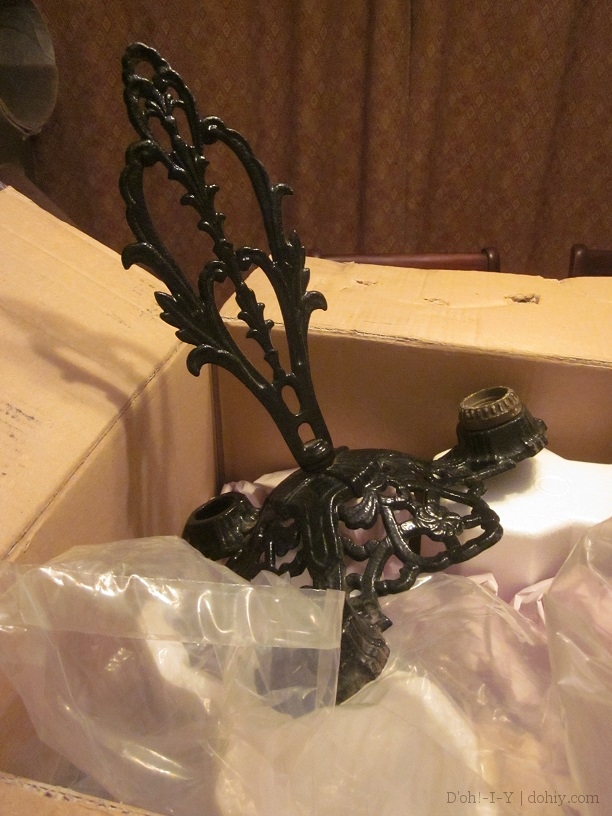
Surely it would have shipped easier in pieces.

Surely it would have shipped easier in pieces.

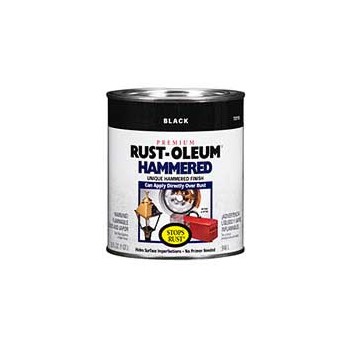
This fixture was put together upside-down and backwards. It was billed as a potential candleholder. The seller also said it was powder-coated, but I was sure it had been painted with something like Rustoleum’s “hammered finish” oil paint, in stock in our local basement. The thick paint was obscuring the piece’s detail.
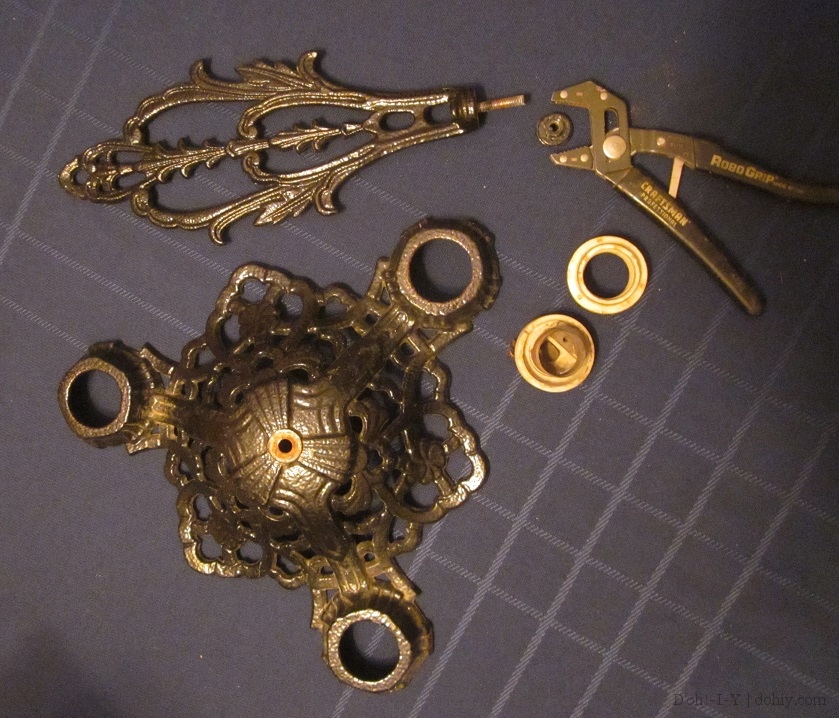
acq unhooked

I bought it with the intention of taking it apart, stripping it, repainting and rewiring. Taking it apart was easy. Stripping it? HA! Rustoleum (as I’m 97% sure this was) is simply the Toughest Paint in the Whole Dang World.
Badder than ol' King Kong, meaner than a junkyard dog

Badder than ol’ King Kong, meaner than a junkyard dog

First I tried the Crockpot method. It gave the finish a slight haze, but removed nothing. Then I tried Zinsser’s safer stripper (formerly used on paint-encrusted hinges with great success). After multiple applications, I started to get a foothold, but it was slow going, and I wasn’t removing anything in the detailed areas. I bought a stripper designed to tease out paint trapped in detail work. Not this detail work!

I pouted for a couple of months. Meanwhile, the bits I had stripped developed surface rust. Fantastique!

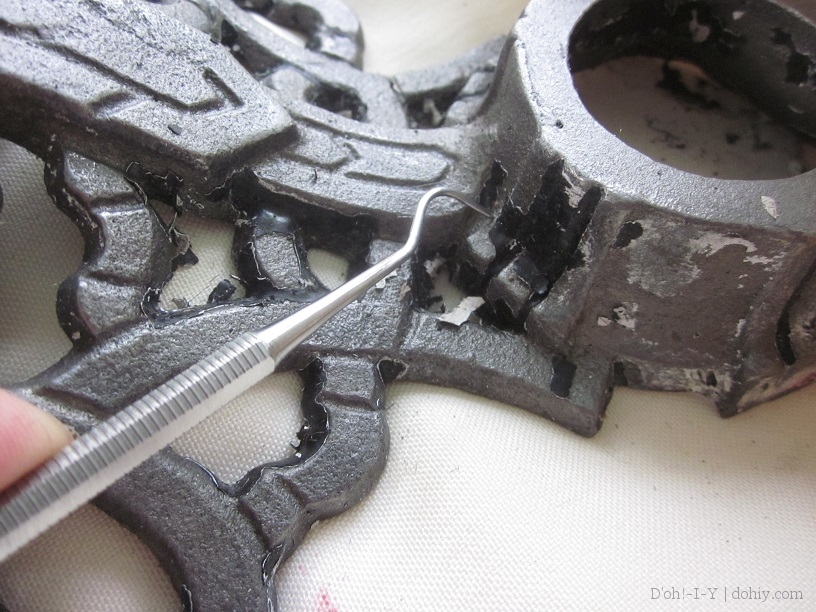
When I returned to it, I used the meanest, most toxic stripping goo I could find. I’d apply that, scrape, clean, and then hit the surfaces with the angle grinder sporting a wire cup brush. Rinse/repeat. This eventually yielded a clean outer surface, but the detail work was still caked with paint. And that’s when I broke out the dental tools.
dental

Yes, we own dental tools. It’s a weird thing to own, not being dentists, but the Kev uses them to clean fossils. I used them to pick, pick, pick at the paint stuck in the niches and crevices on the fixture. It made my eyes go buggy, and while I made significant progress over several evenings in front of the television, these still weren’t the right tools!

In fact, to this point, nothing was inherently wrong with the tools and potions I used — they just weren’t the right tools to remove the World’s Toughest Paint from crevices. But the next tool was just Wrong on all levels. I picked up an off-brand rotary tool to tease out the rest of the paint.

  • The included wire brush spun off all its quills in under a minute, many of them embedding in my shirt in a hedgehog fashion.
  • Other tools ran down to nubs in under five minutes.
  • The tool itself turned itself off. AND ON, more troublingly.
  • And then stopped working entirely a half-hour later.

To be fair (and the reason I’m not mentioning the brand name), I think the thing had been returned before and might have been misused rather than being a lemon from the get-go. Still, the accessories were rubbish. Ok, it was a Performax.

So, back to Menards, where I bit the proverbial and bought a Dremel. On sale, but still — Dremels are more expensive than the knock-offs. It turns out there’s a reason: that dog can hunt. I spent about three hours yesterday in full face mask and goggles Dremeling out the rest of that blasted paint, and it is a champ. I finally found the right tool!
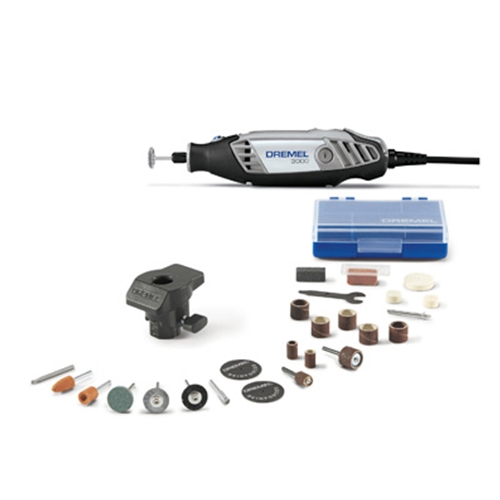
Dremel 3000, you complete me.

Dremel 3000, you complete me.

I wanted to avoid sanding dust, which is why I stuck with stripper for so long. If I had it to do again, I still would have started with stripping techniques before going to the rotary tool, but I’d get there sooner.
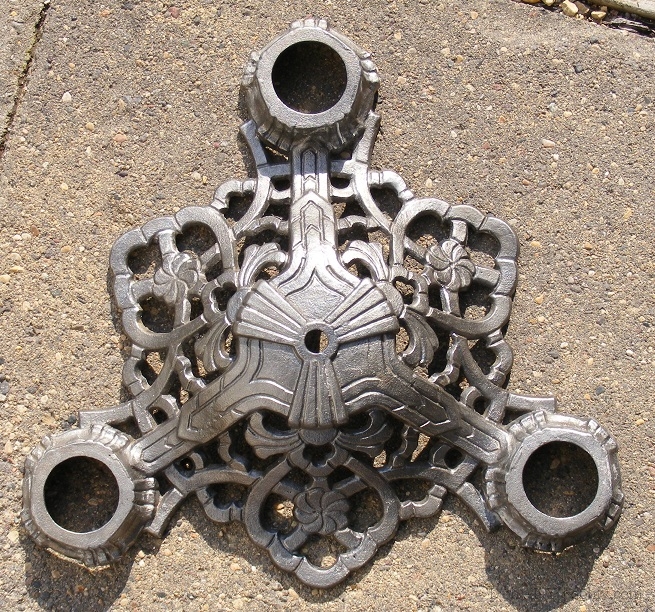
clean

But the biggest timesaver is that I’m never buying something coated in Rustoleum to strip down ever again! But I am going to coat everything I want to preserve in it. I’m just not sure how to get Kevin to stay still long enough.


Posted in D'oh!, Decor, Electrical, Salvage | Tagged , , | 2 Comments

Before and After: End Table to Floating Nightstand

And here I am using my legs like a sucker!

– Homer Simpson

Before we start, check out our sidebar — House of Hepworths featured our vanity table makeover this week! Color me DELIGHTED. If you don’t already visit regularly, hop over to HofH for great ideas. The Hepworths just moved, so I’m looking forward to seeing what she does with their new place. Thanks again, Allison!

Now to the matter at hand…

afterwidetext

A storage bed is a fine and noble thing. When it has drawers right up to the headboard, though, it complicates bedside table logistics. On Kev’s side, we decided to “float” a nightstand by attaching it to the wall. A wall-mounted nightstand would provide a landing place for books (and tea and glasses and cats and implements of destruction) while allowing unfettered access to the bed drawers.

Instead of starting from scratch, I perused Craigslist for something to convert. Many end tables and nightstands are available from ol’ Craig, but few were the right size or met my semi-stringent criteria:

  • A single drawer box, with the surrounding frame screwed or bolted together (rather than stapled or glued).
  • Wider than deep (to snuggle against the wall).
  • Enough solid wooden construction to be able to drill through…
  • …but not too heavy.

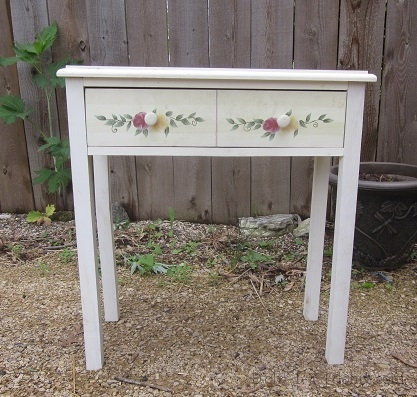
Here’s our criteria-meeting, fifteen-dollar winner:

bsb

bsbtop

Clearly, the first task was de-rosing. I applied wood filler where needed, then sanded the whole thing and primed it.

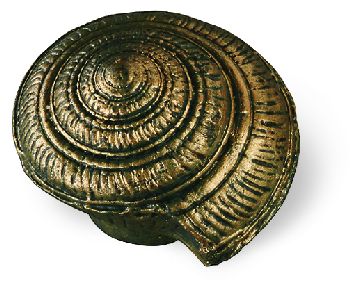
Siro-79-136To make the table as unobtrusive as possible, I painted it the same color as our bedroom walls, Benjamin Moore Hollingsworth Green. It took three coats to cover up those roses, even with the primer. After poly on the exterior, I spraypainted the inside of the drawer black (just for kicks), then I installed the new drawer knob. The Kev’s other mission in life (besides Ben, me, the house, and about 40 other things) involves fossils. He saw this ammonite knob by Siro Designs at Lowe’s about a year ago and liked it, so when I started working on his nightstand, I picked one up.

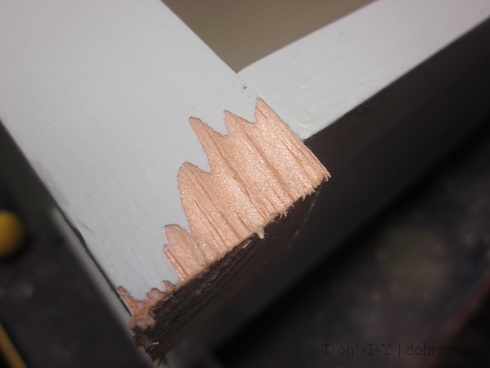
Then I de-legged the table. You’d think this would have come earlier, but I kept the legs through the painting stage, because they gave me a built-in drying rack. No fancy de-legging plan here, just a gal and her trusty reciprocating saw…

bsdeleggedD’oh! Should have started sawing from the front! Since I didn’t, I ended up having to touch up the finish post-de-legging. The drying-rack aspect of leg-having was worth it, but I learned a valuable lesson about saw direction!

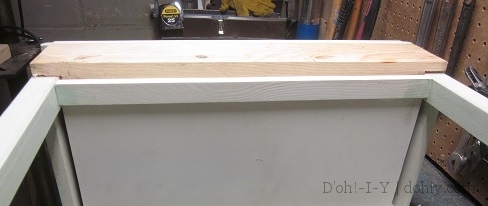
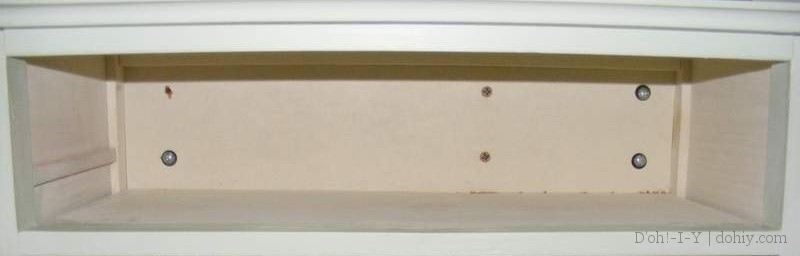
We considered a few different options for mounting the table to the wall, including L-brackets, cleats and super-long screws. The beefiest parts of the table did not line up with the wall studs for any of these options. Kevin had the great idea to add a wood mounting plate across the back so we could screw it in wheresoever the studs turned out to be. He cut a piece of wood to span the back, and we notched out around the frame. Then we screwed that piece to the table.

As long as it doesn't show, I'm a surgeon with this sawzall!

As long as it doesn’t show, I’m a surgeon with this sawzall!

In place on the back

Set in place on the back; we screwed it in at the edges.

Instant installation flexibility!

checking walls

“Just checking the walls…”

With the plate attached and studs located (a la Basil Fawlty — we really need to buy a stud finder!), we leveled the table at the same height as the vanity table on the other side and screwed that puppy in! We used two of what my dad would call “long-winded” screws for the stud (three-inchers), and anchor bolts to secure it through the laths in several other places. You wouldn’t want to sit on it, but it’s plenty solid for its purpose.

DSCF9910

Add the drawer and there you go! The before again:

bsb

And the after:

afterwide

Kevin has enough room for his stuff, and there’s still complete access to the drawers. I like how it keeps the floor clear — I could see doing this even in the absence of storage bed motivation.

afterlongcropped

All in all, finding the right table in the first place (and finding the stud in the second) were the trickiest parts. If you don’t mind wandering around Craigslist (and already own a stud finder), it’s a fun project. Give it a try and let us know how it goes. (And remember not to saw back to front!)

Update: Apartment Therapy readers, thanks for stopping by! See how this project held up long-term (short story: pretty well overall).

Posted in Before & After, Decor, Furniture, Organization | Tagged , , | 17 Comments

Good Easy Plants: Clematis

Lisa: It’s not “foilage,” Mom. It’s “foliage.” FO-LI-AGE.
Marge: That’s what I said: “foilage.”

 – The Simpsons

The Kev says “clah-may-tis” and I say “cle-mat-is” but we both say “ooooooh” when they are blooming. (He says it in a manly way, of course, because he is manly.)

Jackmanii

Jackmanii

Clematis is a hardy vine with a large range of colors, although this shade of purple is the most typical. When we moved in, there were two gorgeous clematis growing on the side of the garage. Aside from one peony, they were the only perennials in the yard, and they were blooming up a storm when we got the keys. They charmed me, and I added to the collection over the years, especially after we put up a fence.

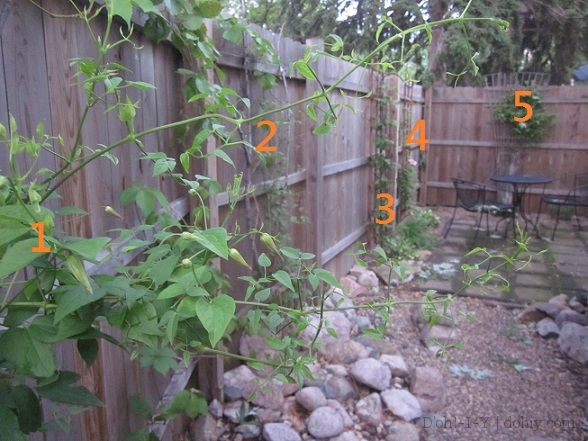
Spring this year: there are actually six clems getting started in this picture (there's a little one tucked in with #3 that I forgot to number).

Spring this year: there are actually six clems getting started in this single corner of our garden (there’s a little one tucked in with #3 that I forgot to number). Clematis addiction is real!

There are different pruning groups for clematis. Group 1 vines bloom on old wood, and should be pruned right after flowering. Group 2s should have dead wood pruned out in spring. Group 3 clematis bloom on new wood and should be cut back about a foot off the ground in late winter to encourage new growth.

Niobe (Group 2)

Niobe (Group 2)

Hagley's Hybrid (Group 3)

Hagley’s Hybrid (Group 3)

Do I follow these schedules? Nah. I cut out dead stuff and trim them back if they get unruly, but otherwise, I let the clematis be. And they seem to like it that way.

clem unknown

The only really critical thing for clematis is shading their roots. I plant hostas and lilies around most of mine, or stack up a cairn around their feet. This keeps the soil cooler as they prefer. So the only difficult thing is piling up a few rocks. If that’s too much to do, look in high-rise living options!

Clems offer a few different bloom types. Most are wide open, as seen above, but there are also nodding bells, double blooms and weird spiky things.

Integrifolia "Blue Boy"

Nodding bells on Integrifolia “Blue Boy”

Multiblue (a weird spiky thing)

Multiblue (a weird spiky thing)

If you plant a range of clems, you’ll have good blooms most of the season, plus nice vine coverage on fences or walls. And they are easy-peasy:

  • Most clematis types are hardy to Zone 4 (click for US and world maps).
  • They are easy to train up a lattice or wall. Even the rambling types can climb if lightly tied up.
  • Once established, they are easy on water consumption.
  • It grows well in sun to part-sun, although I have Sweet Autumn, Hagley’s Hybrid and Scartho Gem in part-shade with great success.
  • As long as you shade their roots, they don’t seem to care if they are planted in mediocre soil.
This one's planted in a tiny gap between the fence and the drive.

This one’s planted in a tiny gap between the fence and the drive.

I pick up a sad straggler or two from the garden center at the end of the season, and no matter how pathetic they look at that point, they’ve always bounced back with gratitude. If you’re shopping clearance plants this month, give a clem a try!

Want other good easy plants? Check out weigelacatmint, and gaillardia.

Posted in Yard & Garden | Tagged , , , , | 2 Comments

Cherries Jubilee

Ick, lemon … ugh, cherry … ooh, custard … mmmmm, purple …….

– Homer Simpson

We have a pie cherry tree. “Pie cherry” is a euphemism for “sour thing that needs lots of sugar to be edible” but I still love them right off the tree. When the cherries are at their peak, they are so perfect and glossy and red that they almost look fake.

From antiquehelper.com

Like these from antiquehelper.com

I was supposed to prune it over the winter, but between one thing and another, I didn’t. Then it bloomed, and I said, “Look at all the cherries we’ll have this year! I’ll prune it after picking.” Well, it’s picking time. It doesn’t look like too much of a challenge from here.

Down the non-proverbial garden path.

Down the non-proverbial garden path.

But once you duck under the canopy, it’s a different story.

That'll do, tree.

That’ll do, tree.

Sunday morning, I decided I’d pick everything that was ready. You’ve heard of the low-hanging fruit? Lesser known are the medium-hanging, high-hanging and just-out-of-reach fruits. I picked. And picked. And picked. I experienced the full Five Stages of Cherry Picking:

  • Stage One: We’re going to need a bigger bucket. Yay! 
  • Stage Two: Cherry juice in the armpits. It is Not Sexy.
  • Stage Three: Sudden understanding of the “pick your own” business model.
  • Stage Four: “Where’s Cesar Chavez when you need him?”
  • Stage Five: Very large cherry in peripheral vision is not very large cherry; it is a normal cherry stuck on your glasses.

Stage Five was my clue to just stop already. At that point, I had 13.4 lbs/6.1 kilos of cherries. The punch line? The Kev doesn’t like cherries. And I can’t make enough pies to use these up. There’s no dang way! And that’s how I ended up spending Sunday afternoon making sour cherry jam.

I used a Serious Eats recipe, Perfect Sour Cherry Jam. It says it’s PERFECT, so it must be good, right? It’s right there in the name! But I mainly selected the recipe because it wasn’t drowning in sugar as much as the others I found — I like how the cherries taste already.

You know I’m cheap, so you also know I’m not going to buy a cherry pitter. My technique reaches the same result. Take a wooden chopstick (from a takeaway pack) in one hand and a cherry in the other. Invert the cherry and find the dimple. This is not straight through the cherry usually — otherwise, they wouldn’t hang at such jaunty angles. Anyway, stick the chopstick right through the dimple and push the pit out through the top, preferably into a receptable of some sort. For the record, 13.4 pounds of cherries takes 2.3 hours to pit, which is a rate of 5.8 pounds/hour. Also, you may get a blister from the chopstick (or the pitter, for that matter).

Next, crunch ’em in the food processor and cook ’em. They do NOT look promising at this point.

cherry goo

As you’ll see in the recipe, this all goes together pretty quickly, but it does make a helluva mess. I’d like to have marble countertops, but whenever I do any sort of canning or pickling, I suspect it’s a bad idea (regardless of my attempts to reassure myself). I thought the kitchen was pretty much cleaned up last night, but I found a missed sticky spot this morning. It doesn’t bother the laminate! Maybe zinc counters instead…?

Anyhoo! I filled 12 of those cute cup-sized jars and six pints, plus a mug full of what was left stuck in the fridge for immediate use. Despite the scary appearance when cooking, it looks just incredible in the jar.

cherry jar

But more importantly, this recipe is delicious. Intense cherry flavour, not too sweet, great texture. *…Homer drooling noises…*

cherry spoon

It’s a ton of work, but worth it once a season! We now have jam to feed a multitude. (Spoiler alert: if you are on my holiday gift list, you’re getting sour cherry jam this year.)

What’s happening in all y’all’s kitchens?

Posted in D'oh!, Food & Drink | Tagged , , , , , | Leave a comment

“I Love These!” “I Know!”

Until this moment, I never knew why God put me on this earth, but now I know: to buy that comic book.

– Bart Simpson

Neither of us are given to impulse purchases, but every once in a while, I chance upon something I cannot resist. I recently went all weak in the knees over a pair of limited edition prints on Etsy.

If you are now swooning, get in touch — we are already friends and just haven’t met. And then go order these from Patrick at Concepcion Studios, because “limited edition” means they are limited!

If you don’t instantly swoon, allow me to explain: these are silhouette versions of Princess Leia and Han Solo, and the captions refer to one of their most dramatic (on-screen) moments:


These prints work for me on so many levels. Everything else aside, they are simply beautifully executed and graphically appealing. And the use of Star Wars images in this sophisticated fashion makes me smile in an “inside joke” way. They’re not in-your-face geekdom — we own no action figures whatsoever, so I appreciate their subtlety. And I like this reference to a romantic cinematic moment for our bedroom.

But also: STAR WARS!!!

Kev loves them too. The geek is strong in this one! (Takes one to know one.)

I should add, Star Wars is far from the only thing Concepcion does — check out his other selections of “Retro Progressive” work. I really love his stuff. (By the way, this is not at all a sponsored post.)

We intend to hang these over the bed, but since they are 5×7 prints, I needed to upsize them a bit so they didn’t get lost on the wall. This picture from Etsy gives a better idea of their scale:

I picked up some 16×20 gallery frames with double mats. I like the simple frames and the big mat size for these; the contrast of the silhouettes can hold its own against all that mat.

leia

Not a great photo, sorry (trying to avoid reflections) but it does show that they work even with lots of mat.

They obviously aren’t hung yet (we’re still yanking furniture and ladders around in there as we enter the final throes of this project), but I can’t wait.

So how about y’all? Found anything irresistible lately, geek chic or otherwise?

Posted in Decor, Romance | Tagged , , , , , | Leave a comment

Making and Installing Upper Closet Doors

Last time, I talked about how we decided to make our own MDF cabinet doors, and today, I’ll explain how I did it.

The first thing was measuring. Inset doors need to be carefully measured because there’s less room for error than with an overlapping door. We followed the directions from an online video about determining the size of the door, based on the size of the opening. This method basically entails subtracting three-sixteenths of an inch from the opening measurements.

We had two measurement challenges. First, because our openings were not perfectly square, we measured the height of the openings at both ends, and then drew a line for the upper cut at an angle between those two heights, making the top edge un-square. Second, because we were putting four cabinet doors across one open space, we had to put a vertical support in the middle of the opening for the center doors to attach to. We wanted to match up the door sizes with the panels in the bifold doors as much as possible. To do this, we made the middle doors slightly more narrow than the outer doors to offset the vertical support and still line up with the bifold doors.

Cutting the doors was quite a slow process, because I had make sure that the MDF on both sides of the cut was well supported, and wouldn’t move once separated. Otherwise, the saw may have gotten trapped, or done some damage to one or both edges.

I clamped a straight piece of wood to the work piece to at act as a guide for the buzz saw to follow. If you use this method, it’s best to try moving the saw along the guide prior to cutting to make sure that your cable is long enough, and bits of the saw aren’t going to hit the clamps.

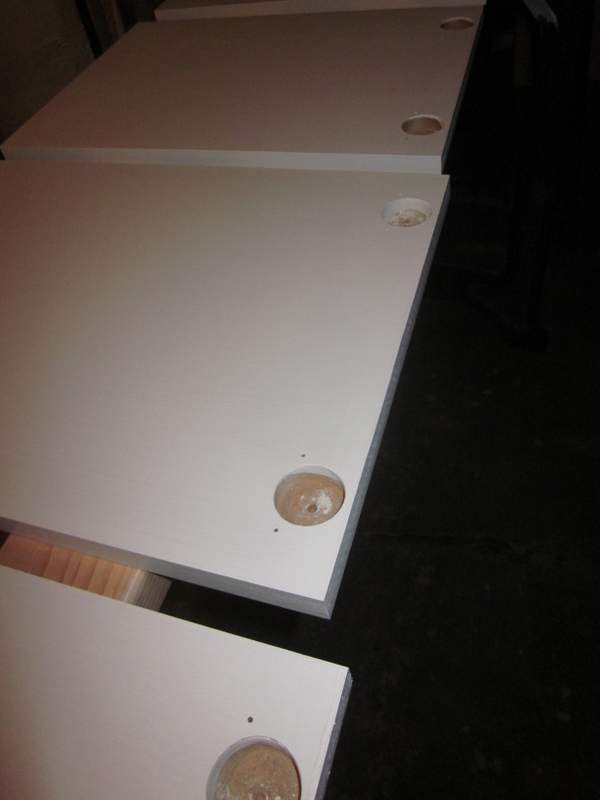
Once all the doors were cut, the holes were marked for the hinges using the template. I was a little concerned that I would go too far with the big hole, and drill all the way through the door, but I found the bit was quite easy to control.

The upper closet doors drilled and painted.

The upper closet doors drilled, painted, and hanging out in the basement.

Once cut and drilled, the doors were painted. MDF must be quite porous, because the primer paint readily soaked into the doors. The three top coats went on easily enough though.

attaching hinges to the upper closet doors

Attaching the European hinges to the upper closet doors is easy.

We attached the hinges to the doors. Then, holding the door in place, I marked where the hinges would attach and screwed them into place.

Fitting the closet doors.

Fitting the hinges to the opening.

One excellent feature of European hinges is that they are adjustable in all three observable spatial dimensions. So after the doors were hung, it was an easy matter to adjust them to exactly follow the top edge.

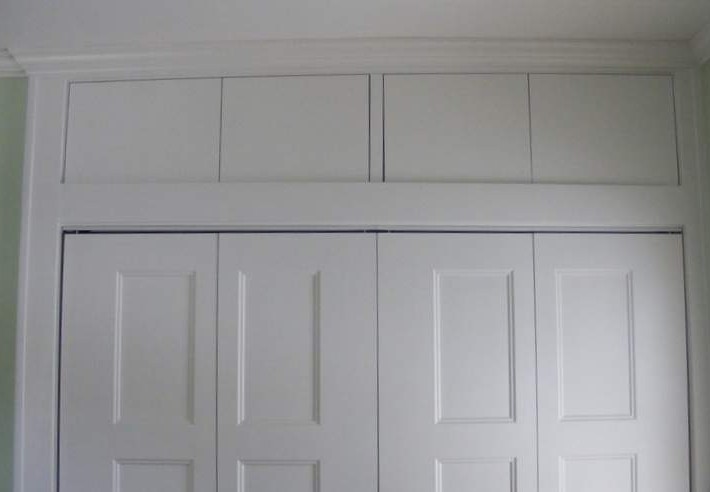
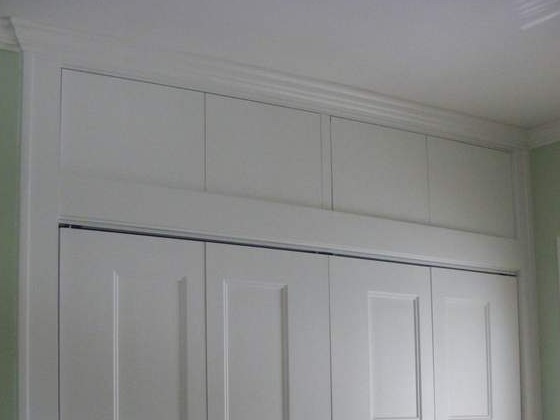
Closet doors in place

The upper closet doors in place.

Closet doors in place

There it is. Judge for yourself whether or not we successfully made converging lines appear parallel.

So, there you have it. Opinions may differ on whether we managed to disguise the fact that our house is all wonky. Although it does seem a bit odd that, on the one hand I’m trying to disguise this imperfection, and on the other, I’m telling the world about it. Oh, the joys of blogging.

Posted in Construction, Decor, Windows & Doors | Tagged , , , | Leave a comment

Selecting Upper Closet Doors

I guess it’s not much when you look at real problems in the world like Major League umpires not using instant replay.

– Homer Simpson

You’ve probably seen optical illusions where parallel lines appear to bend or converge.

Are The Lines Parallel?

An optical illusion that makes parallel lines look unparallel. Image from IllusionsPoint.com

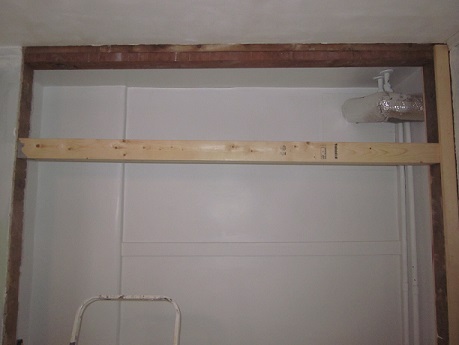
What I want to know is, is it possible to make converging lines appear parallel? Because that’s what we have in the upper part of our bedroom closet. The ceiling slopes down from right to left.

Hint: the new crossbeam is level.

Hint: the middle crossbeam is level.

I installed the lower closet doors level to run with that straight crossbeam. That left the upper cabinet doors. The requirements for the doors were:

  • European hinge @ Lowes

    European hinge @ Lowes

    They help de-emphasize the ceiling slope.

  • They use European hinges, the “inside the cabinet” sort you find on most kitchen cabinet doors (and furniture at Ikea).
  • They are inset (front of the door flush with the frame, rather than overlapping) to match the bi-fold door install.

Originally, we assumed we’d use paneled cabinet doors to match the bifolds. But paneling means that there are horizontal and vertical lines on the doors. More horizontals lines near the ceiling would do nothing for the de-emphasizing goal. In the end, we decided that totally plain, flat doors would be the best way to go. Since we are painting everything to match, that meant we could focus on MDF doors.

With that decided, we weren’t sure whether to order the doors from some place that would cut them to size for us, or to make them ourselves. These were our options:

1. Have the doors made with the top edge sloping.

This would have the least input from us. However, there was a good chance the doors wouldn’t fit well, due to confusion caused by the game of Measurement Telephone we would have to play with the manufacturer.

2. Have the doors made with square corners, with each door’s height determined by the smallest part of its opening.

This would leave a visible triangular gap above each door and would probably emphasize the sloping ceiling.

3. Have the doors made taller than the opening and cut the top edge ourselves.

This was the idea we almost went with. But we didn’t have any experience cutting MDF, and we weren’t keen to start practicing on custom-made doors.

4. Make the doors ourselves with the top edges following the top slope.

This way we could make the doors fit exactly into the opening. Also, if we messed up a piece of MDF, it would be a less expensive mistake than messing up a custom door. But we lacked experience either cutting MDF or fitting European hinges.

Ultimately we chose the last option. Before we went too far, some investigating was going to happen.

First, we researched how difficult MDF is to work with. We had some pieces of ½” MDF lying around from when Stacey fixed up a dresser. We didn’t have a saw blade with enough teeth for the job, so we got one for the Skil saw. I would have used the table saw, but it would have meant doing it freehand, because our set-up is too small to use the fence on a project like this.

I found that MDF is actually very easy to cut with the buzz saw. I was thinking it would be similar to the cheap particle board, and it wouldn’t be possible to get a nice edge. I was wrong. The cuts are very clean.

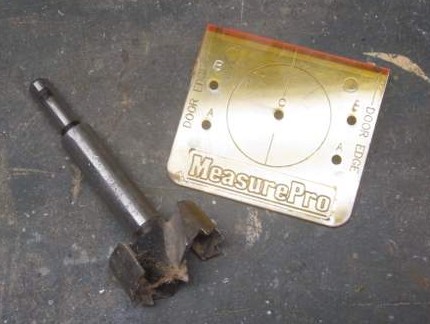
Second, we investigated hinges. European hinges need an 1¼” diameter, ½” deep depression to sit in. We wondered, is that something we can do ourselves? Initially the interwebs told us that we would have to take a second mortgage to buy the necessary equipment. But further searching revealed a cheaper option. A small plastic template and a drill bit:

european hinge template and drill bit

We got these from Menards for $13.50.

So the answer is: yes! It is very possible to make your own doors using European hinges. And that’s what we did — I’ll tell you how next time.

Related Posts Plugin for WordPress, Blogger...
Posted in Construction, Windows & Doors | Tagged , , , , , | Leave a comment