The Wall, Part 3: Our Crowning Achievement

And by the Sacred Parchment, I swear that if I reveal the secrets of The Stonecutters, may my stomach become bloated and my head be plucked of all but three hairs

– Homer Simpson

We left our retaining wall uncapped while we decided what kind of capstone to use. We’d discussed all the capstone options that you can buy at the home improvement stores, and they had all been found wanting.
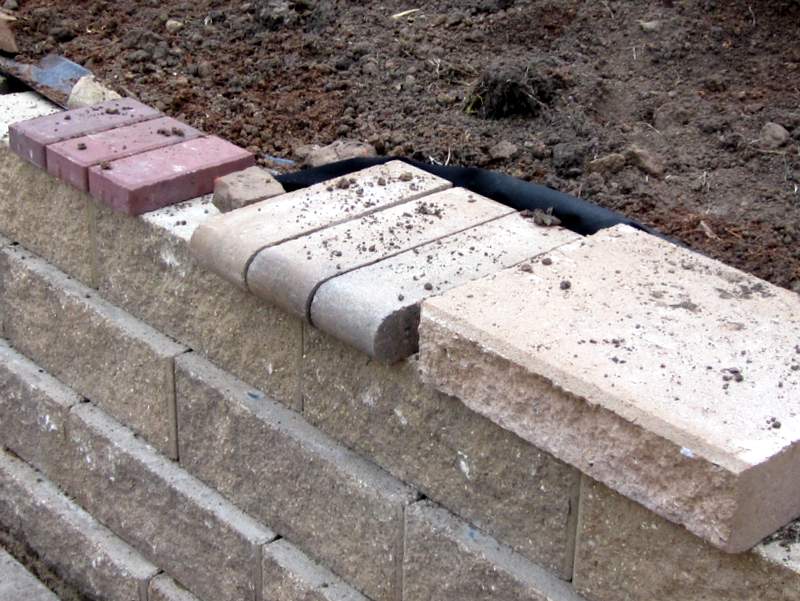
Capstone ideas

These were some of the capstone options we were playing with.

Then, we were given two truck loads of stone. That ended the debate.

Most people who know Stacey know that they can send any old, unwanted building materials in her direction. So it was with this four hundred and fifty million year old Kasota limestone.

The limestone blocks were different sizes between 12″ and 36″ long. They were about 8″ wide, and thickness varied from 2½” to 3½”. We went and collected the stone without having a specific project in mind for it. We just knew it was nice-looking rock for some, as yet, undetermined project.

Then it occurred to us that the rock would be ideal for capstones.
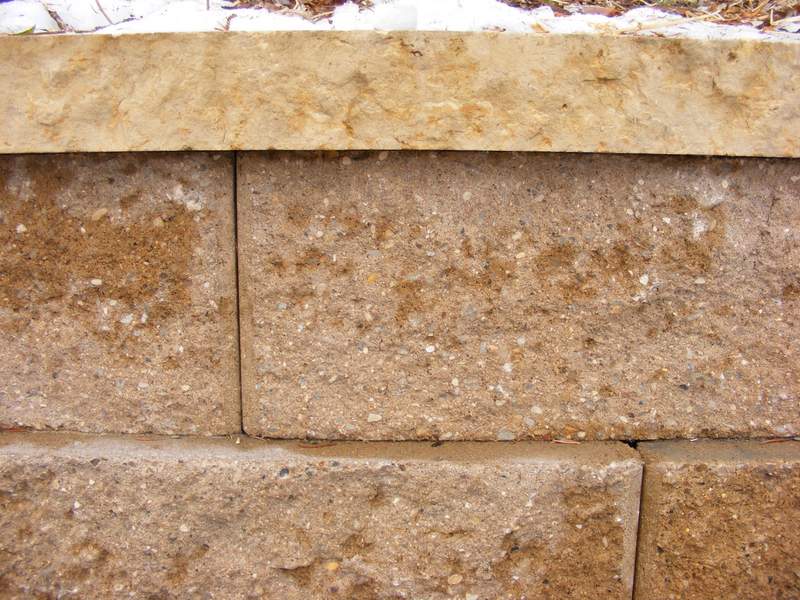
Kasota limestone used to cap a concrete block wall

Kasota limestone used to cap our concrete block wall

The first thing to do was sort the stone into two piles based on thickness. We decided to use the 2½” thick blocks for the wall top, because there were more of those than there were the 3½” thick ones. The thicker ones still have to be assigned to a project. The best idea so far is to create a minature Stone Henge in our front yard.
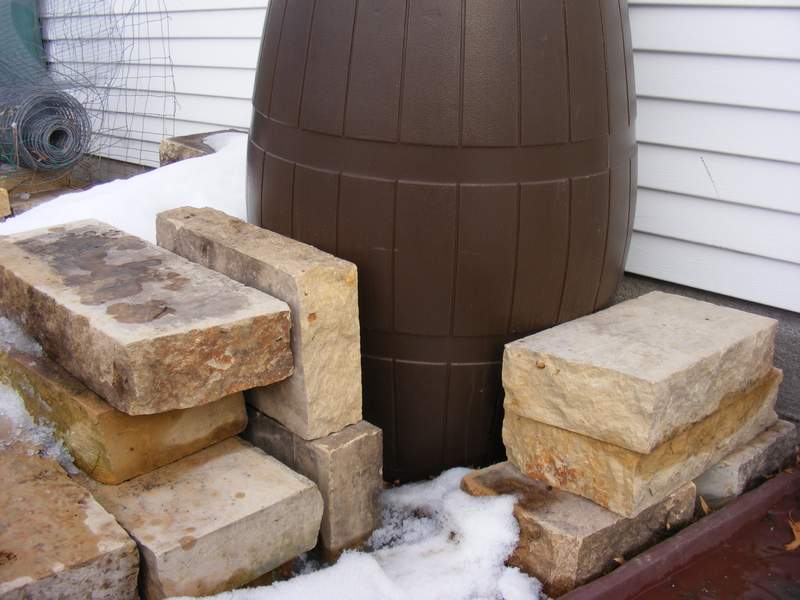
Kasota limestone

At the moment some of the thicker limestone blocks are preventing an empty rainwater barrel from being blown away.

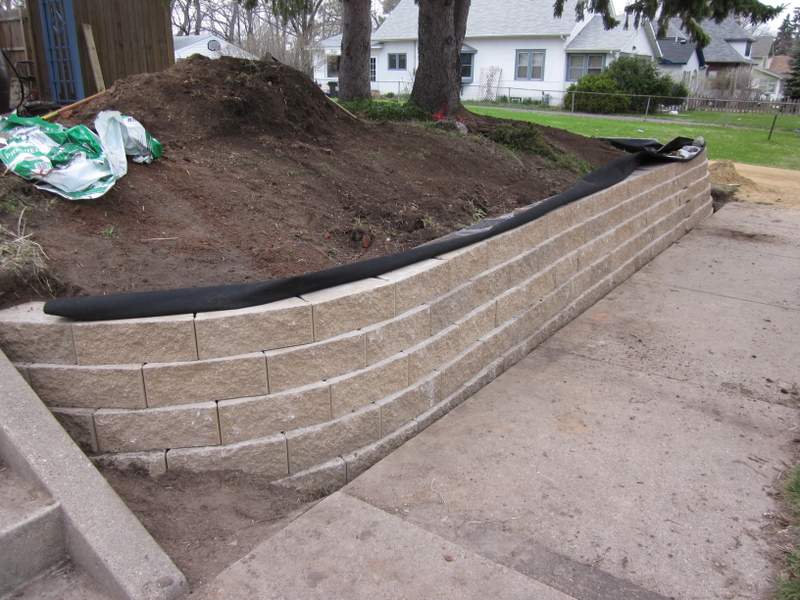
The longer limestone blocks were used to cap the straight parts of the wall, and the shorter ones were used at the corners.

The ends of most of the blocks had been cut square across with a saw, so fitting the straight runs together was easy. At the corners, I cut the blocks at an angle so that they would fit together snugly.

Most of the recommendations for cutting stone involve tapping away with a chisel. But I wanted straighter, cleaner edges than you get with a chisel. Ideally, I would have used a masonry saw, like this one shown in Masonry Magazine.

Masonry cutting saw

This saw is ideal for cutting concrete blocks and stone.

But I don’t have one of those. All I have is a 4½” angle grinder.

My angle grinder was actually pretty effective at making nice cuts. I put a mark all the way around the block where I wanted to cut. Then, using a diamond tipped blade, I cut as deeply as possible on all four sides. Hammering a chisel into the cut separated the two halves.
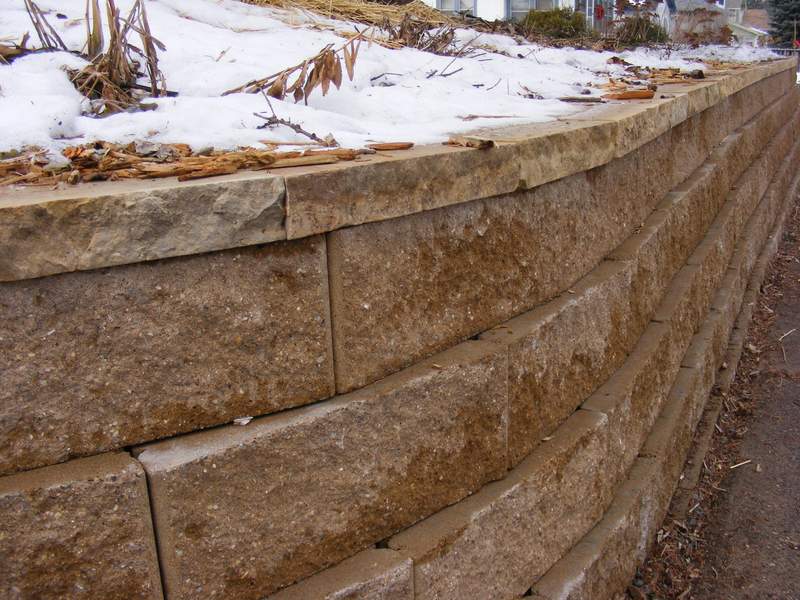
The finished wall with the capstone in place.

The finished retaining wall with the capstone in place.

I was pretty happy with the result. The only thing to bear in mind, if you try it, is that there will be dust. So, wear a face mask, and try not envelope anyone else in your cloud.
Posted in Construction, Outdoor Building Projects, Yard & Garden | Tagged | Leave a comment

The Wall, Part 2

Last week I wrote about starting to build a retaining wall. Building up the rest of the wall with concrete blocks was easy.

The concrete blocks we used have a lip at the bottom on the back side. This lip catches onto the layer below stopping the blocks from sliding forward. This type of wall is most stable if it is back filled. Back filling creates pressure from behind the wall, pushing the blocks forward, and engages each layer with the one below.

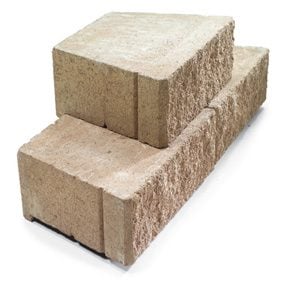
Retaining wall blocks

These blocks are like the ones we used.

Normally, you should put gravel right behind the wall for drainage, and then fill in the rest with soil that was dug out of the trench. But in our case, we didn’t need to use gravel for drainage, because our wall is under three feet high.

Back filling the wall should be done in stages after each layer has been put in place. Use the soil that you dug out of the trench, minus grass and weeds. Removing plant material, not only prevents any weeds from reappearing, it also helps prevent subsidence when the plant material decomposes.

Put a piece of good landscape fabric behind the wall. The landscape fabric will prevent soil from pushing through cracks between the blocks, but allow water to escape between the blocks. Use staples to hold the bottom of the landscape fabric in place.

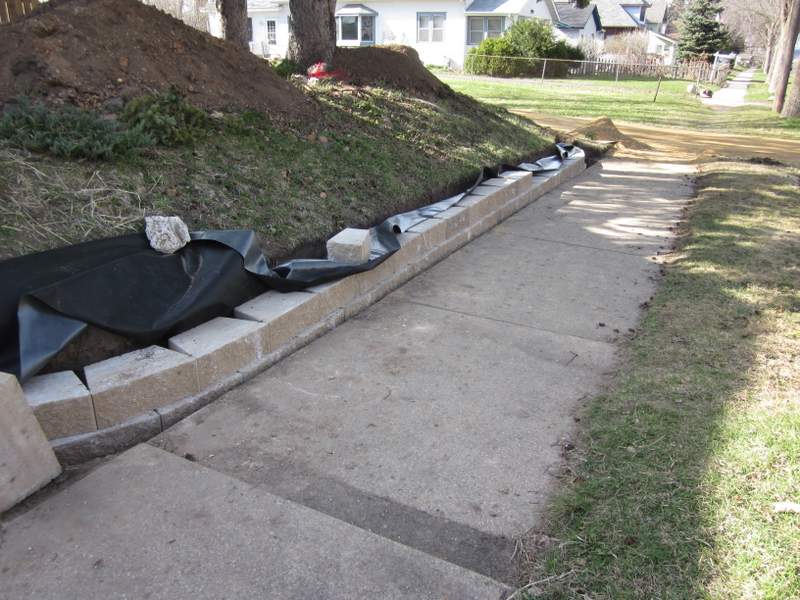
Building up the retaining wall with landscape fabric behind it.

A few layers of blocks in place.

Compact the soil using your feet, a tamper, or anything else that comes to hand and seems appropriate.

Don’t get carried away, remember to leave enough room for the lips of the next row of blocks.

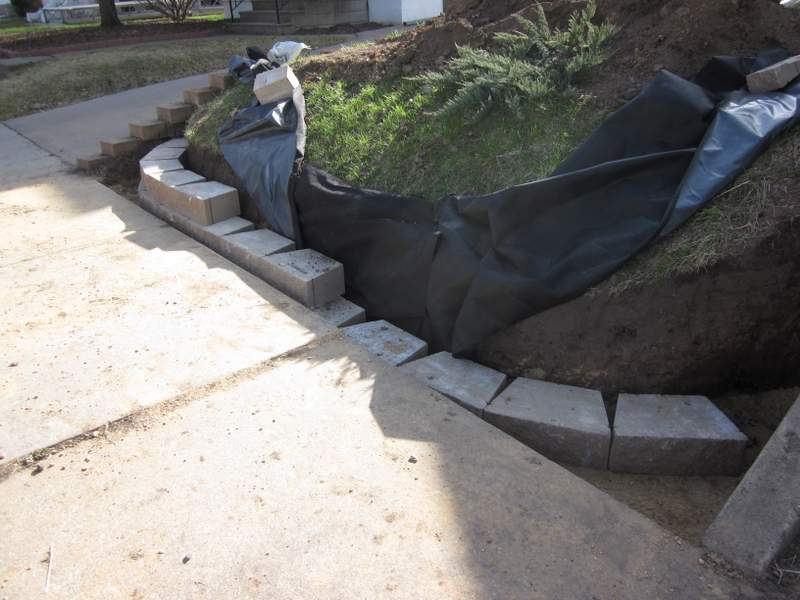
The main part of the wall is finished. Notice the landscape fabric behind the wall.

The main part of the wall is finished. Notice the landscape fabric behind the wall.

When you’ve finished the piling up the blocks, you can do what we did and lay the fabric back over the soil and cover with mulch. Alternatively, the landscape fabric can be trapped under the final layer of blocks and the capstone.

It wasn’t until the following year that we decided on what to use as a capstone. That decision was rather made for us, but more about that in a future post.

Posted in Outdoor Building Projects, Walls & Floors, Yard & Garden | Tagged | Leave a comment

Just Screwing Around

You two look good … open casket good.

– Grandpa Simpson

This star-bellied sneetch's name is Torx.

This star-bellied sneetch’s name is Torx.

The Kev and I have a humongous supply of old fasteners. Many are leftovers from other projects, or older screws that we’ve removed and kept. Kev has a jar-based screw storage system that serves us well and allows us to easily find just the right size for the project at hand.

I’m pretty careful about using the right type of screw — I can’t bring myself to use a star-headed screw to attach an original cabinet latch. Thing is, we might have the right size and type of screw, but the finish might be all wrong.

Fortunately, faking the finish on a screw head can be as easy as fingerpaint. Used to be, I’d daub the would-be fastener with bronze paint by hand. Literally. I wish I could get in the habit of wearing my dang gloves!

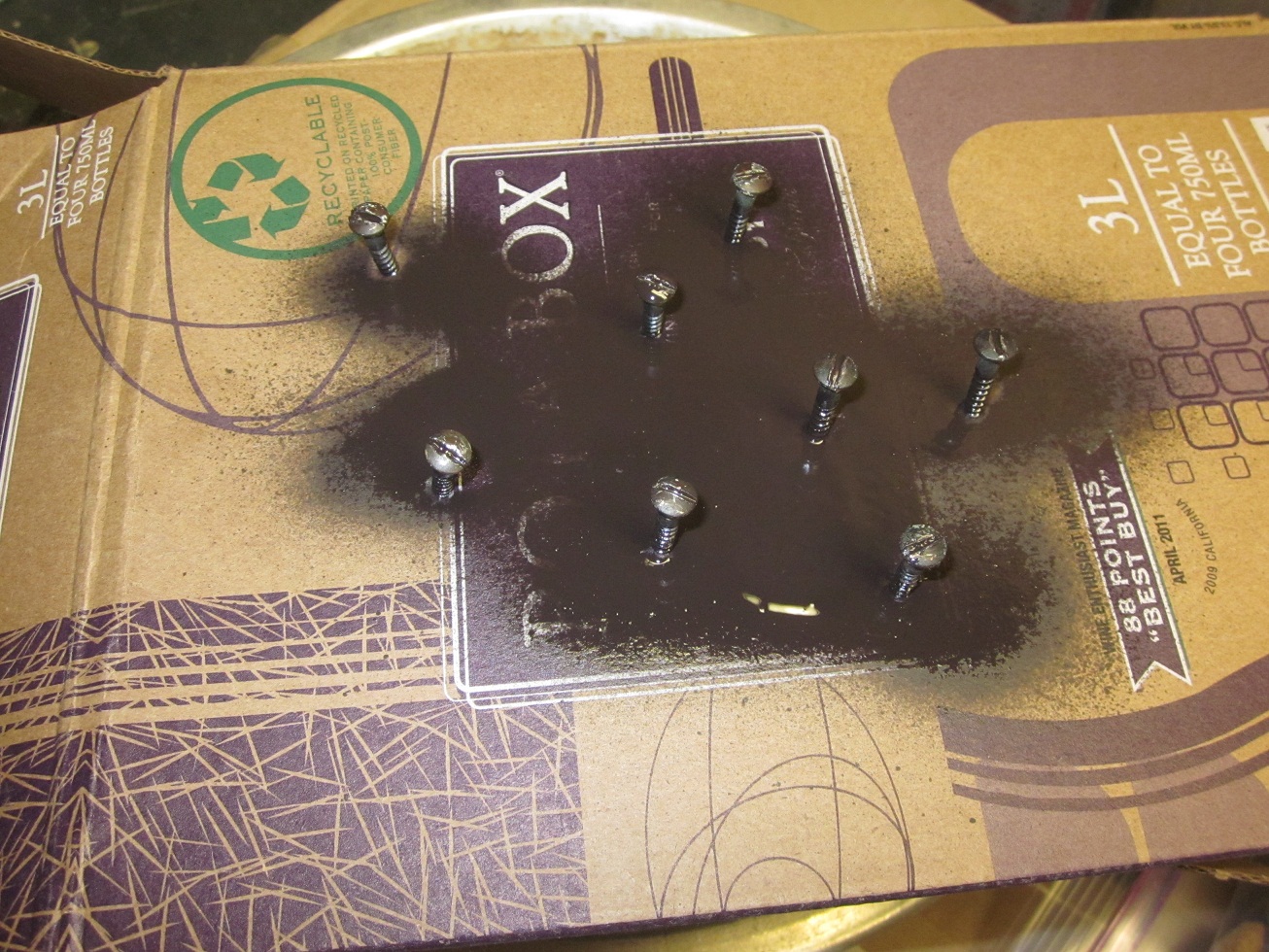
Thanks to House of Hepworths, though, it’s even easier AND my hands don’t even get dirty! I found Allison’s post on making curtain rods (which, by the way, is an awesome tutorial, and one I modified for available materials — will post it at some point).  ANYHOO, HoH pointed out that if you stick the screws into styrofoam, you can paint those puppies with reckless abandon, and they don’t stick to stuff while drying.

Thick cardboard works too, especially wine boxes!

Boxed wine: it just gives and gives!

Boxed wine: it just gives and gives!

These are the screws from my slow cooked hardware — right finish, but that old paint sinks down into the slots most inconveniently. A little spray paint covers that right up and shines them up a bit. Thanks, Allison!

Posted in Before & After, Decor, Repair & Maintenance, Salvage | Tagged | Leave a comment

Restoring Authentic Hardware

Police Chief Wiggum: Well, well, well, look who’s here. Master Detective Eliza Simpson and her easily amazed sidekick, Dr. Bartley.

Bart: What’s this? A doorknob! Good show!

– The Simpsons

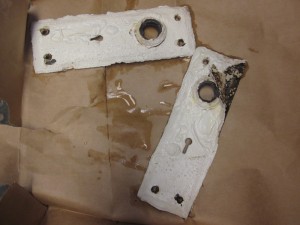
Some people shouldn’t be allowed to paint, including many of the former owners of our home. Between the windows painted shut and the general slapdash fashion in which much of the paint was applied, the Painters of Yore are not my favorite folks. But I’d particularly like to go back and ask them not to paint Every Damn Thing — especially hardware. Now I’ve done this myself, so I see how it can easily happen. You’re painting a door, and there are all these awkward plates and hinges to get around. Just paint those too! And when the door needs repainting, so does the hardware. Eventually:

Goopalicious!

Goopalicious!

Most vintage hardware can be replacement with reproductions, but reproductions often come at a premium. Plus, there’s nothing like the real thing (baby). If you have nice hardware that’s just gunked up with paint, it’s completely salvageable. Bonus? It is usually in nice shape under all that goo! Plus, it matches perfectly with what’s already there (including screw holes).

How to restore it to its former practical glory? First, you have to release it from the surrounding paint. This can be tricky because if you just unscrew a piece from something that you want to stay painted, it may lift off more paint than you want (sometimes in big, jagged scales), making the touch-up a big hassle.

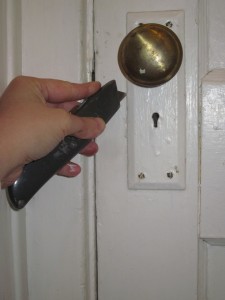
Tap lightly on the screw heads with a hammer to break paint away (be careful to clean this up thoroughly in case of lead in the paint). You can also use a utility knife to free up the heads a bit more and to scrape paint from the slots. Then, using that knife (or similar), score carefully around the edges of the piece. This step will help ensure it lifts off cleanly. But be careful not to go too deeply and scar up the wood. A lighter touch and several passes will get you where you need to be.

Proceed carefully so the knife doesn't get away from you. Muttering about bad painting helps.

Proceed carefully so the knife doesn’t get away from you. Muttering about bad painting helps.

After scoring, unscrew the piece. I generally loosen a little bit on each corner until I’m sure it’s lifting off well. Save your screws (unless totally stripped). At this point, you can do a little paint archaeology: I counted eight layers of paint, minimum.

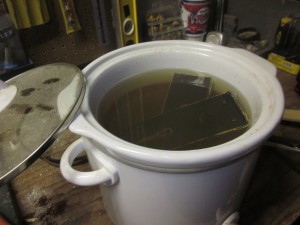
Ok, now? The Big Fun! For a plate like this, you can use a chemical paint remover or you can use a slow cooker. (DO NOT SAND!  There’s likely to be lead paint in there.) Paint removers are great for open flat pieces without a lot of detail — knob plates, brass switch plates, stuff like that. Just follow the directions, making sure that the product is ok for the underlying metal. For latches, moving parts, or detailed pieces, try the slow cooker method. I really like the Crock Pot method, especially now that I have a slow cooker that I have ruined for any other use.

Can you smell what the Crock is cookin'?

Can you smell what the Crock is cookin’?

Submerge the painted piece in water and throw in about a tablespoon of liquid laundry detergent. Most people recommend putting the cooker on medium, but mine has no medium! I put the slow cooker on high, cover, and leave it for 4-6 hours (you may need to check water level). Depending on progress, I may turn it down to low and run for another 4 hours or so. It’s an art, not a science.

Let it cool, and then?

Hardware, reveal thyself!

Slow cooking: paint so tender it almost falls off the bone

Much of the paint may just slide off. What’s left is softened, and can be removed with a plastic scraper and a soft brush (I use worn-out toothbrushes). Don’t use anything too hard or scratchy, lest you injure the original finish. Sometimes, not everything comes off. In that case, repeat the process, or use remover. It will go much quicker for whatever is left. (Dispose of any lead-based gunk appropriately — and obviously, don’t use the crockpot for food again!) When the paint is gone, wash the piece with plain dishsoap and water and dry thoroughly. Then, save the hardware for later or reattach:

Voila!

Voila!

Enjoy the momentary feeling of living in a Restoration Hardware catalog!

UPDATE: Don’t want to unscrew it? I’m experimenting with stripping hardware in place.


Posted in Before & After, Repair & Maintenance, Salvage, Windows & Doors | Tagged , , , | Leave a comment

Building a Retaining Wall

I hope you learned your lesson, Lisa. Never help anyone.

– Homer Simpson

At the front of our house was a grassy slope. It was difficult to mow, and the grass was always trying to grow out onto the sidewalk. Pine tree debris constantly rolled down the slope, littering the footpath. So, we built a retaining wall to solve all of our problems.

work on the retaining wall begins

Work on the retaining wall begins.

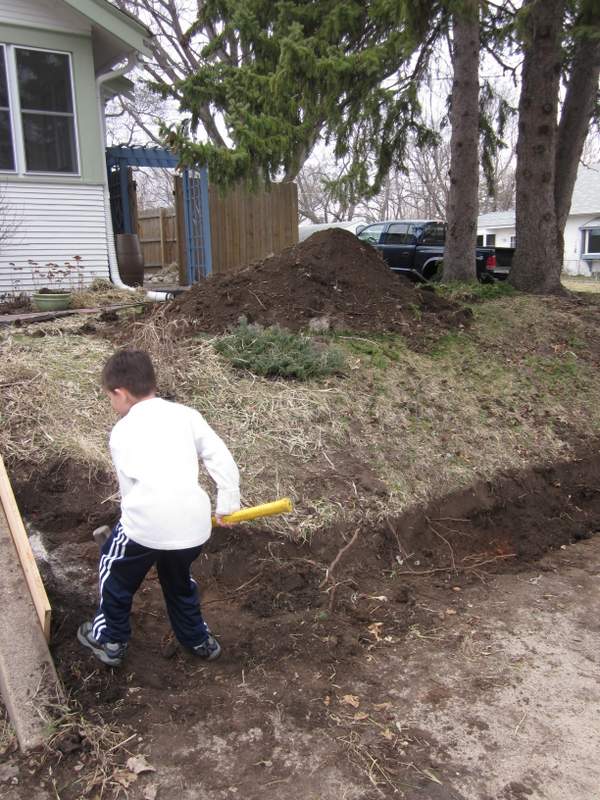
Now, we have a professional landscaper in the family, which is useful at times like this. Mary kindly gave us good advice and lend us some very useful equipment, including a fancy laser level. Not only that, she also pitched in to help dig the foundation trench, and lent us her nine year old son to use as child labor.

Mary and Drew digging trench

Mary and Drew being awesome

Drew wielding a sledge hammer

Drew wielding a sledge hammer

The most crucial part of building a retaining wall with concrete blocks is starting out right. If the first layer of blocks is straight and level, building the rest of the wall is just a matter of stacking up the blocks to the required height.

When you start to dig the foundation for your wall, the first thing to check is whether or not the ground is level. If it isn’t level, find the low point. Dig the trench deep enough so that the first row of blocks will be below ground level at the low point.

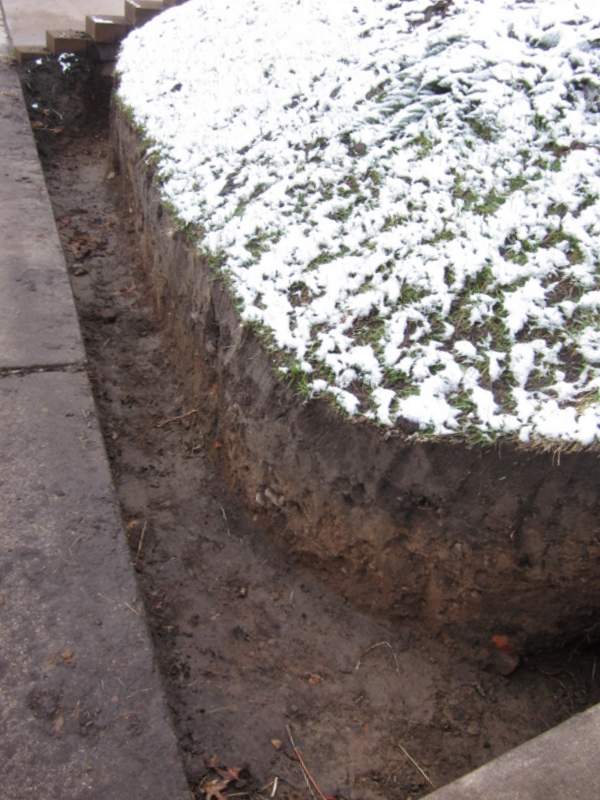
The blocks should sit on a four inch layer of paver base. So, to work out the depth of the trench at the low point, add four inches to the height of a block. Dig the trench so that the bottom is level, and tamp it down. Pour four inches of paver base into the bottom of the trench, level it and tamp it down.

Trench dug and ready to be filled.

Trench dug and ready to be filled.

Once the base is level, lay the first block. Use a rubber mallet to set it in place. Level the block side to side and back to front, making adjustments with the mallet.

With the first block is in place, run a builders line the length of the wall. The line should be run along the top of the first block at the front edge. Using a string level, adjust the builder’s line until it is level. Using this line as a guide, lay the remaining blocks for the first course.

lower part of retaining wall

Get the bottom layer level and straight, and the rest is easy.

You should then have a level straight base for your wall. Building the rest of the wall with interlocking concrete blocks is straightforward and fun. Pretty soon you’ll be sat on top of your new retaining wall enjoying a cool beer, or maybe that’s just me.

Posted in Outdoor Building Projects, Yard & Garden | Tagged | 2 Comments

Say It With Flowers, But Cats Won’t Listen

Good-bye, cruel world…hello, ironic twist.

– The Simpsons

As part of the AT January Cure, cure-ees must buy fresh flowers for their homes. But not all flowers are safe for cats. Careful flower selection is important to keep curiousity from killing.

Potentially less fatal is the choice of floral vessel. Our cats love to knock over flower arrangements, so I thought I would try a different vase shape. I linked to a low, round cat-friendly vase in my last post, but I am cheap and Goodwill is closer than Ikea, so I started there. I scored a low, round Umbra bowl for $1.99 — perfect for a proof of concept before splashing out a whole $12 at rapacious Ikea. The Kev and I picked up some cat-safe Gerbera daisies, and Bob was truly our uncle.

Waiting for the cats to come and have a go

Waiting for the cats to come and have a go

I verily trembled with excitement awaiting the cats’ approach. How would they react to this new item? Would they nibble the flowers? Would they drink the water? Would the bowl’s shape and weight prevent a capsize? What techniques would they utilize? For the love of all that’s holy, what would happen???

Basically, this:

Your flowers are so boring I forgot to retract my tongue.

Your flowers are so boring I forgot to retract my tongue.

The cats have never cared less about any household item. Other than Inigo glancing at the New Thing in passing, there have been no flower-based antics whatsoever. Is this…success?

Posted in Before & After, Decor | Tagged , , , | Leave a comment

Say It Without Flowers

Aw, come on, gravity — you used to be cool.

– Homer Simpson

I mentioned last month that we joined the Apartment Therapy January Cure. We’re on Day 3, and one of the directions for this weekend is to buy some flowers.

Flowers do freshen the place up. But if I haven’t mentioned it before…we have Cats.

Plotting against us

Ever vigilant, ever prepared

Or they have us.

Cats and cut flowers are not a great combination. First, many common florist selections (particularly lilies) are poisonous to cats. But if it comes in the house, it needs to be checked, and mostly orally.

Fortunately, though, there are many selections that make for acceptable noms.

  • Flowers for Cat Lovers (on the Natural Cat Care Blog) lists roses, sunflowers, snapdragons, Gerber daisies, and zinnias as safe options.
  • What Flowers are Safe for Pets (on GardenGuides.com) suggests camellias, roses, marigolds, or bachelor’s buttons.
  • Most definitive, though, is the ASPCA Toxic and Non-Toxic Plants list, which is sortable by cat, dog, and other animals. It contains all plant types, not just cut flowers.

Other Cure participants recommend silk flowers, potted or cut herbs, and colorful fruit as ways to freshen up your home while protecting your cats.

But even having selected safe flowers, the curiousity issue remains. I’ve never had cut flowers without the risk (and often reality) of capsize. The containers I have on hand are tall or narrow and therefore cat-susceptible. I considered finding one of those hideous flared coffee mugs from the 1980s, but maybe there’s a better solution…

Ikea Varlikt Vase: feline resistant?

Ikea Varlikt Vase: feline resistant?

…from Ikea? Pretty! But low and grounded. Could a cat still roll this vase like a drunk and go through its pockets? It would be nice to have worry-free flowers. I like this “buying nice things” part of the Cure. I’m focusing less on the “mop your floors” part at the moment.

Posted in Before & After, Decor | Tagged , , , | Leave a comment

Laptop Screen Replacement: Undo’hing the Damage

Well, a paperweight will be nice. But what I really need is a computer.

– Homer Simpson

A couple of weeks ago, while preparing the house for the holiday festivities, we smashed Stacey’s computer screen. Our large, heavy, pointy-topped lamp executed a perfect swan dive from the couch, its temporary resting place, onto the floor. Except that, for reasons known only to Stacey, the floor was shielded by her netbook computer.

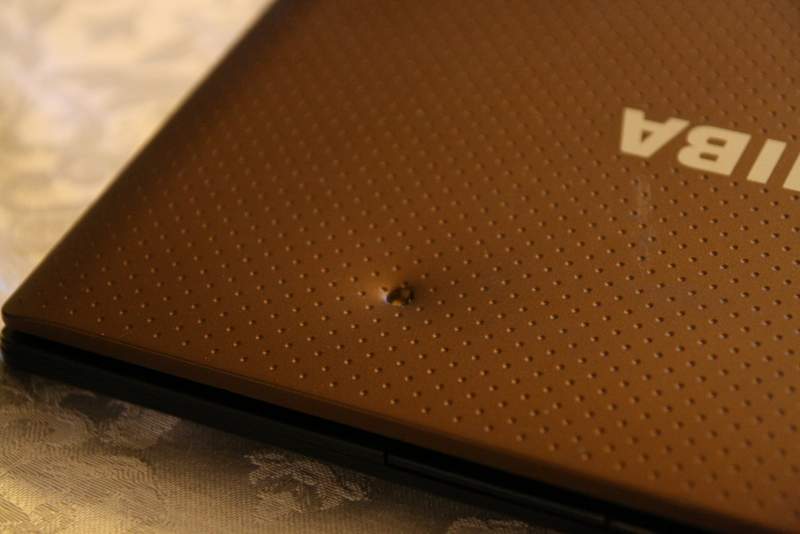
Stacey's computer with lamp induced dent.

Stacey’s computer with lamp-induced dent; weirdly, the lamp was fine.

As our nephew pointed out, the computer looked like it had been shot. The pointy bit of the lamp dented the back of the screen, which smashed the front of the screen, making it unusable.

Stacey's netbook screen after its encounter with our pointy-topped lamp.

Stacey’s netbook screen after its encounter with our pointy-topped lamp

Not wanting to believe that we had just wrecked a perfectly good machine, I started Googling the issue. Much to my surprise, it turns out that replacing a laptop screen is both possible and easy. A new screen was reasonably priced, and fitting it was a fun DIY project.

This YouTube video told me how to remove the old computer screen and buy the correct replacement. The video was made by Screen Surgeons, who also sell replacement laptop screens. There are videos for many different models.

Changing the laptop screen was very easy, if a little bit fiddly. The screen is held in place by six small screws and the piece of plastic that goes around the screen.

Removing the screen was a three step process:

1. Remove the screws from the bottom of the screen and pry off the plastic surround.

Two screws at the bottom of the screen hold the plastic surround in place

Two screws at the bottom of the screen hold the plastic surround in place.

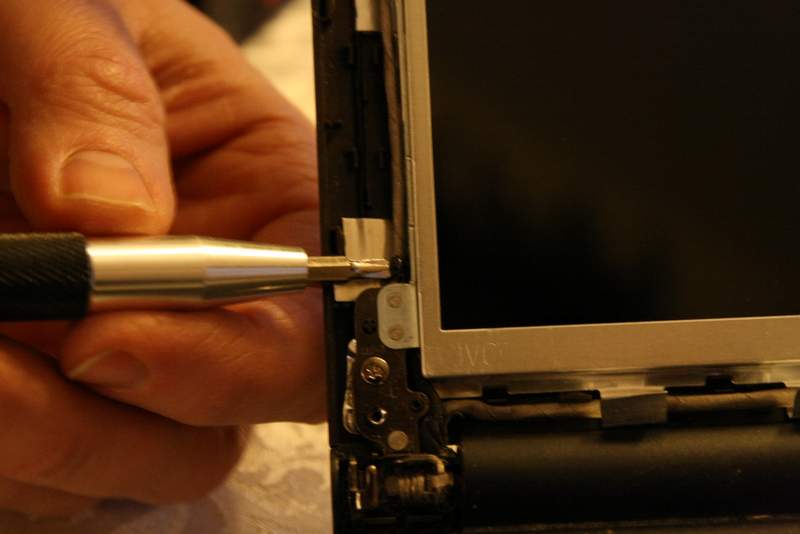
2. Take out the screws that hold the screen in place, two on each side.

Four screws, two on each side, hold the laptop screen in place.

Four screws, two on each side, hold the laptop screen in place.

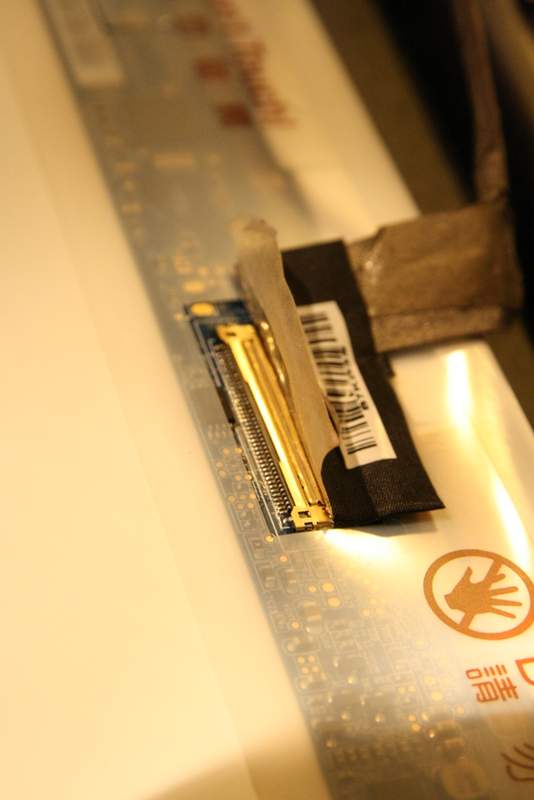
3. Disconnect the wiring connector.

The wiring connector on the back of the laptop screen.

The wiring connector on the back of the laptop screen

Putting in the new screen is a simple matter of doing these steps in reverse order.

When we put the new screen in, we turned it on before putting the plastic trim back.

Testing the laptop screen before fitting the plastic surround.

Testing the laptop screen before fitting the plastic surround

The screen works well, and Stacey was delighted to have her little machine up and running again.

Replacing a laptop screen really is that easy! I hope you never have this sort of accident with any of your precious things. But, if you do, you now know that it’s not the total disaster it first appears to be.

Posted in D'oh!, Repair & Maintenance | Tagged | Leave a comment

Home Improvement Resolutions for 2013

I resolve to lose 10 pounds, and then gain it back by Valentine’s Day.

– Homer Simpson

Spending New Year's Eve with a 10-year-old requires a bright approach to beverages.

Spending New Year’s Eve with a 10-year-old requires a bright approach to beverages.

I emailed the Kev today with a proposed list of projects for 2013. Nothing is all that urgent, but I want to have some focus and direction this year. Tangents are so easily gone off on.

    Strip and refinish porch floor
    Replace front porch railings
    Reconfigure work room
    Decide what to do with the upstairs
    Crown moulding in bedroom, living/dining room
    Update wiring on one circuit (maybe dining room)
    Repair front windows

Ten minutes later, I emailed again:

    Also, countertops

Kevin replied:

    Yes, all that and the porch door.

The porch door!  I forgot!  And it felt like I was forgetting something else.  A couple of hours later, I replied:

    Also, I’m recovering the couch.

Then while we were making dinner, Kev said, “Should we put the closet door expansion on the list? I don’t think it would be so bad once we started.”

There is just No End! And there are so many little things besides these top-of-head thoughts. Must remember to breathe deeply and enjoy the process. ENJOY IT, DAMMIT!

In the interest of process enjoyment, I’ve winnowed down the list.

  1. The Upstairs: Our half-storey upstairs is basically one huge room, and was finished in the 1950s with no real work since. At the least, we need a Plan, whether or not we start executing it. The Plan will impact what happens with the roof, which needs new shingles soonish.
  2. The Porch: The floor, door, and stair railings are all manageable projects that will address real desires we have for the space.
  3. The Closet: We have tiny closets. The one in our bedroom runs for quite a distance inside the wall, but the space isn’t really usable. If we opened up the wall and installed folding doors (nice ones!), we might actually have a place to put clothes–a serious annoyance right now.
  4. The Countertops: We also have a tiny (but perfectly formed) kitchen. I have a hankering to replace the laminate that reminds me of our troublesome tenants.
  5. The Couch: We love our sofa! It is so comfortable! And sofas are spendy! But this one is looking sad. Point and laugh as I attempt to make it a slipcover!

Certainly, other things will happen, but these are the biggies for 2013. Deep breath…and off we go.

Posted in Before & After, Construction, D'oh!, Porch, Repair & Maintenance | Tagged , , | Leave a comment

Starting the New Year Organized and Neat

Now it’s Marge’s time to shine!

– Marge Simpson

To give us something to look forward to in January, I’ve signed us up for the Apartment Therapy January Cure. This will be news to the Kev when he reads this post. Hi, honey! We’re gettin’ CURED!

I’ve been intrigued by the Cure in the past, but I’m (we’re) taking the plunge this time.  I even bought the book. The interactive Cure involves emailed assignments to organize, clean, and generally freshen up your home. So why now? The other night, I went in search of Christmas socks in the Firetrap Closet of Doom (a/k/a the upstairs closet) and it nearly had me in fits. The first step is admitting you have a problem. DONE.

We’ll let you know how it goes!


Related Posts Plugin for WordPress, Blogger...
Posted in Before & After, Decor, Organization | Tagged , , | Leave a comment