A Merry Power Tool Christmas

Lisa, stop that racket! I’m trying to fix your mother’s camera. Easy, easy. I think I’ll need a bigger drill.

–  Homer Simpson

Last week, Stacey wrote about tools that make good Christmas presents.  I suggested she include a cordless drill, but apparently she didn’t want to hear about power tools.

So I decided to write my own list of most useful tools. These are the power tools that I would recommend buying first for you or a loved one, because they combine the least amount of money with most amount of usefulness.

Cordless Drill

If you only have one power tool it should be a drill. Corded drills are fine, but I love the easy portability of cordless drills. Get a variable speed one, and it can also be used as a power screwdriver. Look for one that’s reversible, then you can remove screws with it.

Of course, the downside with cordless tools is that they can be underpowered and the battery runs down. If you get at least an 18 volt drill, it will have plenty of power. And choose one that comes with a spare battery pack, so that one can be recharging while you use the other.
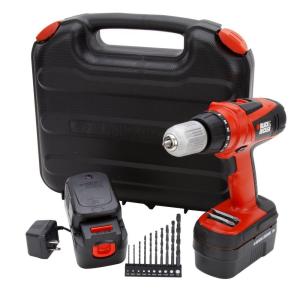
Black and Decker cordless drill

This is like our Black and Decker cordless drill set, only we didn’t get the drills with ours.

Our Black and Decker cordless drill is over ten years old. The battery packs still hold a charge well, and it has as much power as when we got it.

10″ Miter Saw

The next thing I’d suggest is a 10″ miter saw. You might be able to cut a bit deeper with a 12″, but you rarely need that extra depth capacity, and the 12″ blades are apt to flex. You’ll get a straight cut every time with a 10″ blade.

We went for quite a while without a miter saw, then we borrowed one. I had thought that the only advantage would be speed. But now I realize that miter saws offer a number of advantages over hand saws:

  • They are faster, which is awesome!
  • They are better at cutting straight and square.
  • They are especially good at mitered cuts (hence the name), which makes coving or molding installation a doddle.

Hitachi Miter Saw

This Hitachi miter saw is not a top of the range tool, but I think it does an excellent job with fewer bells and whistles.

By switching blades, you can cut wood, metal, or plastic with a miter saw.

7¼Skilsaw Circular Saw

Lastly, I’d suggest a handheld circular saw. The miter saw cuts lumber that’s not too wide, but if you want to make a longer cut, a circular saw is a good choice.

A handheld circular saw can be a good substitute for a table saw. To accurately cut materials such as plywood, clamp a straight edge onto the material and run the saw along it.

Circular saws can cut a variety of materials. By choosing the right blade, you can use it to cut wood, metal, masonry, or plastic. If you’re cutting masonry, it will kick out a lot of dust. Make sure you use a dust mask, because that stuff is lethal.
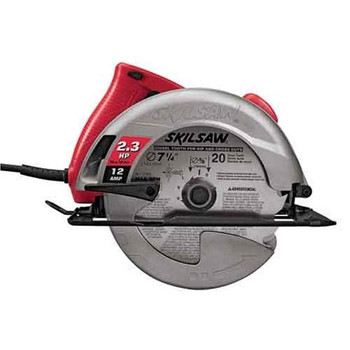
Skilsaw circular saw

This is like our Skilsaw circular saw. It’s a good solid piece of kit.

We have had our Skilsaw as long as we’ve had the Black and Decker drill, and it’s showing no signs of packing up either.

So there you have it, my Cyber Monday recommendations for power tools that will deliver the most bang for your buck.
Posted in Construction, Repair & Maintenance, Romance, Yard & Garden | Tagged , , , , , , | Leave a comment

A Very Merry DIY Christmas

Look at me, Marge, I’m making people happy! I’m the magical man from Happy Land, who lives in a gumdrop house on Lollipop Lane!

– Homer Simpson

With the holiday shopping season in full swing, we’re making our lists and checking them twice. We have a few handy folks on our list, and it’s fun to shop for them. Pretty Handy Girl (go see her!) posted a great list of gifts for DIYers earlier this year.  From magnetic wrist bands to magazine subscriptions, her list is a highly informed and diverse gift-giving guide.

Her post inspired me to put together a list of my own. Whether you are shopping for a DIY-expert-to-be who just bought a house or for a seasoned veteran of many campaigns, here are some very affordable—and useful—stocking stuffers.

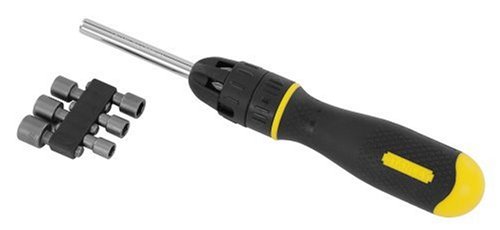
Rachet Multi-bit Screwdriver

This is, hands down, my favorite tool of any sort.  We have two of them, but I would be delighted to have a third (for the garage). Or a fourth (for upstairs!).  I can’t think of a DIY enthusiast who would not love one of these. First, it rachets, making it a great effort-saver. Second, it’s multi-bit, meaning whatever screw head you face, you can likely swap out the bit right there and then. I can’t say enough good things about having all this goodness in one tool. Highly recommended!

We have the Stanley racheting screwdriver shown here, but there are other versions.

Tape Measures

You can never have too many.  Plus, besides the standard palm-sized retracting tapes, there are a number of tapes that are useful in specific situations.  For instance, if you are laying out a garden, a super-long tape that you can reel out as you walk makes the job fly by.

This 200-foot tape measure by Komelon has a nice point to set down at your stopping place while you take your reading.

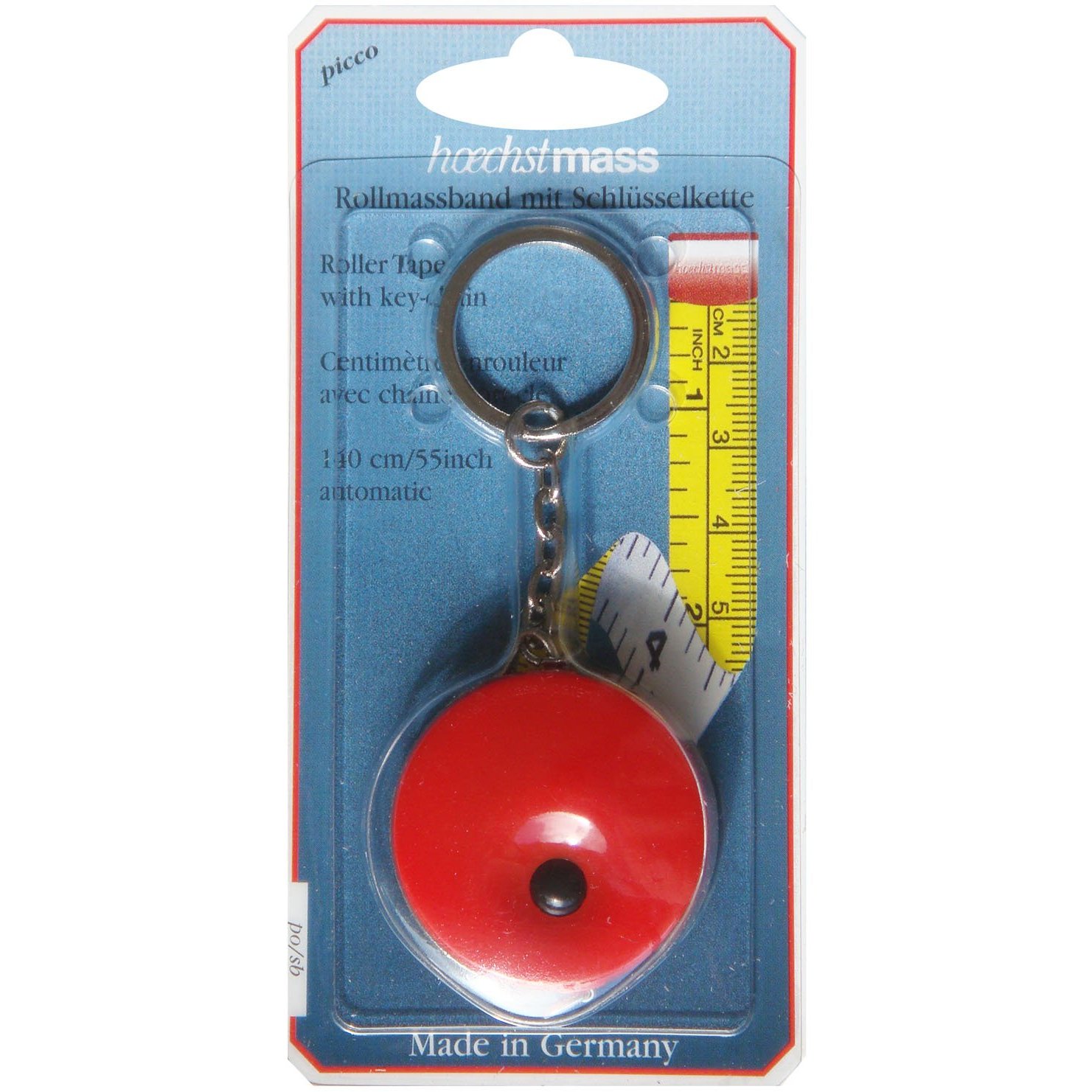
I have a small tape that I keep in my handbag so I can measure things when I’m at the store or salvage yard.  Unfortunately, I can’t seem to stop using it at home…and not putting it back. D’oh!  A keychain model would be terrific. In fact, I hope the Kev puts one in my stocking (update: HE DID!).

Tool Carriers

We’ve had toolboxes.  We’ve had tool belts.  We’ve had all manner of ways to move tools around, but the best option for our money is a tool carrier.

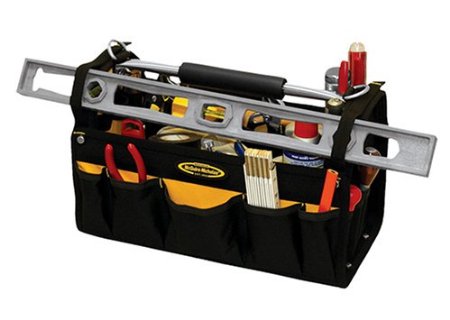
Here’s a great example of a tool carrier, this one from McGuire Nicholas via Amazon.

The open top makes it easy to grab what you need and drop in what you don’t. It’s easy to swap things around for specific jobs, while keeping the basics in view. There are lots of versions, but looks for one with a place to clip a tape measure, some pencil holders, and a padded handle.

Pry Bar

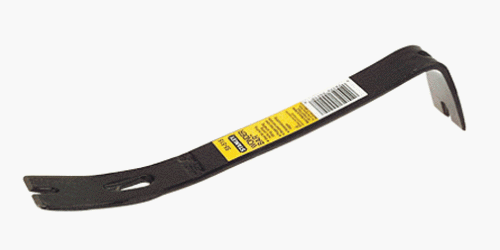
The Kev suggested I include a pry bar.  This surprised me, as I would anticipate he would add something subtle, well-designed, and vaguely European. I’m usually the one reaching for a heavy, blunt instrument when a problem arises.

Of course, the Kev uses a heavy piece of steel in a subtle way. He uses a pry bar not to pry, but to convince mouldings to come off the wall in one perfect piece, or to disassemble furniture for repair. We used to use a crowbar for these jobs, but the Kev reports that the pry bar is more maneuverable and precise, particularly when you intend to reuse materials. Which, for us, is most of the time.

Hope this gives you some cheap but useful ideas for the home improvement nut on your list!

Images from Amazon.com; listing links provided with each item.

Posted in Construction, Repair & Maintenance, Romance, Yard & Garden | Tagged , , , , , | Leave a comment

The Old Switcheroo

How come things that happen to stupid people keep happening to me?!

– Homer Simpson

Remember I was talking about frost heave the other day? Well, here’s another thing about a harsh winter: The water in your rain barrels freezes solid! If you don’t want your barrels bursting with the pressure, they have to be drained and removed from under the downspouts.

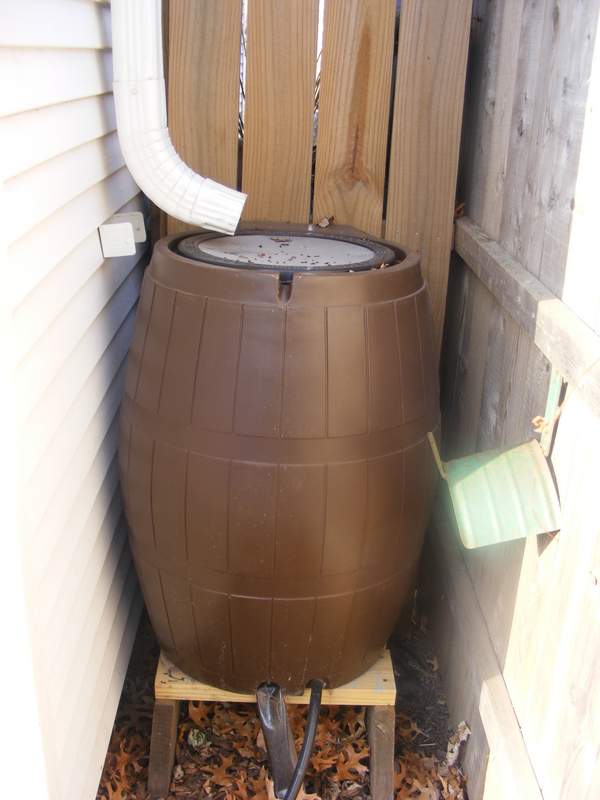
One of our rain barrels in place.

One of our rain barrels in use.

We have four rain barrels. Draining and removing them is not a difficult job; in fact, I quite enjoy it, especially now that the job is organized. You might wonder what’s to organize about draining a few rain barrels. Thing is, it’s not just the barrels. The downspouts have to be sorted out as well.

The downspouts used with the rain barrels end just above the barrel (of course). But when the barrel isn’t there, you need a longer downspout to direct the water to the ground. I now have two sets of downspouts for each barrel. Brilliant, huh?! So now all I have to do is locate the correct set of downspout components, and do the old switcheroo.

Finding the right set used to be a problem, because I’d just throw them in a heap in the garage. The following spring, I wouldn’t know which bits of spout went where. But now I’m organized! It’s simply a matter of selecting the right set using my amazing labeling system.

There are two aspects to my system:

  1. All the pieces of each set are taped together, and
  2. Each set is labeled to indicate which rain barrel it goes with.

I know! Genius!

When I want to replace the downspout set for the southeast corner of the house, I simply look for the appropriately labeled set. Take out the screws from the short spout and remove it. Then, attach the new set using the same screws.

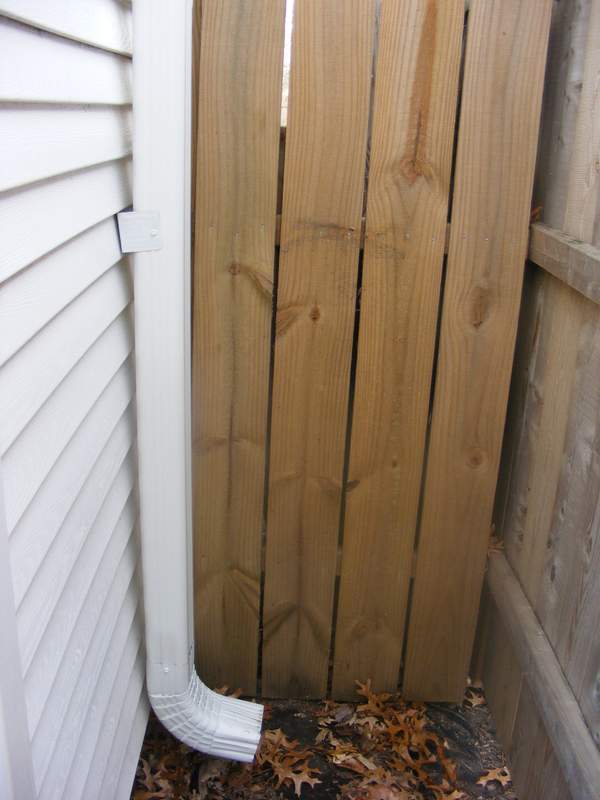
Down spout extended after removal of rain barrel

Rain barrel removed and down spout extended.

Once you have the barrel drained and the winter downspout attached, you can store the barrel up against the wall, right next to its summer location. Just flip it upside down so that it doesn’t fill with water again, ‘cos that would make this whole exercise pointless.

Posted in American vs English, Yard & Garden | Tagged , , , , | Leave a comment

Post Mortem

You can’t keep blaming yourself. Just blame yourself once, and move on.

– Homer Simpson

One thing you don’t have to think about in England is frost heave. So, when we built our privacy fence, I didn’t! I sunk the 8′ posts 2′ deep, as I’d been taught.

I didn’t know that bottom of the post hole should be below the frost line. In fact, I didn’t know what a frost line was. It is, of course, the depth to which the ground freezes in winter. If you don’t take this into account when setting fence posts, they will be pushed out of the ground by frost heave.

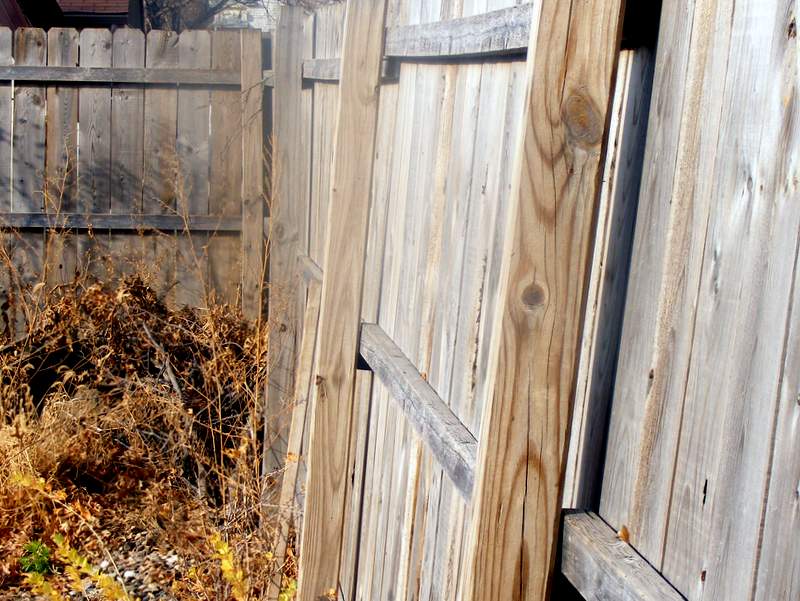
Frost heave happens when soil moisture freezes and expands. If the soil freezes below the post, expansion will push the post upwards. When the ground thaws, it goes back to normal. But, repeated cycles of heave can loosen the posts and cause the fence to lean, as you can see below.

Picture of fence posts that are leaning due to frost heave

Fence posts that are leaning because of frost heave.

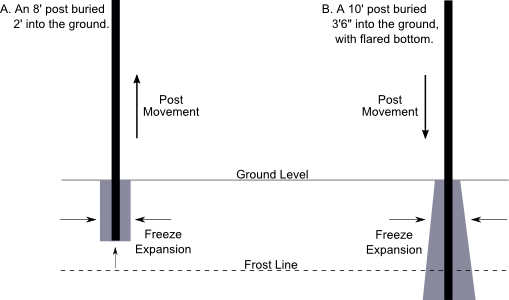
Recently, I was helping the neighbors to replace their fence, which also borders our yard. They bought the materials, and I did the work. This time, I did some research on combating frost heave. The Minnesota governement states that the maximum frost depth in the southern part of Minnesota is 3’6″. So, that’s what I went with. Whereas before, I had used 8′ posts and buried them 2′ deep. This time, I used 10′ posts and buried them at least 3’6″.

Diagram of Fence Posts Showing Effects of Frost Heave.

Figure 1. Diagram of fence posts sunk into the ground and surrounded by concrete, indicating the effects of frost heave.

Another tip that I learned from the U of M was to flare out the bottom of the post hole, as shown in part B of Figure 1. Do this by chiseling the sides of the hole with a long pry bar. With a hole of this shape, sideways squeezing pressure from expanding soil moisture exerts a downward pressure on the post footings, further reducing the effects of heaving.

So, it might take a bit more work to sink those posts, but I think it’s well worth the extra effort. Especially since I’m now faced with the prospect of replanting my original fence posts. D’oh!

Posted in American vs English, D'oh!, Outdoor Building Projects, Yard & Garden | Tagged , , , , , , , , | Leave a comment

Japanese Knotweed: My Part in its Downfall, Part 3

So far, using a combination of weedkiller and excavation, I felt I was getting the upper hand over our Japanese Knotweed and wannabe Audrey III.

Seriously. I had dreams like this.

But this was no time to ease up. As they say, The best defense is a good offense, and I intended to be as offensive as possible. AS USUAL, right?

When last I left you, I was digging and burning and hating. It wasn’t enough! Here are the last steps in my technique.

  1. Drill. You are not going to get all the knotweed’s roots. I followed one down to a meter below grade, and then it took a turn straight down into the bowels of the earth. Spray the cut ends with…you guessed it! Let dry for a few days, and then take your drill and riddle the stinkers with holes. Cover each one completely with stump removing powder.
  2. Fill. Fill in with uncontaminated dirt back up to grade, compacting as you go. Get bog standard dirt – anything with lots of organic matter or fertilizers will encourage fleeceflower to come back, and it needs no encouragement.
  3. Cover. Get a big, nasty, impermeable tarp and cover the area. Go at least five feet beyond the kill zone. Weigh it down with big old rocks, and then cover the whole thing with landscape rocks or mulch. You won’t be growing anything here for a couple of years. I kept container plants on top.
  4. Patrol. By now, you know the shoots and leaves and even the roots of your enemy. Check beyond the edges of the tarp for signs of life. If the tarp heaves up somewhere from new sprouts, peel it back, spray, and re-cover. Repeat at least once in a couple of weeks, then cut it back, and re-tarp. Stay alert!
  5. Wait. And patrol. For a couple of years. You want at least a year to pass between the last sprout and the next step. Keep in mind it can re-sprout from rhizomes over ten years later. I had a resprout over a year after reading it the last rites, but I was able to bring the smackdown right away.
  6. Resume your life (sort of). Get some of the fancy-pants landscape fabric – the stuff that lasts 25 years with the rubberized backing – and replace the tarp. Cut holes to plant stuff through. Don’t spend a lot of money on plants for this area, ‘cuz you may have to move them. Keep an eye out for scary leaves. Gardening will never be the same (sob!), but your alert level can step down a bit.

I am aware that some of these steps may be superfluous or not supported by research (particularly the bits about hating), but hey: success. Also, I’m not really much of one for weedkillers usually, but this is an unusual case. Outside of the technique described here,  controlled chemicals and injection equipment may give you good control. I did not cover those because they require licensure or a chunk of change to implement. My method: Cheap and Cathartic.

If you face knotweed, good luck, soldier!

Posted in D'oh!, Yard & Garden | Tagged , , , , , | Leave a comment

Japanese Knotweed: My Part in its Downfall, Part 2

Eradicating Japanese Knotweed is a long process. In my first post about killing knotweed, I listed the initial attack tactic: amp up the attitude, spray with glysophate, and wait for a couple of weeks. There’s no way that stopping there will get you anything other than stronger, angrier knotweed. Stick with it! Here’s what to do next:

  1. Cut it down. Fallopia japonica can (and does) regenerate from clippings, so put down a tarp and cut the stalks off about a foot from the ground. Gather EVERYTHING in the tarp and dry it out, then burn it. Do not compost it. Do not trash it. Do not leave any pieces behind. Do not fail to completely clean your shoes and tools before leaving the area. Destroy it.
  2. Spray it. What?? Yes, more Round-Up/glysophate. Once you cut it down, you’ll have the gaping maws of the sheared canes exposed. Stick the nozzle right down their throats and spray with abandon. Renew your commitment by imagining them gagging and choking.
  3. Wait. Give it another couple of weeks. Yes, this area looks like hell. War is hell and you are at war with this plant.
  4. Spray it! Really? Yes, because the thing will most likely put up some sprouts. Look yards away for sprouts – I found some that vined under the porch and came out where it thought it was safe. Coat the leaves on the new growth, top and bottom.
  5. Wait. A couple of weeks, yes. And while waiting, imagine the plant in its death throes. Hate it a lot! You have reason.
  6. Dig! Get your tarp out again, and start digging. The roots will be unbelievable – woody, thick, gnarled, vicious. You’ll need a saw. Dig. Cut. Dig. Cut. Tease out the smaller roots. Follow every big root you can find and get it out of there. Gather everything on the tarp; you’re going to burn it or encase it in nuclear waste. (Burning is more practical.) I also had a heap of dirt that I screened and supplemented with clean fill. When I was doing this, I had a trench over three feet deep. I insisted the Kev spend some time outside so the neighbors knew he was well. It looked as if we’d had some sort of extremely serious argument with illegal outcomes.
  7. Keep hating it!

Now, we’re getting somewhere!

Some people recommend eating knotweed shoots (or drinking them). Many recipes and even videos extol the virtues of control via eating.

Japanese Knotweed Pie (from foragingfoodie.net, a great site with a plethora of forage-based recipes and gorgeous photographs)

Part of my cunning plan is to keep weakening the plant’s reserves by repeated trauma and cutting. If your diet is knotweed jelly-deficient and you are committed to hacking back the shoots religiously, this technique may work for you. But I hope it’s obvious that you should do one or the other! Any knotweed shoots on my property are brimming with poisonous goo, and not the yummy kind.

At this point, the Japanese Knotweed is definitely on the run. Tune in for the thrilling final episode

Posted in D'oh!, Food & Drink, Yard & Garden | Tagged , , , , , | Leave a comment

Japanese Knotweed: My Part In Its Downfall, Part 1

Now what is a wedding? Well, Webster’s dictionary describes a wedding as: the process of removing weeds from one’s garden.

– Homer Simpson

When we bought the house (and for years afterwards), our yard was only a couple of cars on blocks and a bathtub shrine away from Redneck Nirvana.

We focused first on the interior, with necessary attention to Things That Were Blowing Up Right Now. Later, we moved on to Things That Could Cause a Freak Accident and slightly more leisurely points beyond. During this time, we mowed the scrubby grass, cut down the worst of the monster weeds, and planted a few gift plants. It’s all we had time for.

Picture of our yard before we had done any landscaping

I wish I were kidding. This was our yard.

One of the gift plants was called “fleeceflower,” and it looked really pretty. It was vigorous and attractive, and I didn’t have to do a thing to it. It had pink veining on the leaves, and fluffy flowers in late summer.

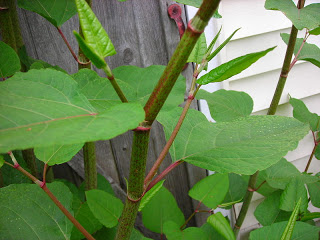
Picture of japanese knotweed, also known as fleeceflower.

What’s not to love?
Photo credit: Wikipedia/Ancatdubh43

But pretty is as pretty does, and in this case, pretty does Dallas. It’s a very busy plant, which is a nice way of saying it’s an evil, invasive bully from hell. When it first started its conquest of our garden, I was pleased – but when it knocked out the ditch lilies and lily of the valley, I started to be concerned. When it started heaving up large rocks, I freaked. And researched.  And despaired.

But I knocked it back in one season, and three years later, there’s no sign of it. It wasn’t fun, and it wasn’t environmentally friendly, but over the next three posts, I’ll tell you how I did it.

There are several phases to this fight, with this post covering the initial shot(s) across the bow.  Which are:

  1. Commitment. With Japanese Knotweed, you have to want it. I had a mantra: “I am smarter and meaner than you, plant, and I am going to win!” Hold on to your mantra, because fleeceflower will make you feel dumb and helpless if you let it.
  2. Glyphosate (Round-Up). If this is a midway stop in your research, I can imagine your laughter. Round-Up will not kill it, no. But it’s a good start on weakening it. Spray the bastards with Round-Up to cover every leaf surface, top and bottom. You’re going to want the bigger “tank” size.
  3. Patience. WAIT. Seriously. Wait. Round-Up requires the plant to keep going while it gets down into the roots. Wait a couple of weeks. Cackle maniacally from time to time, because the plant has no idea what’s coming for it.

Keep these opening moves in mind, because commitment, chemicals and patience are your arsenal in this siege. In Japanese Knotweed, Part Two, I’ll go over the next tactical stage.

Posted in D'oh!, Yard & Garden | Tagged , , , , , | Leave a comment

Replacing Garage Siding, Part 4: Hang Loose

Stupid sexy Flanders!

– Homer Simpson

I received advice about vinyl siding from lots of people, including my neighbor’s dad. Once you get started off level, installation comes down to is one overarching directive: let it hang loose.

Installing vinyl siding isn’t very difficult, all you have to remember is that vinyl siding shrinks when it’s cold and expands when it’s warm. I heard that an eight foot panel can change length by 5/8ths of an inch. So, make sure the panels can move, or else they will buckle. They should just hang from the nails, not be trapped by them.

To help you keep your vinyl siding relaxed and happy, bear in mind three simple rules:

Rule 1: Don’t hammer the nails all the way in

You can nail the siding to the studs with galvanized or aluminum nails. I tried aluminum nails, but I didn’t like working with them. They were too easy to break or bend. Of course, that could just be a problem with my hammering technique. I found two-inch galvanized nails were much easier to work with.

Not hammering the nails all the way in is a bit tricky at first. More than once I had to pry one back out after getting it too tight. But after a while, it gets easier to judge how hard that final tap should be.

Leave a 1/16″ gap between the nail head and the siding. If you go further than that, 1/32″ is probably the minimum.

Rule 2: Put each nail in the middle of the hole

The nails go through horizontal slots at the top of each panel. Don’t nail at the end of the slot! Put the nail in the middle, so there is room for the panel to move sideways as it expands and contracts with the weather.

Rule 3: Leave a gap between the end of a panel and the channel

Channels wrap around the edges of the siding where panels end: inside and outside corners, the top of a wall, under eaves, and around windows and doors. The siding slides into the channel, which makes the whole thing look neat.

Cut the panel a bit short so that it doesn’t go all the way into the channel and fit too tightly. Instead, leave about a 1/4″ gap. Again, this allows the vinyl panel to expand into the channel, rather than buckle.

(Interesting note about J-channel I learned only after completion: J-channel doesn’t expand and contract as much as the siding pieces. So, if you need to use more than one piece in a run, you can just cut those to size and butt them up against one another.)

There you go: siding and neighborhood relations in four easy lessons! To sum it all up: start off level relative to the building at the bottom, then work your way up and around the structure. But loosely. While avoiding eye contact with the neighbors.

Posted in Garage, Outdoor Building Projects, Siding & Roof | Tagged , | Leave a comment

Replacing Garage Siding, Part 3: The Thin Blue Chalk Line

You know, Moe, my mom once said something that really stuck with me. She said, “Homer, you’re a big disappointment,” and God bless her soul, she was really onto something.

-Homer Simpson

It turns out that if you want to start a conversation with a stranger in Minnesota, all you have to do is start working on siding. The usual Minnesotan reserve is forgotten. Once taciturn strangers, now feel free to wander up and to proffer advice.

I am not complaining, I welcome good advice, especially in areas where I lack experience. Helpful advice comes from many familiar sources. But this phenomenon–random Minnesotans volunteering unsolicited words of wisdom–was new to me.

As I described in part two of this post, we decided to replace the rotten garage siding with vinyl. So, on a warm sunny day, I walked out to the garage with a tape measure, a spirit level (that’s a “level” to you Americans), and a chalk line. The guy next door was sitting out back with a few guests. I waved, said “Hi,” and then turned my attention to the garage. After a while, one of my neighbor’s guests wandered over. He introduced himself as my neighbor’s dad.

My neighbor’s dad told me that he was well-versed in the ways of siding, and he began to disperse his siding wisdom. My chalk line and level troubled him. Disregard level readings! was his advice. Siding should always follow the lines of the foundation! I understood what he was saying, and thanked him for the advice. After a little more conversation, he returned to his group.

Now, I have a particular way of working that could be called deliberate and thoughtful. I don’t like to rush into unfamiliar projects. I spend a lot of time researching, and looking, and thinking. My neighbor’s dad, who was keeping a watchful gaze over me, didn’t know about my way of working. He thought I was at the begin-attaching-siding stage. But I wasn’t! I was still in the measure-look-think stage.

I carried on measuring walls, snapping chalk lines, and checking the walls for level. I was not ignoring his advice, just scoping out the project before beginning.

The distinction was not apparent to my neighbor’s dad. Thinking that I had either not understood his advice, or was willfully ignoring it, he came back. This time, he made his points more slowly and loudly, in words simple enough for a dumb Limey to understand.

This time, it was harder to convince him that I understood. In fact, I don’t think he was convinced. I smiled and nodded until, crestfallen, he wandered off.

I hadn’t wanted to disappoint my neighbor’s dad. Apparently, when a Minnesotan offers unsolicited advice, anything other than full and immediate implementation will result in feelings of guilt and regret for both parties. Now I begin to understand the need for the usual Minnesotan reticence. It’s like siding for people, offering protection from external threats. Threats like being disappointed by your son’s neighbor.

Posted in American vs English, Construction, Garage, Outdoor Building Projects, Repair & Maintenance, Siding & Roof | Tagged , | Leave a comment

Evolution of a DIYer

If you really want something in life you have to work for it. Now quiet, they’re about to announce the lottery numbers.

– Homer Simpson

Skills are learned. Some of my biggest d’oh moments involve undoing something I did once upon a time in a mediocre fashion. Case in point: the hallway light.

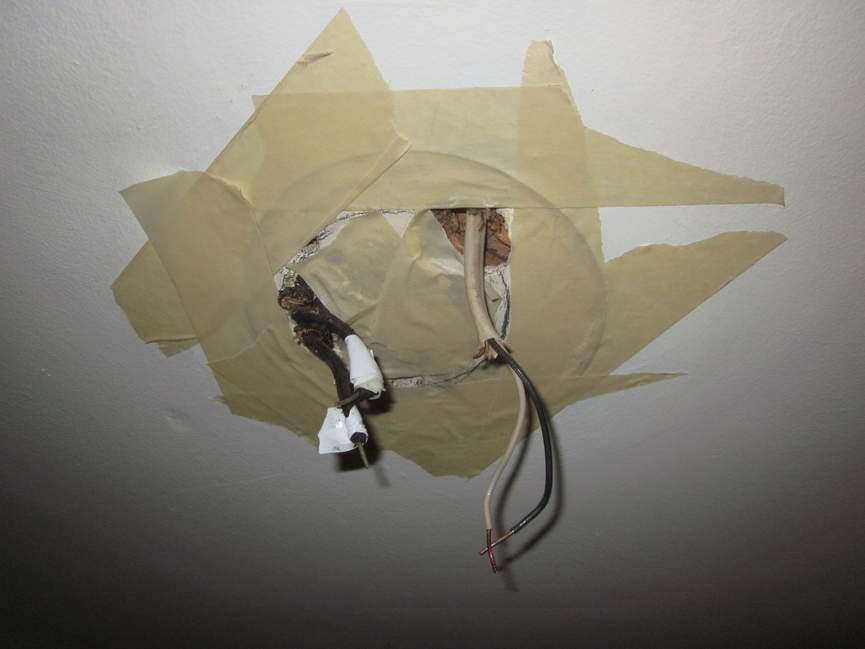
Old house, old infrastructure. For the original electrical installations, this means knob and tube wiring exiting a frame member into a light fixture canopy without benefit of a box. I was in a hurry to change the fixture, so I just swapped it out without retrofitting the box. I wasn’t sure how to do it, and I didn’t want to figure it out. Meaning that every time I walked down the hall, I thought about (a) my unacceptably high tolerance for mediocrity and (b) the likelihood of the house burning down.

EVERY TIME.

Needless to say, a re-do was on my personal List.

Seriously, though, adding a box to house old light fixture wires is pretty simple. For plaster ceilings, you just need a ceiling pan (like this one from Viking Electric Supply). This is about the depth of the plaster, so you can knock just the plaster out and pull wires into a nice safe space without having to saw through laths. (Note that this won’t do it for a ceiling fan, but that’s a whole other story.)

I used a 4-inch ceiling pan (update: I read somewhere that 3-inch pans may allow too much heat to build up, so go bigger than that). After TURNING OFF THE BREAKER and removing the fixture, I held the pan up to cover the holes the wires were coming through and traced around the outside of the pan. I applied masking tape over the area to reduce plaster fallout, then used a chisel and hammer to knock out the plaster to fit the pan.

Tape around light fitting on ceiling

There will still be a fair bit of plaster dust and grime. Wear a mask!

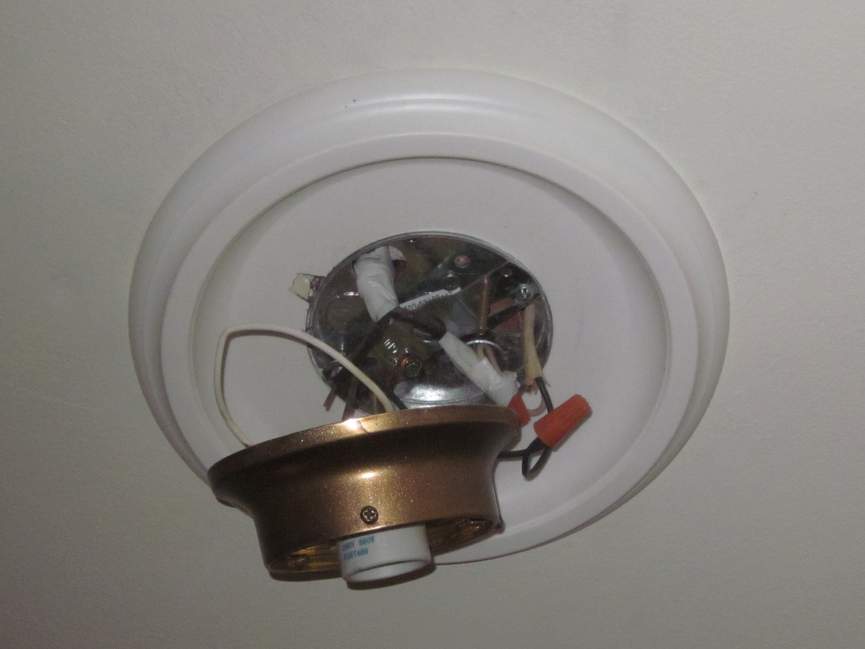
Pull the wires through and shimmy the pan up into place (adjusting the hole if needed). Use wood screws to attach the pan to the frame.

Light fitting ready to be installed

I used a plastic faux plaster medallion to surround the fixture, so that went on first.

Now you can attach standard fixture mounting hardware and reattach the light. Make sure the switch is off, then turn your breaker back on and do a blue smoke test.

It’s still knob and tube in part, yes. We’re replacing that in pieces each time we open up the floor in the attic. In the meantime, I enjoy not using the hallway as my own personal Walk of Shame.

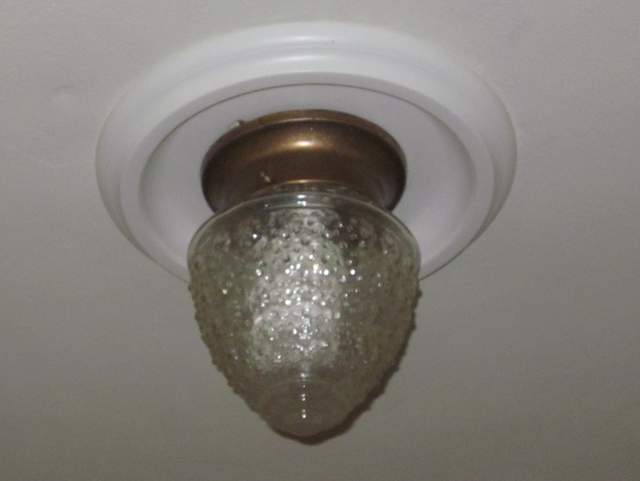
Finished light fitting

Done!

I needed more than skills to do this little project. Working on this house taught me something unexpected. It taught me patience. Not the abiding patience of the Kev, born at Patience General Hospital in Patientville. Patience is not my natural state—cut to the chase, done is good, HIT IT WITH A HAMMER ALREADY! But after dozens of projects done shoulder to shoulder with my husband (including many re-dos of jobs I did in haste), I know the value of care and craft, of measuring twice…and of taking a damn break instead of doing something regrettable!

Happy anniversary, sugar.

Related Posts Plugin for WordPress, Blogger...
Posted in D'oh!, Electrical, Repair & Maintenance, Romance | Tagged , , | Leave a comment