Quest for the Elusive Storage Bed

Ms. Hoover: First, we’re going to construct paper mailboxes to store the valentines.
Lisa: Isn’t that just pointless busy-work?
Ms. Hoover: Bull’s-eye. Get cracking.

– The Simpsons

One of our 2013 home improvement goals is to expand access to our bedroom closet. As long as we’re putting the whole dang bedroom out of commission, we’re also going to spruce it up — fresh paint and curtains, wider crown mouldings, and new fixtures and furniture.

We’re awaiting some heating work before starting, so I’ve been planning the room. It’s fairly small and can feel crowded, so we thought we would look for a bed with drawers. Lots of drawers! Thereby eliminating the need for a dresser! In my research, I found many people yearning for the same space-efficient solution, but surprisingly few good options from manufacturers.

And so, since it’s Valentine’s Day, a list of beds!

One or two drawers per side:

  • The ever-reliable Ikea has several options. The Brimnes storage bed has two huge drawers per side, and so does the Mandel. The Oppdal bed is a platform with inset drawers (and a decidedly 1970s waterbed look to it, if you ask me).
  • Some manufacturers have beds with a couple of drawers in the footboard or on the sides. Check out Ashley Furniture or the Hawthorne bed.  For more of a bachelor vibe, there’s the Vogue Panel Bed. These types of beds are readily available at major furniture stores and outlet centers.
  • Similar models show up at major retailers on a regular basis.

Three drawers per side:

  • Again, several manufacturers have this covered. The Providence Bookcase Bed or the Covington bed are good examples.
  • These Yaletown beds (also known as Prepac, and available in three faux wood finishes) are ubiquitous. Little Green Notebook featured this bed in a recent post (although note Jenny’s disclaimer: “Guys, I don’t recommend this route [the storage bed] unless you are in dire straights like we were.”)
  • An odd but effective solution: check out Craiglist for waterbed frames, which often have storage in the base and can accommodate a standard mattress instead of a waterbed.
  • You can build it yourself! The amazing Ana White’s Farmhouse Storage Bed features three drawers per side, and you really can build it yourself! Her plans are terrific.

But we want to replace one or more dressers. It’s harder to find a bed with lots and lots of drawers or storage. Thing one, these beds are more expensive to produce and ship, and therefore to buy. Thing two, lots of drawers makes for a higher bed, which doesn’t appeal to most consumers. It’s not as big a pay-off for furniture makers. But there are some options:

  • The Yaletown/Prepac bed mentioned above also comes in a 12-drawer model. This is pretty much exactly what we want in storage capacity, but I am not confident that particle board construction will hold up over the longer term. $600 is a lot to spend on something disposable.
  • The Anderson “Ultimate Bed” is most remarkable. Drawers on both sides, and out the footboard end. What can’t it do?? Honestly, I’m a little bit frightened of it. I also found a similar product at DresserBed.com.
  • If you are in the New York area, try Gothic Cabinet Craft for storage beds. Their 12-drawer option was leading our list until I called for shipping rates — freight is scary-spendy to the flyover zone. But it looks like a great bed.
  • Ana White has you covered here too! Check out the Fillman Storage Bed with six drawers on a side, modifiable to different sizes.

In all categories, it’s also worth checking out your local unfinished or Amish furniture retailer for their options. These are typically very high quality, but the prices reflect it. As they should.

A final word about storage beds: discussions on various boards indicate that foam or latex beds may trap moisture between the mattress and a flat platform, causing mold. Ikea beds and others with open slats do not have this problem, but most storage beds do have flat tops. Innerspring mattresses are said to disperse moisture rather than trap condensation. Something to keep in mind.

If you have other sources for storage beds, please do comment with links — I’d love to give others a resource for finding such a useful piece of furniture. Our current thinking? We’re probably going to build.

Happy Valentine’s Day to you and yours!

UPDATE: We bought a bed! See what we chose here. AND ANOTHER UPDATE: Here’s our review of the bed after sleeping in it for a few months.
Posted in Decor, Furniture | Tagged , | Leave a comment

Look on My Works, Ye Mighty, and Despair!

Following an unsuccessful sledgehammering, we rented a jack hammer to demolish the concrete steps leading to our side door. I was pretty sure a jack hammer would easily get the job done. I hadn’t reckoned with coming up against the world’s most durable stoop.

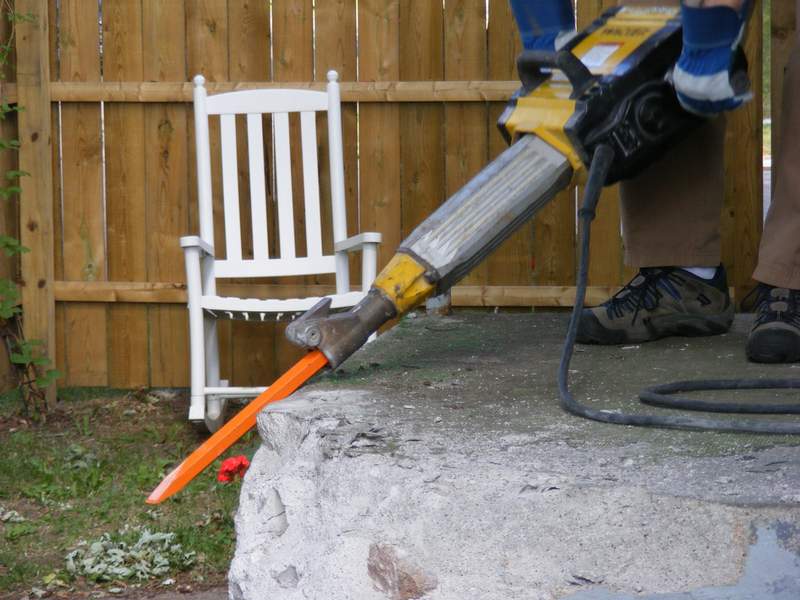
It was Friday the Fourth of July when I started up the jack hammer. Pretty quickly, I realized that this was not going to be as easy as I first thought. The chisel tip was bouncing around on the surface, rather than digging into the concrete. Not a good sign. The concrete was the hardest I ever came across.

Beginning to demolish stoop with Jack Hammer

Beginning to demolish stoop with jack hammer

I since learned, from a local builder, that they used a special method for making this type of concrete. Apparently, builders of old would use a dryer than normal concrete mix, and pound it to remove air pockets. Normal concrete has small pockets of air that make it weak to shearing forces. There was nothing weak about this concrete, and every crack and break had to be worked for.

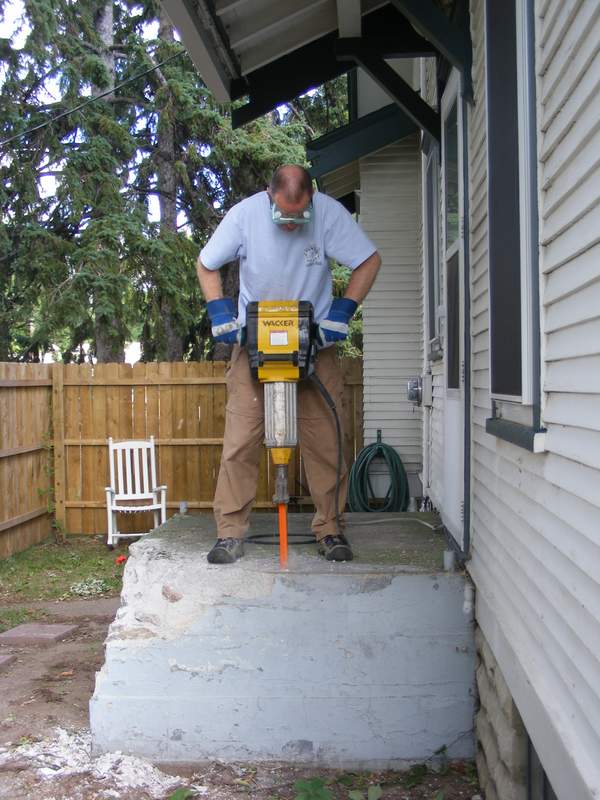
Jack Hammering StoopKevin

Jack Hammering Close to the Edge

I tried jack hammering close to the edge. Yes! Some small pieces broke off. But the rest was not going to break apart very easily. As the concrete began to break up, I found rocks embedded in it. The builders used granite field rocks to take up space. I presume this was to save on concrete. Initially, I thought this was a good thing. I imagined that I could dig between the rocks with the jack hammer, and they would break apart. That didn’t really happen.

Field stones protruding from half demolished stoop

Field stones protruding from half-demolished stoop

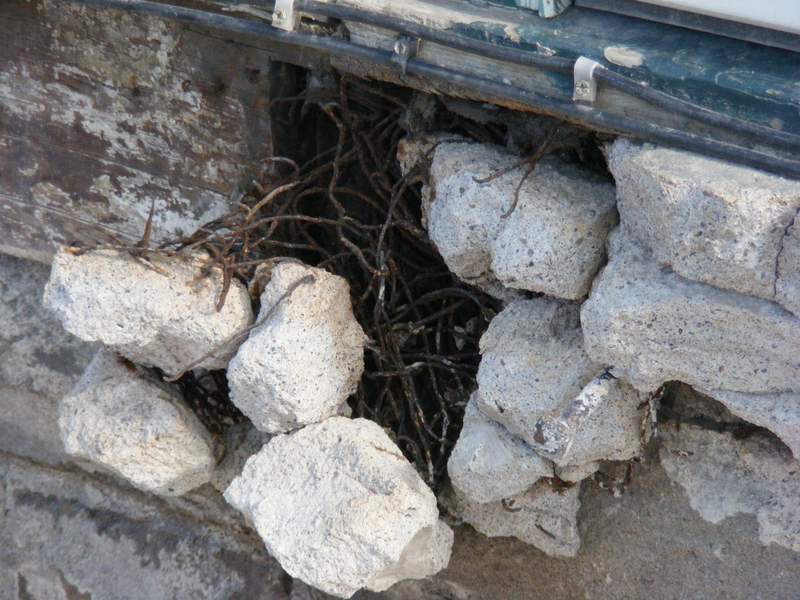
At first I couldn’t see why the stoop wasn’t coming apart the way I thought it should. Then I saw a piece of steel in the concrete and began to realize what I was dealing with. The stoop had been constructed in layers with wire laid in a three-dimensional mesh pattern. This was very effective at binding the whole structure together.

Lumps of concrete held together with wire

Lumps of concrete held together with wire

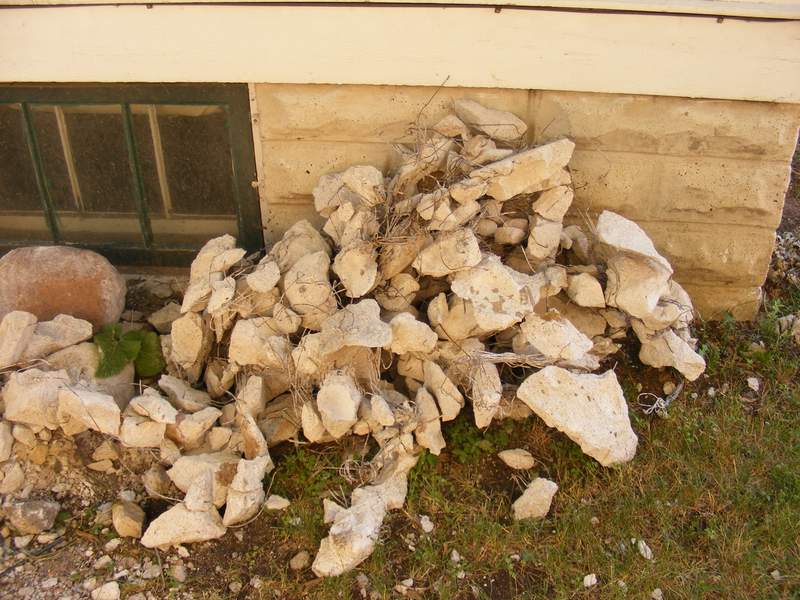
Concrete and wire from the stoop

Concrete and wire from the stoop

We used heavy duty wire cutters on every piece of wire that was uncovered. It was extremely painstaking work and was the main reason that it took us two full weekends to demolish that stoop.

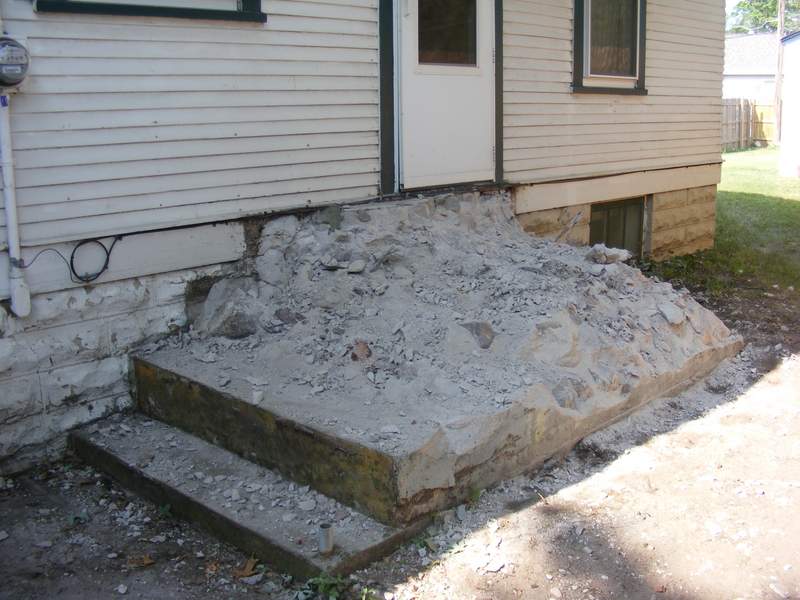
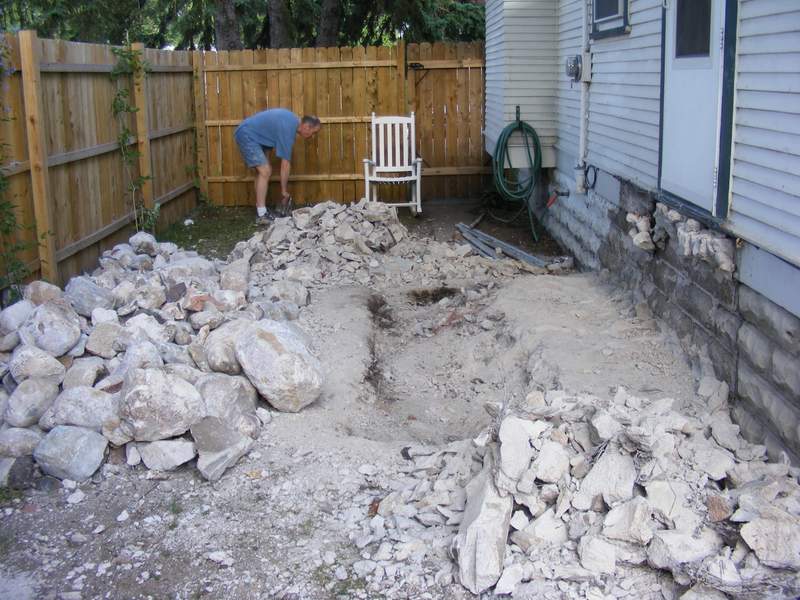
Stoop gone. The rocks and bits of concrete you can see are only a small part of the total

Steps gone (at last). The rocks and bits of concrete in the picture are only a small part of the total stuff we got out of that stoop.

There was one fun part to that job. We found a time capsule had been left in the stoop. The stoop builders had stuffed a newspaper, dated July 1946, into an old paint tin and built the stoop around it. We joked that the front page headline should read Man Builds World’s Most Durable Porch.

So, that stoop had stood for fifty-six years, and would have remained standing for many more. In fact, I imagine that if a cataclysmic event had destroyed everything else around here, those steps would have remained standing, Ozymandias-like, to be discovered by future archaeologists.

Posted in Before & After, Construction, D'oh!, Outdoor Building Projects, Porch | Tagged | Leave a comment

Apartment Therapy January Cure: The Reckoning

Bart: Now they’re talking about holding me back in the fourth grade if I don’t shape up.
Otto: That’s it?  Hey, relax, man!  It could end up being the best thing that ever happened to ya.  I got held back in the fourth grade myself, twice!  Look at me, man!  Now I drive the school bus!

– The Simpsons

The AT Cure grades are in, and mine is FAIL.

"After the first four years the dust doesn't get any worse." - Quentin Crisp

“After the first four years, the dust doesn’t get any worse.” – Quentin Crisp

Well, that’s perhaps a bit harsh.  I did get through most of the tasks, and because I read the book first, I had a head start on some of the items.  It’s probably more of a “needs improvement” mark. Here’s an overall rundown:

Outbox (items to take to Goodwill): I set this up and dropped it off twice so far. This is an ongoing effort at our place, so it wasn’t new or a particular strain. I’m always looking for stuff we can shed. I’d call this one a wash. Nul points.

Frame and Hang Artwork: I picked what I wanted to frame (a hand-painted tile) and got a frame, but it was the wrong sort, and I couldn’t figure out how to mount the tile anyway, so I ran away and just never got back to it during the Cure. I shoved the abandoned pieces in a drawer for now. FAIL. -10 points.

Flowers: Did this once, and thereafter relied on bowls of orange cuties. +10 points!

For the win!

For the win!

Landing Strip: This one went pretty well. I repurposed our linen closet as a coat closet, and that makes a big difference to liveability.  +10 points!

Projects: One of the first Cure tasks was to make a list of projects, choosing one to complete as a capstone to the whole effort. Well, holy getting-off-on-the-wrong-foot, Batman. I chose to clear out a large closet/small room filled with boxes. Each of which appears to be filled with boxes. And so on down to the core of the earth. I’ve made progress (I CAN SEE THE FLOOR!), but it’s still a ways off. I should have aimed lower. -10 points.

Declutter Media and Files: Part of the problem with the closet clear-out is that many of the boxes contain old files, so my project fail is necessarily a file fail. Gah! -10 points.

Get-Together: While I didn’t tell our guests that they were invited over to see our Cured abode (seriously, how would you work that into conversation? Awkward!), we did have some lovely folks over for dinner, pudding, and Farkel. Love me some Farkel! +10,000,000 extracurricular points for fun.

I would recommend trying the Cure, whether via Apartment Therapy online or using the book. While I didn’t get everything done, the Cure’s assignments gave me some structure to make serious progress. Give it a go!

Posted in Before & After, D'oh!, Food & Drink, Organization, Repair & Maintenance | Tagged | Leave a comment

We’re Gonna Need a Bigger Hammer!

A gun isn’t a weapon; it’s a tool. Like a harpoon, or a hammer or a … an alligator.

– Homer Simpson

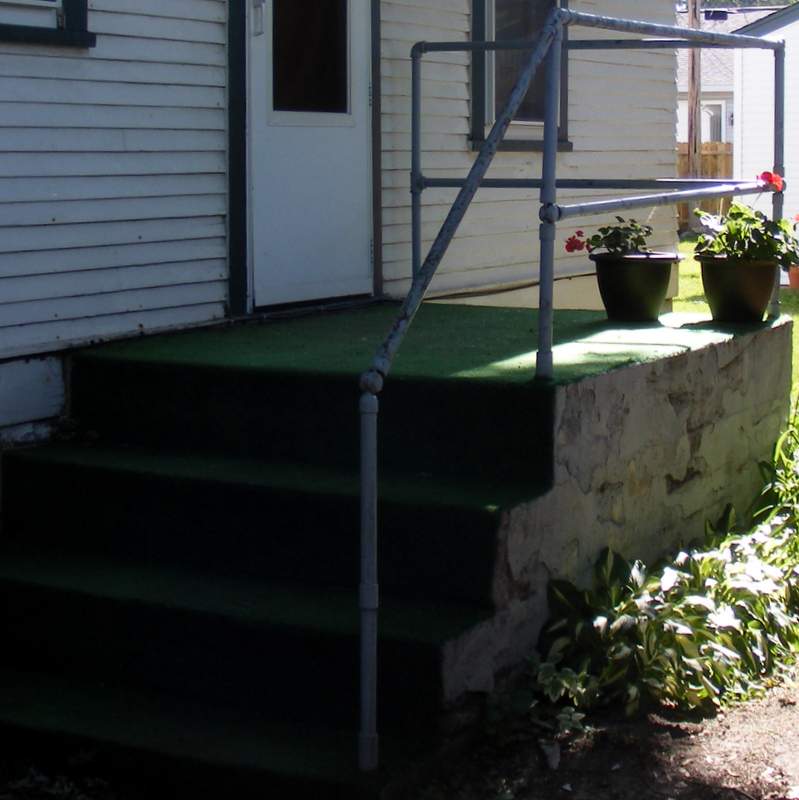
Our house came with a side stoop that was rather utilitarian, but did the job. That was until we built a fence, when its utility decreased and we decided to replace it with wooden steps.

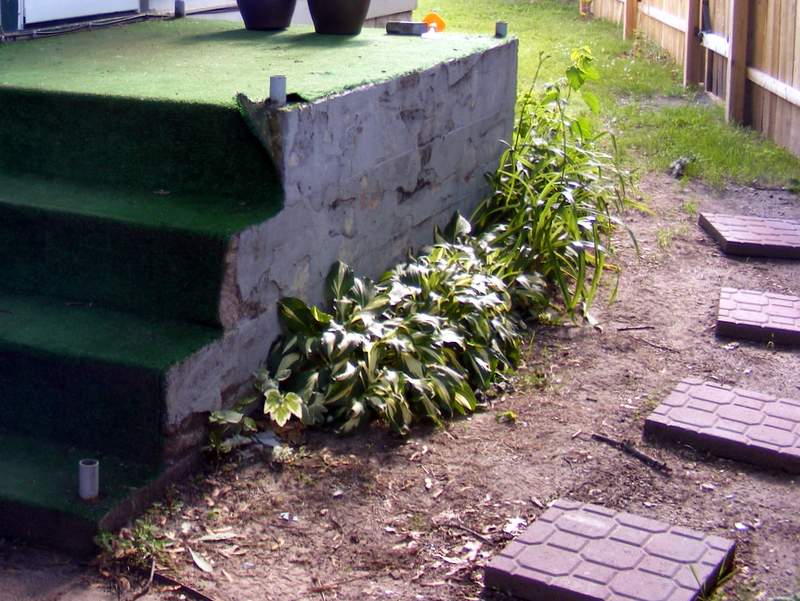
The old steps were facing the wrong direction, especially after the fence was finished.

The old steps were facing the wrong direction, especially after the fence was finished.

Removing the handrail was surprisingly easy. Nuts unscrewed from bolts, and tubes slid out of tubes with minimal effort.

With the handrail out of the way, it was time for the fun to begin. I don’t consider myself a violent person, but I’ve wielded a few sledge hammers in my time, and I do enjoy a nice bit of demolition. So, I was in a good frame of mind when I picked up my seven-pound sledge hammer that warm, bright Saturday afternoon.

Concrete Steps without the handrail

The corner to the left of the hammer and chisel was where I planned to begin the demolition. Yes, I even thought that a small hammer and chisel would be enough to take out these steps.

I would start at one of the corners, a weak point. That would show me how the steps were built, and help me decide the best way to proceed.

I prepared by placing the head of the hammer on the spot I wanted to hit, and getting my feet into position. Once ready, I took a big swing. The hammer came from high over my head onto the steps. The blow was perfect. The hammer head struck those steps with full force. The force of the strike should have created cracks in the concrete, breaking off a chunk.

What actually happened took me by surprise. You know that thing about every action having an equal and opposite reaction. Well, never before was it so well demonstrated. Most of the force transmitted by the hammer to the steps was immediately given back to the hammer, which sailed back over my head, moving backwards along the same arc it followed on its way down. It was as if the film had been reversed. My surprise was such that the hammer almost flew from my grasp. The only energy not sent straight back into the hammer, went into the clear, bell-like tone that came from the concrete.

In that fraction of a second, I knew that further attempts to demolish those steps with a sledge hammer would be futile.

I did continue with the hammer that day, and some small pieces of concrete broke from around the edges. But to get the job done, I knew that we were gonna need a bigger hammer.

Posted in Before & After, Construction, D'oh!, Outdoor Building Projects, Yard & Garden | Tagged , , | Leave a comment

Uncontrolled Demolition

Son, being popular is the most important thing in the whole world.

– Homer Simpson

The steps to our side door were ugly, solid, concrete steps with worn out plastic grass on the the top. They weren’t very pretty, but they were solid enough, and we had no immediate plans to replace them. That changed when we built a fence.

The Old Concrete Steps

The old steps were not very pretty.

When we built the fence, it blocked the path from the steps to the driveway. To get to the garage, you had to perform a ‘U’ turn at the bottom of the steps, and then walk back between the steps and the fence to the gate. A small inconvenience.

But then we had a storm, which made the ground very muddy and very inconvenient. I made a makeshift boardwalk from pieces of our old garage door (one day I’ll have to tell you the story about taking out that garage door).

It turns out that smooth, wide pieces of garage door are not the best path-making material ever. It soon became quite slippery, especially for friends with inappropriate shoes. So, we needed a better solution. We decided to remove the concrete steps and replace them with wooden ones pointed in a more useful direction.

The old steps with stepping stones to the gate.

Eventually I replaced the boardwalk with pavers.

That sounds so easy, it makes me smile. The part that I find most amusing is “…remove the concrete steps…”. It’s such an obvious step, almost not even worth mentioning. All it will take, I thought, is me, a sledge hammer and a spare Saturday afternoon.

Ha!

What it actually took was me, Stacey, wire cutters, chisels, crowbars, two whole weekends, and a JACK HAMMER!

I found out that the price to rent the jack hammer over a weekend is the same as for one normal day. This even applies to long weekends.

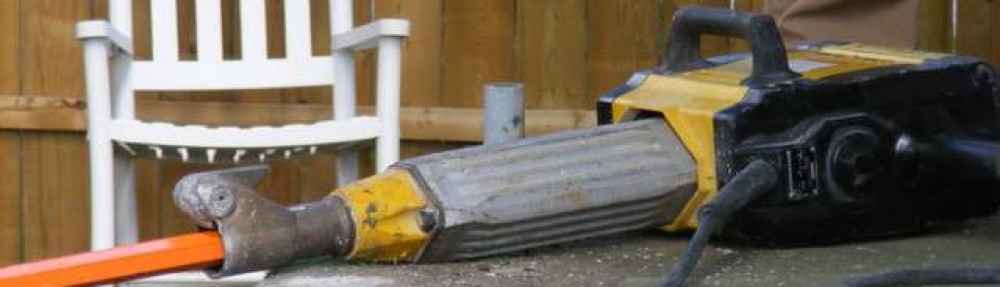
Jack Hammer

The first weekend I wanted to rent the jack hammer was a long weekend, because the Friday was the Fourth of July. Brilliant! I thought. Three days for the price of one! But I hadn’t really thought it through.

I hadn’t thought about the neighbors. Imagine how that must have been. They were probably relaxing on the Friday morning of a long weekend, enjoying the prospect of a well-deserved break from work. Perhaps they were planning to celebrate the independence of the nation by hosting small, quiet, informal gatherings of family and friends. Then, at about ten o’clock that Friday morning, the explosive staccato sound of a jack hammer viciously assaulted their ears. Imagine how popular we became. As welcome as an outhouse breeze.

Since we really had no wish to ruin anyone’s weekend, we tried to only used the infernal machine for a short period in the middle of each day. And, even then, it wasn’t a continuous noise, mainly because of the fiendish construction methods that the step builders had used. But it was a pretty bad noise, and I’d have found it quite annoying, to say the least.

If it’s any consolation to my neighbors, it does go down as the worst, most difficult, and horribly frustrating project I’ve done on this house. My next post will be about demolishing those steps and why it was the worst project ever.

Posted in Before & After, Construction, Outdoor Building Projects, Yard & Garden | Tagged , , , , | Leave a comment

Coat Closet Rod…or Industrial Curtain Hardware?

Do you see towels? If you see towels, you’re probably in the linen closet again.

– Marge Simpson

This is not one of those spectacular before and afters — you know, the ones where you’re not even sure it’s the same space? But it is something that instantly made the house more comfortable.

We had a linen closet.

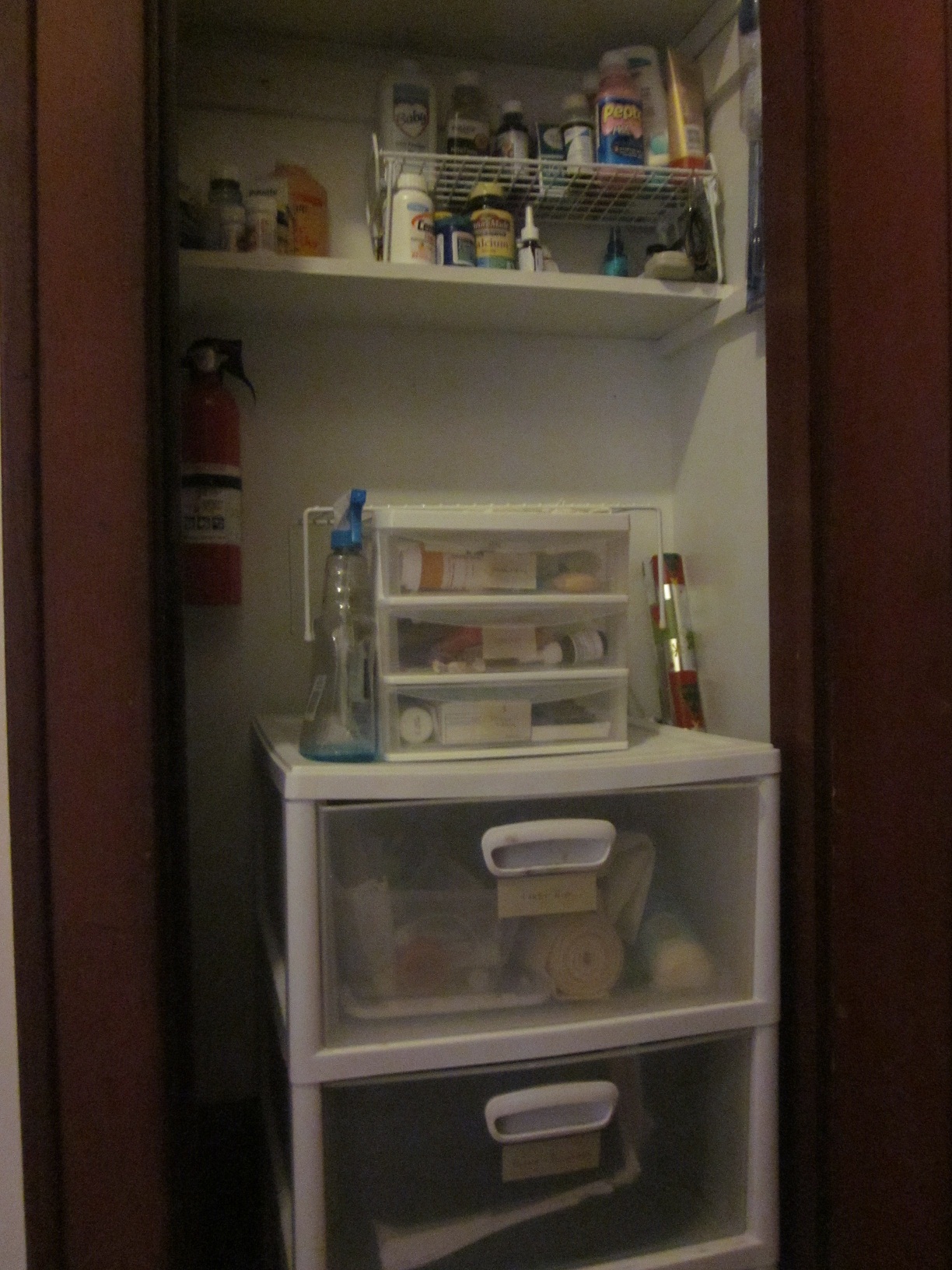
Actually, less a linen closet and more a pharmaceutical enclosure.

Actually, less a linen closet and more a pharmaceutical enclosure

We still have a linen closet, but after a little work, it’s also…

Fewer drugs, more jackets

Fewer drugs, more jackets

A COAT CLOSET. Which we didn’t have. Despite a series of hook- and rack-based attempts near the back door over the last, oh, decade, our coats tended to end up draped over dining chairs. The cluttered and disorganized feeling was irritating, and we often said how great it would be to have a coat closet. We were just stuck on the idea that this perfectly useful closet was only for linens!

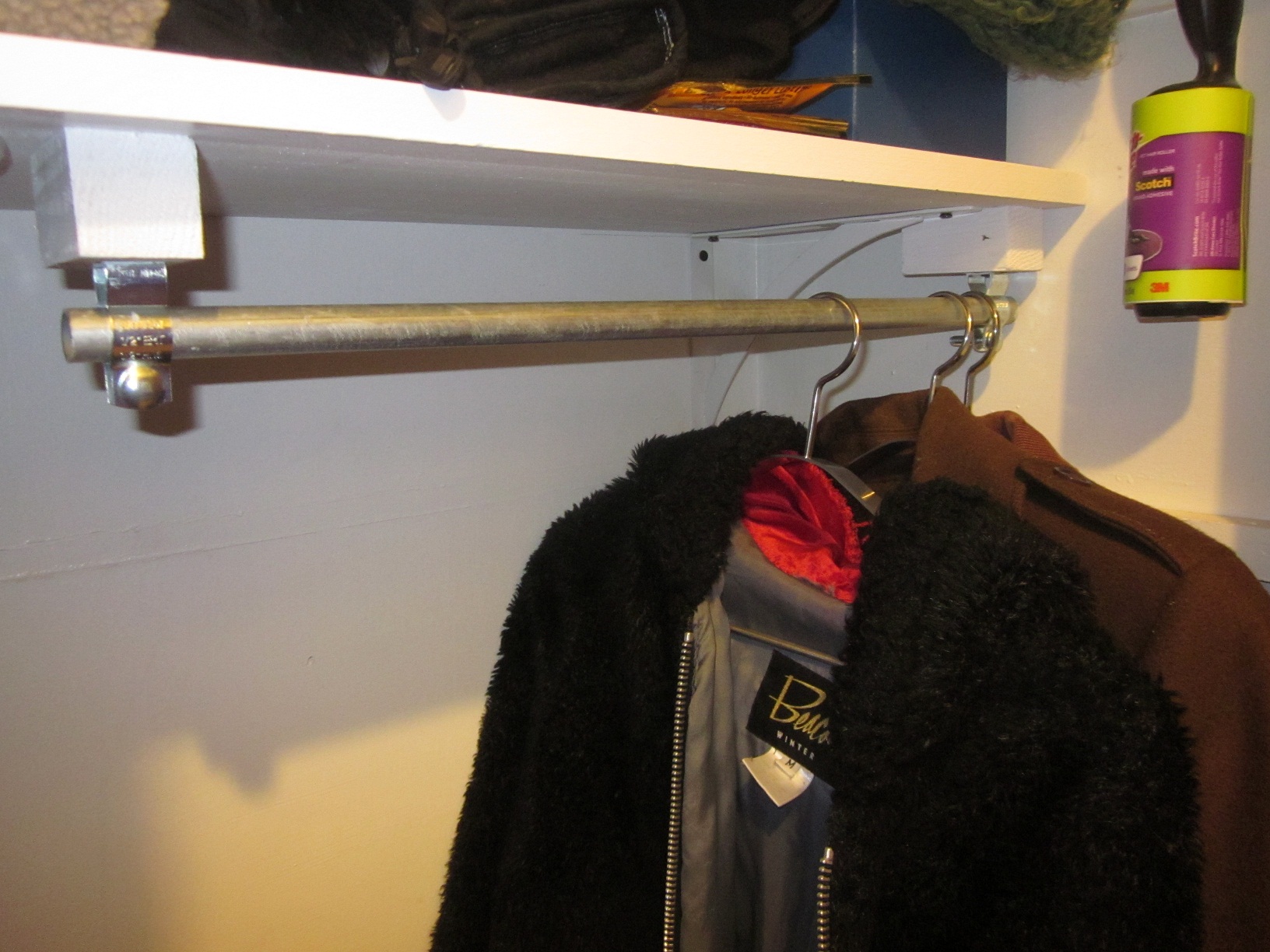
Ok, so that’s all well and good, but what I really wanted to share was my closet rod here. It’s made from leftover electrical conduit from the curtain rod project, but suspended by conduit hangers from the underside of the gloves-and-hats shelf. It’s perfect for our needs, but it occurred to me that it could be the basis for some great industrial style curtain rods. (You can read more about industrial style at Houzz.)

This, but attached to the ceiling and with curtains.

This, but attached to the ceiling and with curtains.

Without painting, and using conduit hangers (about $2 for a package of five), this would be even cheaper than my earlier project, and would be great in the right space.

Conduit hanger: cheap and cool!

Conduit hanger: cheap and cool!

Conduit hangers are in the electrical aisle near the junction boxes. Get the ones that match your conduit diameter. For closet or curtain rods, they are a handy little gadget.

Posted in Before & After, Decor, Organization, Salvage | Tagged , | Leave a comment

The Magic Carpet Ride

Things on the ground are out of my jurisdiction.

– Chief Wiggum

Sweet ruggy goodness!

Ooooooooh, sweet ruggy goodness!

You know those ads that follow you around after you shop for something online? About half the time, I’m stalked by rugs. On shelter blogs, when commenters are swooning over colors or architecture, I’m on the sidelines shouting, “Look at that freakin’ RUG!”

Since rugs often get short shrift in these photos, I enjoy perusing carpet merchant sites for my rug porn fix. (And with that, I look forward to the Google searches that bring folks to this post. Welcome, rug porn lovers!) Lately, though, I’ve been rug surfing with purpose: our living room. Since a recent remodel, the semi-antique Persian we had in there wasn’t working, and we just purchased a smaller and more muted substitute (on which more another time).

The cats promptly claim ownership of every rug we bring into the house.

The Persian now heading to temporary retirement. It is shown here upon its original unrolling, at which point the cats claimed ownership. They were less welcoming (in a “FLOOR IS LAVA!” way) to the new rug.

In case you are also in the market, here are a few of the sites I’ve been skulking around.

  • Overstock.com: Enormous rug inventory and great prices. You can also sort by several useful criteria (style, shape, color, material, etc.).
  • Rugs-direct.com: 150% price guarantee, tons of rugs, lots of specials (and be sure to check promo code sites for further savings).
  • Etsy, Ebay, and Craigslist: Antique and vintage rugs are more available than ever. If you are in the market for an older carpet, do some research on rug types and materials to focus your search. A little knowledge will help you hook up with the rug of your dreams (get it? GET IT??).

A few notes on rug shopping online:

  • Colors may vary dramatically from what you see onscreen. If it’s a new rug, see if you can find alternative pictures on another site, or in someone’s house as posted on a blog. Try looking at it on different monitors or devices. Keep in mind that, even if the rug matches an online photo, it might still look different in your room or with your lighting. If the color isn’t quite right, that’s not usually grounds for free return shipping. Rugs are HEAVY.
  • If you find a new rug from a major maker (Safavieh, for instance) that you love, Overstock or another vendor may well have it at a better price, or offer a better deal on shipping. It’s worth shopping around — I paid under $350 online for a rug I saw elsewhere for $1,200.
  • Measure! It’s important to know how much room you need to cover and whether the rug will do it. It’s no good falling in love with an antique rug that is dwarfed by your furniture (or vice versa).
  • Keep in mind that vintage rugs are often not perfectly square (or round or whatever). And even for new rugs, measurements are often approximate within a few inches (it’s like 2x4s: check for “size” and “actual size” in the listing).
  • Older rugs will typically have wear or even repair work. I love that, but you might not. Read any descriptions of wear carefully and consider whether you want a rug with visible history before committing.

Rugs add warmth, texture, and beauty to the home, and shopping for them is a visual feast. Enjoy the process, and remember that there’s no need to hurry — there are so many rugs that you will eventually find the one that is magical for you.

Update: Check out how to make a rug pad on the cheap.

Posted in Decor, Walls & Floors | Tagged , , , | Leave a comment

Introducing Our Golden Ratio Calculator

A paper-based thing-a-ma-jig? What are we, cavemen?!

– Homer Simpson

Check out our new Golden Ratio Calculator, where we’ve done the work for you.

People often find beauty in objects with certain proportions. This proportion is often seen in the natural world, and for thousands of years, artists and architects have based their work on the “Golden Ratio.”

The Golden Ratio is the proportion of 1 to approximately 1.618, which is represented by the Greek symbol Φ (Phi). Like Pi, Phi is a number that goes on forever, so 1.618 is the short version. Phi can also expanded through the Fibonacci sequence, or simplified to the Rule of Thirds.

We’re primarily a left-brain couple, so we like the idea of using a mathematical principle in our projects. We used Phi to design projects including a trellised pergola and a built-in unit in our sitting room.

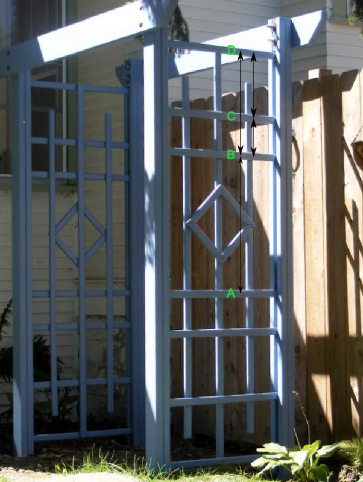
Using the Golden Ratio to Design a Pergola

Pergola with bars situated according to the golden ratio

The ratio B D to A B is 1 to 1.618.
Also, the ratio B C to C D is 1 to 1.618.
These ratios are then reflected in the lower part of the pergola.

This is a small arbor we built as a gate arch. This photo was taken before we put the bars on the top. But it does show how we positioned the horizontal bars according to the Golden Ratio.

Using the Golden Ratio to Design a Built-In

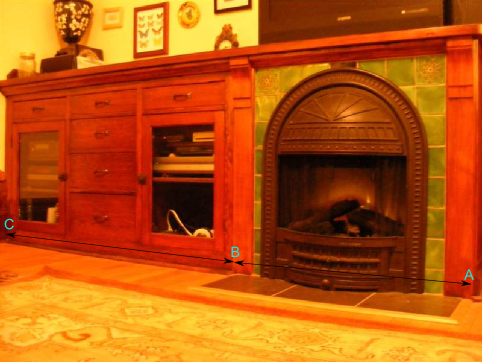
We recently built a unit incorporating cabinetry and a fireplace. We spent quite a while drawing diagrams before we began construction, and incorporated Phi into the final version.

Built-in unit that uses the golden ratio in its design

The ratio A B to B C is 1 to 1.618.

The Golden Ratio can also be seen in design elements in the pieces we used. The heights of the drawer fronts on the repurposed cabinetry follow the ratio, as does the design of the fire surround. We can’t claim any credit for those, but it does demonstrate Phi’s prevalence.

If you look for it, you will see the Golden Ratio everywhere. You can see it on cereal packets, in logos, in commercials, and, of course, on web pages. I think it’s always a good idea to incorporate the Golden Ratio at the design phase, whether you’re making greeting cards or building a house.

Suckers that we are, we’ve historically worked out our designs on paper. With a pencil (and, more importantly, an eraser). But you don’t have to because I’ve built a Phi calculator for you. It will give you complimentary proportions for a figure, or split up a horizontal or vertical measurement in a Phi-friendly fashion. Please let us know how you end up using it in your projects.

Posted in Calculators, Construction, Decor, Furniture, Outdoor Building Projects, Repair & Maintenance | Leave a comment

These are a Few of My Favorite D’ohs

Like Mozart and Johnny Knoxville, my genius cannot be stopped.

– Homer Simpson

Recent projects have been a breeze. I’m working ahead on the Apartment Therapy Cure. I kitted out a coat closet using on-hand materials. I replaced the kitchen faucet. It was all effortless, as if the DIY were just flowing out of me. I started to feel that these projects would be my enduring legacy to future owners of our home.

You see where this is headed, right? Last night, I decided to replace an under-cabinet light fixture. Even before I ascended to a higher home improvement plane, I could do these in ten minutes. This time? It’s still not done.

I overtightened the mounting screws. When I loosened them, I found cracked veneer because I didn’t drill pilot holes. I drilled holes in different locations; the screw heads prevented assembly. I came up with a kludge that trapped the ballast cover under screw heads. It popped out. I decided to see if the wiring was even intact, so I turned on the circuit and flipped the fixture-mounted switch. Repeatedly. Nothing. So I disassembled the whole thing. Then I remembered the wall switch for the undercabinet lights.

It was off.

KHAAAAAAAAAAN!

KHAAAAAAAAAAN!

Consider me suitably humbled. Fortunately, the internet offers sweet, sweet balm for all hurts. Here are a few of my favorite DIY “D’OH!” moments experienced by others. Some offer lessons on enjoying the process. Some are just very funny.

  • Even the best and brightest occasionally stumble along the way. Young House Love posted a great mirror makeover. Ultimately, they had a good outcome, but I love how they showed the things that went wrong with good humor and grace.
  • At the other end of the spectrum, I love a This Old House feature from the American Society of Home Inspectors: Home Inspection Nightmares. The most recent edition includes duct tape siding and some very special decks. This column will help you realize how good you’ve got it, even if you screwed part of “it” up.
  • There, I Fixed It is another way to make yourself feel better. No matter what you just did, someone there did it worse.
Sometimes, curling into the fetal position is the best option.

Sometimes, curling into the fetal position is the best option.

  • The comments to this DIY Mistakes post on Apartment Therapy are great. Although largely paint-related, the sheer volume of stories is reassuring.
  • But my hands-down favorite is from Thrifty Decor Chick: When DIY Goes Oh So Wrong. Best use of a repeated photo in a blog post EVER. And I needed it, because the big reveal of the problem had me yelling a disbelieving “NO!” at the screen. You’ll laugh, you’ll cry, just click!

Really, when you screw something up, it means you learned something. As my wise mother says, “No experience is wasted.” So proceed fearlessly — just don’t get any delusions of grandeur when things DON’T go wrong.

Posted in D'oh!, Electrical, Kitchen, Repair & Maintenance | Tagged , | 2 Comments

Double Curtain Rods at a Fifth the Price

My brain goo’s coming out all artistical, thanks to you.

– Moe Szyslak (to Lisa)

When I was looking to upgrade the window treatments in our living and dining rooms, I naturally turned to the internet for inspiration. I was lucky to find the perfect tutorial, How to Make a Cheap, Awesome Professional Curtain Rod at House of Hepworths. It really delivers on the title, showing how to make great-looking curtain rods from super-affordable electrical conduit.

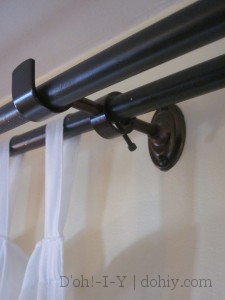
There’s no improvement to be made on the Hepworths tutorial, but I did change up a few things based on my specific dealio. First, I wanted double rods, so I started with these allen + roth brackets that would work with the conduit.

I used Rustoleum "Dark Walnut" spraypaint to work with the brackets.

I used Rustoleum “Dark Walnut” spray paint to work with the brackets.

The conduit is the same diameter for both rods, but the rod for the sheers is slightly shorter.

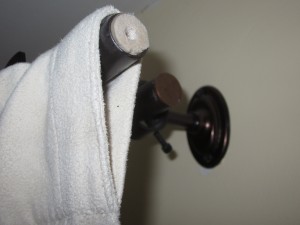
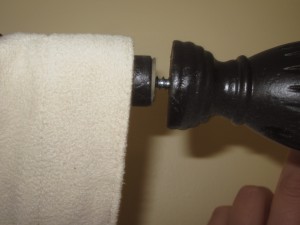
The HoH rod was finished off with an Ikea finial with a fitting that clamped it to the rod. I went to Ikea, but the shopping gods were not with me — none of the finials in stock spoke to me. (Speaking of speaking, there are minutes of fun to be had interacting with Anna, Ikea’s “automated online assistant” — Siri she ain’t.) Instead, I picked up some screw-in finials at Menard’s and painted them to match the rods.

But the conduit is hollow. What could I possibly screw them into? As is weirdly common Chez D’oh, the answer involved wine.

In vino, resourcefulness.

In vino, resourcefulness.

I whittled down some of those rubbery pseudo-corks and pounded them into the ends of the conduit. I want you to know: I did try actual corks from actual wine, but real corks did not hold as well as the fake ones. These ideal curtain-finial-holding corks are found on many a bottle of ridiculously sweet riesling featured at Trader Joe’s.

The Amazing Screw-In Finial

The Amazing Screw-In Finial

Keep the finial straight as you screw it in. The end of the conduit/rod will nestle into a recess on the base of the finial, making the whole thing look like a single, custom rod.

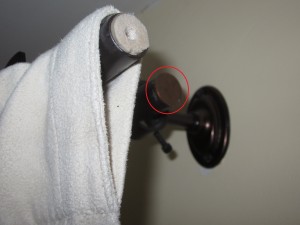
On most double rod sets, the second rod is shorter and does not have a finial. I painted into the ends of the second rods so they were not obviously unfinished, but I still wanted them to be closed. On a lark, I checked to see if a penny would be the right size.

It was!

It was!

We’ve had the rods in service for a few months now, and I’m really pleased with them. Since our living and dining rooms are separated only by a big open arch, I needed consistent hardware, and without the HoH insight about conduit, we would have been looking at quite a bit of money.

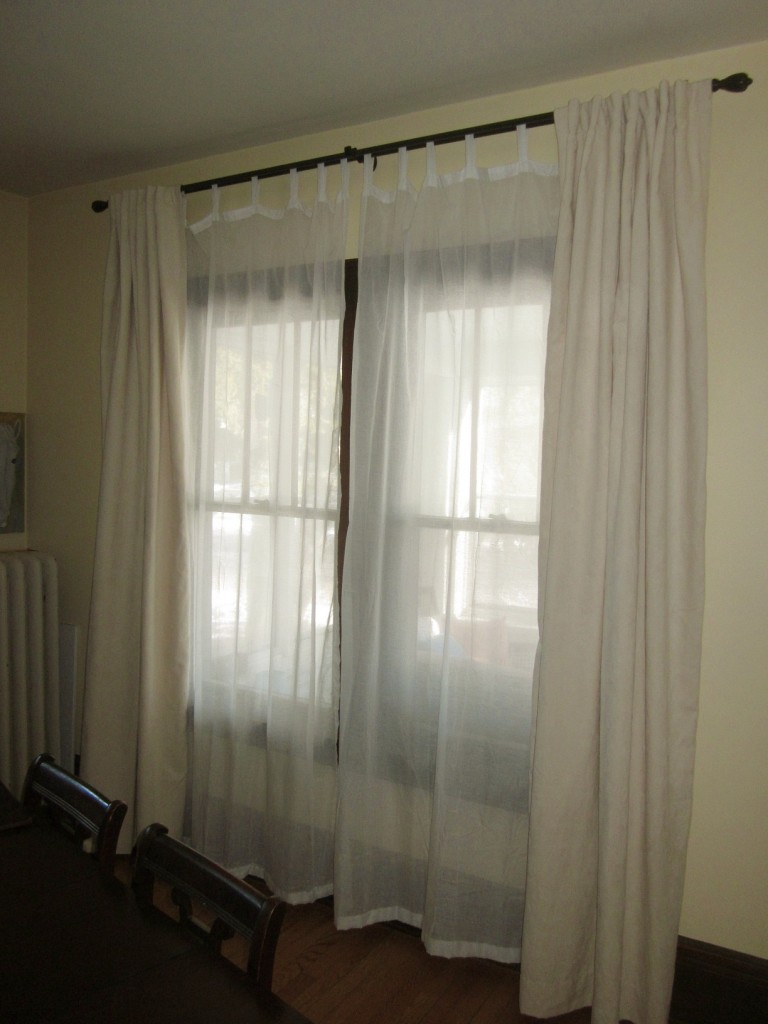
The dining room windows. I clearly need to get out my steamer!

The dining room windows. Hmm, maybe more colorful drapes in future?

This solution? About $10 in conduit, $5 of spray paint, $10 for finials, $30 on brackets, $20 in cheap wine, and $0.04 to cover decorative pennies. And we would have bought the wine anyway!

Update: Looking for a way to make cheap wooden curtain rods? We’ve got you covered.

Related Posts Plugin for WordPress, Blogger...
Posted in Decor, Windows & Doors | Tagged | Leave a comment