Cheap Curtain Rods, Part Deux

Just bring us your freshest bottle of wine, chop-chop.

– Bart Simpson

Mr KrabsOne of our most popular posts is the how-to for making curtain rods out of electrical conduit. We also needed curtain rods for our bedroom project, but I wanted to use wooden rods in there. I mean, why repeat an easy and affordable DIY when you can head off in some uncharted direction?

Not surprisingly, I wanted to part with as little money as possible pursuing this little experiment. This version was even cheaper than the electrical conduit model, which was still pretty dang affordable. Here’s how I got what I wanted for less than $20 per rod.

Birch dowel from Home Depot

Birch dowel, Home Depot

The fancy-pants, ready-to-go wood curtain rods with coordinated finials are 1.75-inch in diameter. These were thicker than I was looking for, but I did want a wood curtain rod that would match the finish we put on the bed. In search of inspiration, I went poking around the big box places. Closet rods were also too thick, so I picked up one-inch diameter birch dowel rods in six-foot lengths. (Actually, I started with four-foot lengths and had to return ’em because that’s sooo much more efficient than measuring first. Go, me!) I cut the dowels to length, stained them to match the bed and did a double-coat of polyurethane.

The rods are different lengths, so I marked them on the ends.

The rods are different lengths, so I marked them on the ends.

The birch dowels are fine for my purposes — I’m covering fairly narrow windows, not much over a meter wide — but the oak dowels would be stronger if you had a wider span. They’re a little more expensive, but still pretty dang cheap — the birch ones were $3.59/dowel, and the oak was a couple of bucks more.

Since the usual wood rod is 1.75″ and the usual metal one is 0.75″, I had a little trouble finding hanging hardware. I ultimately ended up ordering Urbanest brackets ($4.99 each) that would fit up to a 1.25″ rod.

That left the finials. I wanted some, but I couldn’t find the modestly sized ones I used for the conduit rods. Dangit, Menards, changing your inventory to meet the needs of customers other than me! That left the finials for the thicker rods, which were (a) spendy and (b) disproportionate, by which I mean HUGEMUNGUS.

So I went poking around again, this time at Michael’s. I found some appropriately sized balls. They were flattened on one side and disturbingly labelled “doll heads.”
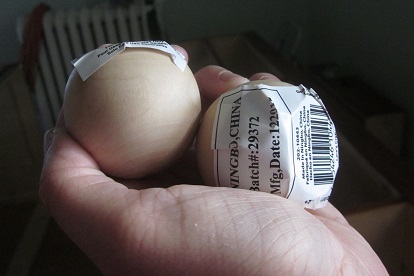
Heads to put on spikes

Heads to put on spikes

But I also wanted a transition from this shape to the rod. The answer was hanging above the doll-head bin.
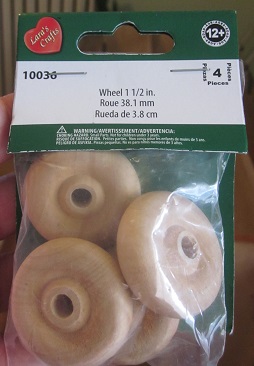
Wooden toy wheels

Wooden toy wheels

Stack ’em and glue ’em, and voila!

rod finial

I stained these up to match the rods that matched the bed (in the hole in the bottom of the sea). Both parts already had holes drilled, so I added dowel screws to the rods so that the finials could just be screwed on by hand.
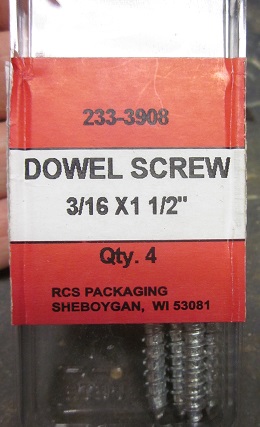
Dowel screws are just double-ended screws (something that sounds naughty but isn't) used to attach dowels to each other, or random things to dowels.

Dowel screws are just double-ended screws (something that sounds naughty but isn’t) used to attach dowels to each other, or random things to dowels.

It helps to drill a pilot hole to keep them as centered as possible.

It helps to drill a pilot hole to keep them as centered as possible.

Our bedroom windows are both in corners, so I did a little variation on the usual two-bracket installation. When we tore out the fittings in the closet, I salvaged some paint-caked closet-rod hardware. After removing the paint, I had cool brass end hangers. I decided to use these to hold the curtain rods in the corners rather than using brackets.
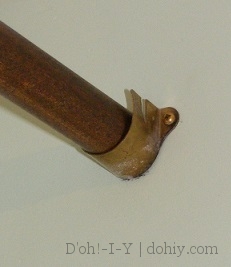
The "wing" piece away from the wall can be bent around the rod and pinned to it for extra stability.

The “wing” piece away from the wall can be bent around the rod and pinned to it for extra stability.

I don’t have the curtains done (or started) yet, but here’s one of the finished rods in place.
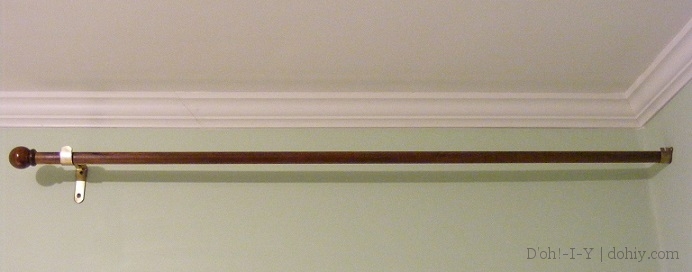
rod done

And after installing this one, I pinned a ratty old blanket to it as our interim “window treatment.” Class! We have it!

Assuming most people want finials and brackets on both ends, here’s how these would break down price-wise:

  • Six-foot birch dowel: $3.59
  • Stain: if you don’t have any on hand, this could be done with the little ketchup-sized sample sachets, so let’s say $1 tops.
  • Glue: I’m not pricing the glue! Strictly speaking, you don’t need it anyway — you can just thread the finial pieces on the dowel screw individually.
  • Doll heads: 2 @ $1.29 each
  • Wheels: 4 in a package for $1.99, so $0.50 each
  • Dowel screws: 4 in a package for $0.99, so $0.25 each
  • Brackets: $4.99 each (I got mine from Amazon; there may be cheaper options out there)

Total: $18.65 per rod, including hardware (and excluding two dabs of glue). Even with sales tax and shipping on the brackets, if any, these would be under $25/six-foot rod. I don’t think you can get anywhere near that with ready-made.

Super easy, super cheap, just how I like it! Let me know if you try this and how yours come out.
Posted in Decor, Salvage, Windows & Doors | Tagged , , , | 2 Comments

Before and After: Princess Vanity Grows Up

Where do I keep my princessness?

– Princess Penelope

Back when I was facing that hard avenue of academic rigor commonly known as Fifth Grade, my parents gave me a desk. It matched my white-and-gold French provincial bedroom set, and I placed this new addition at a sophisticated angle beneath a window. Between the desk and a floral pen stand, I felt like the classiest lady scholar the world had ever known! (Thanks again, Mom and Dad!)

vanity before

The desk was, in truth, a vanity table, with a hinged top concealing a mirror. I used it primarily as a desk for many years, and subjected it to some hard use. As my studies progressed, I needed larger workspaces, so my original desk/vanity was consigned to our loft for many years. When we started the bedroom renovation, I took a closer look at it and decided to include it in the plan.

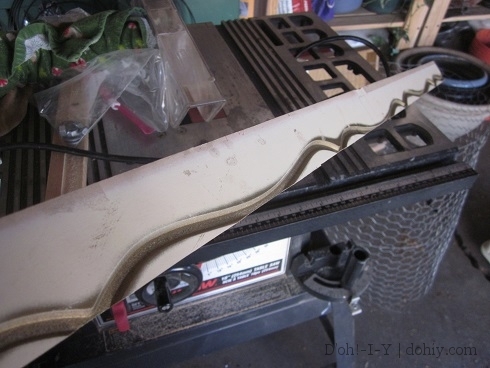
At this great remove from fifth grade, I felt the scalloped front was a little too ornate, so the first order of business was to deal with that issue. Because the piece in place was the perfect size (obviously), I used the Sawzall to cut through the joints so I could remove it. Then I cut the scalloped side off square on the table saw.

vanity trimmed front

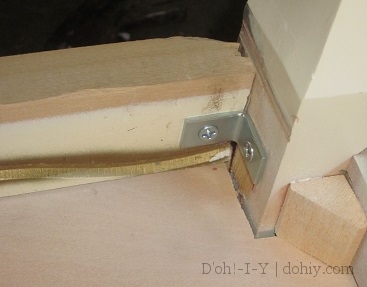
The back side was just flat wood, so I reinstalled it backwards using metal braces. I also reinforced some other loose joints.

vanity L bracket

Retrospectively, I maybe could have left the apron in place, used the jigsaw to cut the front down, and applied wood filler to eliminate the routed pattern, but I don’t think I could have gotten the edge so straight that way. (I previously filled a routed pattern on a similar dresser, so that part would have worked, though.)

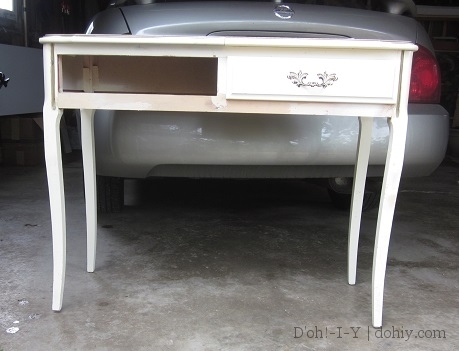
Here it is with the new front:

vanity pre filler

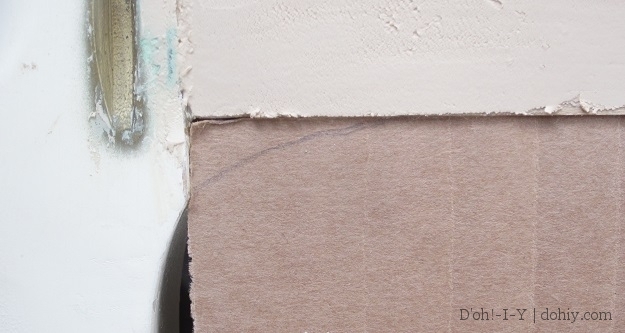
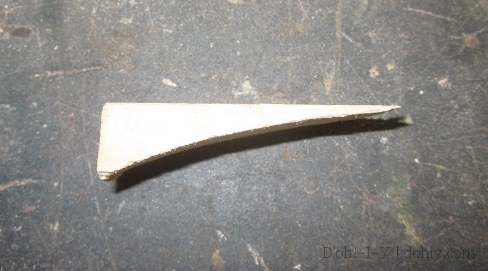
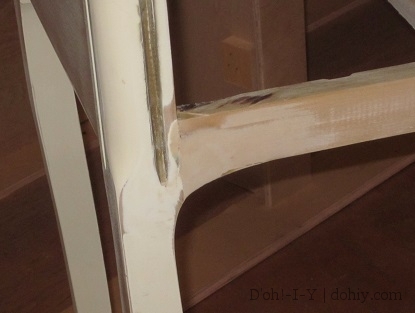
I liked this look better, but I wanted to carry the curve of the legs through to the front, instead of having the hard angle before the new front. I used cardboard to draw a template.

vanity template

Then I used the jigsaw to cut out a piece to patch in.

Cut with the grain as much as possible.

Cut with the grain as much as possible.

After touching this up with wood filler and sanding, the curve revealed itself.

vanity sanded

I fussed over this detail quite a bit (to the point that I was pretty annoyed with myself for fussing over it so much!), but I was really pleased with the eventual result.

60f6d4629a1c6193114a4b4ee8dab5b6I cleaned, sanded and primed the whole thing, then it was paint time. I almost lost my mind looking at deep blue paint chips. I had a colour in my head that did not exist in paint! I did a ridiculous mental detour through the idea of making the thing Tardis blue. Because the Tardis is an attractive color! And I’m a bit of a geek! But I couldn’t find a good, locally available commercial equivalent for Tardis blue, and I am not enough of a geek to take in a model Tardis for color-matching purposes.

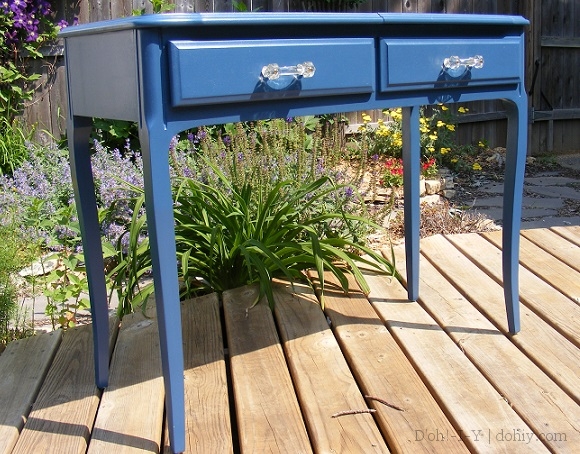
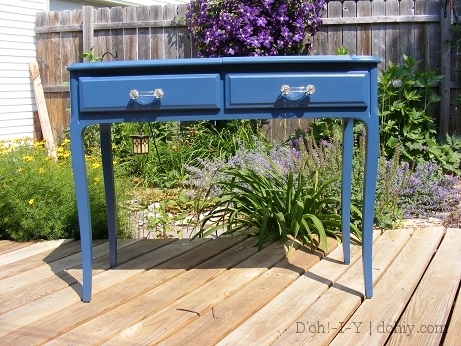
Paint choice was also complicated by the fact that I didn’t have curtain fabric selected by that point. I had to step back and do things in a reasonable order. Once I had my exuberant drapery fabric purchased, picking a paint color was much easier — I just picked up a blue detail from the fabric. The winner was Benjamin Moore’s Champion Cobalt, BM 2061-20.

2061-20

This swatch doesn’t do it justice, but there are lots of gorgeous pictures of Champion Cobalt out there.

I sealed with a satin-finish poly and replaced the handles with vintage glass pulls from Art and Architecture in Minneapolis. If I were craftier, I might have added patterns or texture, but I wanted to keep it simple and let the color be Miss Thang here.

The before again:

vanity before

And the after:

vanity first after

vanity angle

vanity after

I really love how it came out (and that’s good, because it took more work than I was anticipating), and I’m looking forward to seeing it in the finished room. I’m putting it in front of one of the windows, just like when I was eleven! Some things don’t change.

Posted in Before & After, Decor, Furniture | Tagged , , , | 5 Comments

Mission Impossible: Mattress Shopping

Dear Lord, may your loving hand guide Homer to the mattress, square and true.

– Ned Flanders

We like to research stuff before buying said stuff. When we reach the point that the research is folding back in on itself, we’re well and truly ready (and probably a bit over-prepared). But I’m convinced that this point can never be reached when shopping for mattresses. The best article I found on this effect starts:

Here’s a fun game I play. First, I walk into a mattress store and ask what’s on sale. Then, I throw my hands in the air and shout along with the salesman, “EVERYTHING’S ON SALE!!!!” Oh how we laugh, the salesman and I. And while he’s still chuckling, I turn around and walk out, because I fricking hate mattress salesmen.

The article (and a range of websites and message boards) detail how mattress makers and sales staff make it difficult to comparison-shop for the most-used piece of furniture in your home. There are just so many variables — coil count, metal gauge, foam density — and they are couched in such opaque language, it’s enough to make one’s pretty little head spin! Which I suppose is the idea.

(If you are mattress shopping and finding it frustrating, spend some time at The Mattress Underground, starting with their Mattresses 101 thread. It’s still a mystifying industry, but the site is very helpful.)

After much reading and some initial shopping, we determined that we would focus on factory-direct outlets — better pricing, better quality, less slickness. Today, we hit the Original Mattress Factory and Minnesota-based Restwell Mattress Factory.

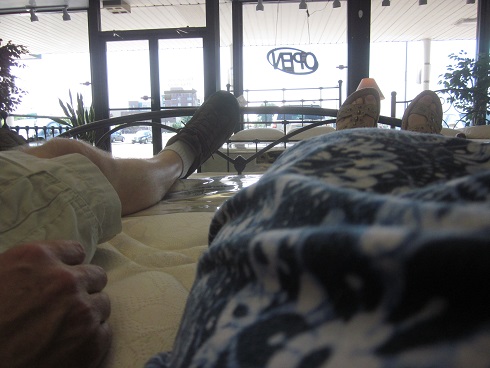
Mattress shopping is weird. It’s hard to have a dignified transactional conversation whilst lying down. That doesn’t deter the mattress guy from starting one, though.

bedshopfeet

“And could you please tell me about the warranty?”

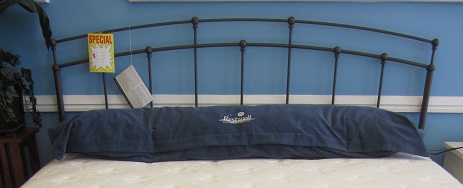
The mattress factory places do seem to have better-informed salespeople who were lower-pressure than those at the retail showrooms. But they do have some similarities with other mattress places. For instance, some retail consultant once told a mattress shop that it should paint its walls blue and everyone followed suit.

bedshopblue1 bedshopblue2

Blue: it’s SOOTHING. Also (apparently) considered soothing? No ambient music. I didn’t realize how much I’ve come to expect background music in retail until shopping for a mattress, where silence is golden. Or maybe it’s blue. Either way, you are trying to make an expensive, multi-year decision lying on your back (write your own punchline). In a quiet blue haze. While being closely observed by a guy in chinos.

Which we did! We bought a tight-top (read: no attached pillow-top) inner-spring mattress at Original Mattress Factory, to be delivered on Wednesday. The deciding factors for the OMF mattress versus the rest of the marketplace:

  • Good coil count and substantial steel gauge for long-term resilience.
  • Spring structure extends to the edge of the mattress so the whole thing is sleepable/sittable.
  • Better quality components, like higher density foam and cotton batting.
  • Option to buy only the mattress (since we’ll be putting it on top of our now-complete storage bed and won’t need a box spring).
  • Flippable (double-sided) mattress for longer life (assuming we remember to flip it) — these are surprisingly hard to find on the market, even though they used to be the standard item.
  • Great price.
  • Good warranty.
  • Most importantly: it felt good!

The deciding factor between OMF and Restwell? Price. Restwell had a mattress that we liked about as much as the one we purchased at OMF, and they have a longer warranty. But even with their online coupon, the Restwell mattress we liked was almost $200 more expensive, including delivery. On something this important, I wouldn’t go cheap, but as between two very similar products that I like equally, I’m going to save a little money if I can.

I don’t know if I can believe it, but this purchase means that, by the Fourth, the Kev and I should be actually be living in our own bedroom again!

Posted in Furniture | Tagged , | Leave a comment

Making the Bed

Can’t sleep, clown’ll eat me…can’t sleep, clown’ll eat me…

– Bart Simpson (in a clown bed)

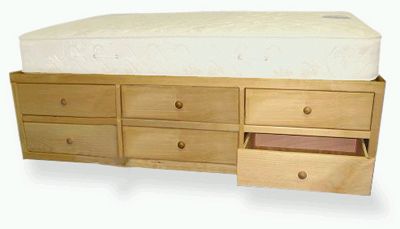
Things are starting to get done in the bedroom. Back at the dawn of time in March, we researched and then ordered a storage bed. It was an unfinished piece that we ordered from a company out east.

12-Drawer Queen Storage Bed by Delroc Furniture

12-Drawer Queen Storage Bed by Delroc Furniture

Since its arrival in early April, I’ve finished the wood and added cup pulls. It was looking pretty done by that point, but we needed to wait until we could get it into the bedroom to do the last few things.

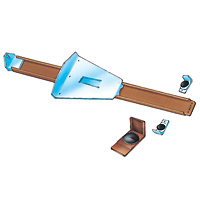
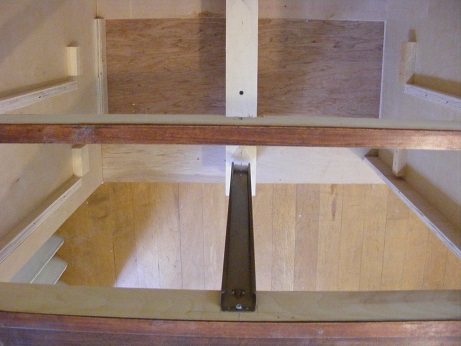
delta glideOne of these things was to make the drawers more functional. It was my original intention to add metal drawer glides to the piece. There was an option to have the bed delivered with or without them; the price increase for glides wasn’t bad, but it sent the shipping through the roof (must put it over some weight limit). But we still wanted to avoid wood-on-wood induced sawdust and to have the drawers move smoothly, so we decided to order without glides and retrofit. I picked up some single-rail, undermount glides from Rockler.

Before getting freaky with glide installation, we mocked up one drawer to see how it would work. The Kev built a center support for the rail to attach to and we tacked it all together.

glide in place

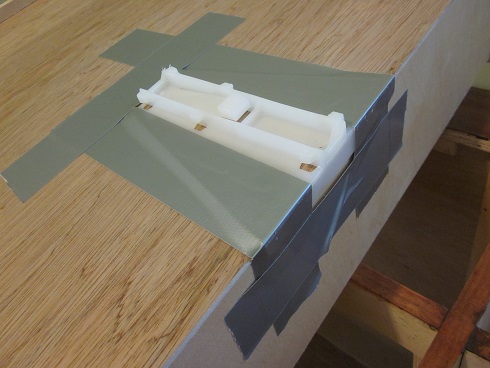
I attached the glide itself to the underside of the drawer. With duct tape, natch.

glide on drawer

We inserted a drawer and it worked! But it made the inset drawer fronts sit a little high in their openings. It was within tolerances, but it didn’t look great. It is nice that the glide locks the drawer in so you can’t yank it all the way out, but these days we’re not rock-n-roll enough to be strewing furniture parts hither and yon. The glides are good for retrofitting — I do recommend them for that — but they just weren’t going to work for us.

Feels slimy, but isn't.

Feels slimy, but isn’t.

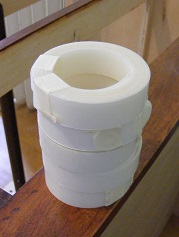
The alternative was drawer tape. Drawer tape attaches to the rails a drawer sits on and reduces friction (and dust creation). Initially, we could only find thick (10 mil, which is 3/8″) nylon tape. That was thick enough to put the inset drawer out of good alignment, just as the metal glide had. But then we found Slick Strips (ewww, I know), which are only 1/32″ thick — less than one mil! According to Woodcraft, “This special UHMW (Ultra High Molecular Weight) adhesive-backed flexible plastic film has a low coefficient of friction and a high abrasion resistance that surpasses even Teflon.” Even Teflon! It takes one’s breath away.

The Kev cleaned the drawer rails and swiped rubbing alcohol on them to remove any oils. After cutting the strips to length, it was just a matter of pulling off the backing and sticking them down. I don’t know WHAT this adhesive is, but it sticks like grim death, which is great in the long run but a little tricky in the installation. We persevered.

small drawer

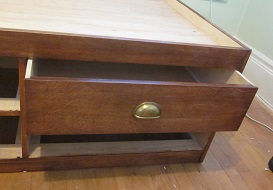
Moment of truth — the drawer slides wonderfully, and the skinny tape doesn’t mess up alignment. It’s a winner!

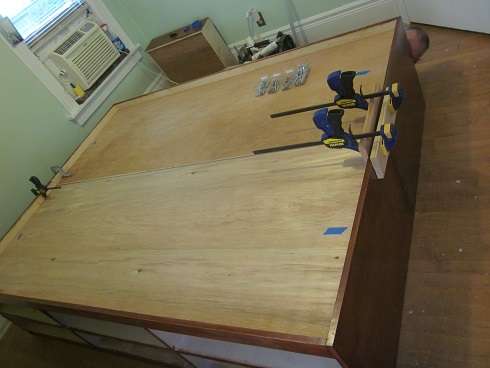
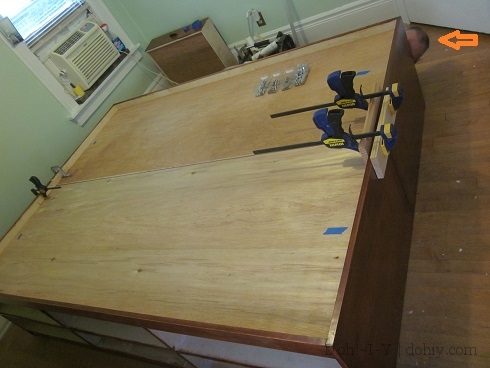
So that was one thing. The other thing was that this bed is basically two separate dressers, and we wanted to bolt them together for long-term stability. First step was to align the two halves and then clamp them together so we could drill bolt holes that would line up correctly.

clamped bed

This is where we began to think the bed was gonna win on the home stretch. In the picture, you’ll notice the openings for the drawers are not super tall and the sides of the bed are comparatively deep. But did you notice what these dimensions meant for the Kev when trying to drill through the structure from one side to the other?

clamped bed with kev

Quite a bit of stretching, cramping and generalized moaning ensued from both of us, since a bolt inserted on one side must be immobilized from the other. The face-smooshing exceeded even cinematic levels.

We managed to add six bolts — three along the upper structural rail and three along the bottom. I need a massage to put all my various shoulder muscles back into place, but you can stick a fork in this bed because it is DONE. (Update: Here’s our review of the bed after using it for a few months.)

Posted in Construction, Decor, Furniture | Tagged , , , , | 4 Comments

A Page is Born

Moe: You know what really aggravazes me? It’s them immigrants. They want all the benefits of living in Springfield, but they ain’t even bother to learn themselves the language.
Homer: Hey, those are exactly my sentimonies!

– The Simpsons

Check out our new American English Versus British English page.

Some time ago, we published a post about the differences between American English and British English. There are, of course, many such lists. The unique feature of our list is that it mainly covers the words each language uses to refer to things around the house.

Since writing that post, we found other examples and appended them to the list. But now that table is buried among all the other posts, and there’s nothing in the title of that post (What We Have Here is Not a Failure to Communicate) to suggest that the table even exists. We’d like to make the table more visible so we receive more suggestions for further updates.

So, this post introduces our newest page, titled: American and British English Around the House. Now it will be readily available resource that we will continue to update. Look for it at the UK–US tab.

We would be delighted and grateful for any suggestions you might have, whether in comments here or on the page itself, or by email: kevin […at…] dohiy.com or stacey […at…] dohiy.com.

Posted in American vs English | Leave a comment

Irked, Vexed, and Mostly Peeved

I am disgusted with the way old people are depicted on television. We are not all vibrant, fun-loving sex maniacs. Many of us are bitter, resentful individuals, who remember the good old days when entertainment was bland and inoffensive.

– Grandpa Simpson

On return from our Canadian vacation, I was all emotional bliss and post-nasal drip. Odd combination, especially when greeted with several high-level meetings requiring me to wear shoes and everything! A week on, including a working weekend just past, and I’m still dealing with the dregs of this cold, the house is still in project mode, and I’m just a tiny bit peevish.

grumpycat-300x168

So as long as I’m peevish anyway, how about my top three DIY pet peeves?? (I’m going for most uses of “peevish” in a blog post EVER. Put that in your pipe and smoke it, Google!)

1. My Least Favorite Phrase on the Internet

no_tool_needed“My husband installed it” and variations thereon. Typically found in product reviews, this phrase puts my undies in a bunch pretty much every time. I do a lot of product research while we’re planning a project, and I find reviews about installation and actual use pretty helpful. But if the review is not by the person who did the DIY part of it, then I’m not getting the whole story!

Also, lady reviewers — you can totally put up that shelf yourself! (Ha, that rhymed. Cold medicine is a wonderful thing.) I encourage you to give it a try. It’s very rewarding to gain and apply DIY skills in your own home. Up to the point of peevishness, obviously.

2.  The Decorification of Home Improvement Warehouses

Once upon a time, I was at a B&Q in Wimbledon (yes, that Wimbledon) and I asked someone if they had any self-tapping wood screws. “I’ll just…check,” he said, and wandered off, never to return! That particular location was given over largely to wallpaper, roller shades and laminate flooring. I later did 20 peevish minutes on “how can B&Q pretend to be a DIY place when it’s just all interior decor stuff?” to the long-suffering Kev.

Twinkies are coming back (to a Menards near you)!

Word is that Twinkies are coming back (to a Menards grocery aisle near you)!

I love interior design and decorating, but sometimes you need some weird circuit breaker that used to be in the aisle that is now all about rugs! It’s not just British DIY warehouses — it seems like Menards loses DIY floor space monthly, and the trend continues at Home Depot and Lowe’s. Menards now has a GROCERY section. (Which is deucedly convenient, but still!)

D’oh!


3.  The Limitations of the Space-Time Continuum

tardisHow come there are always just the 24 hours in a day? Why can’t my car accommodate a 10-foot piece of lumber this one time? How can they possibly mean that primer takes four hours to dry? Why won’t this spraypaint stay in its area rather than getting all over everything? And why is this dust mask binding up under my eyeballs anyway?!?

I never said it was going to be a rational or measured post. Hope your days are going better. Peevish out!

Posted in D'oh! | 2 Comments

Getting to Square in a Trapezoid World: Fitting Bifold Closet Doors

Then I got this scar sneaking under the door of a pay toilet.

– Homer Simpson

Maybe we mentioned that we were working on the closet in our bedroom. When we were ready to fit the bifold doors, we had to find a way to overcome the obvious problem. No doubt you remember, the floor slopes down alarmingly away from the exterior wall (right to left).

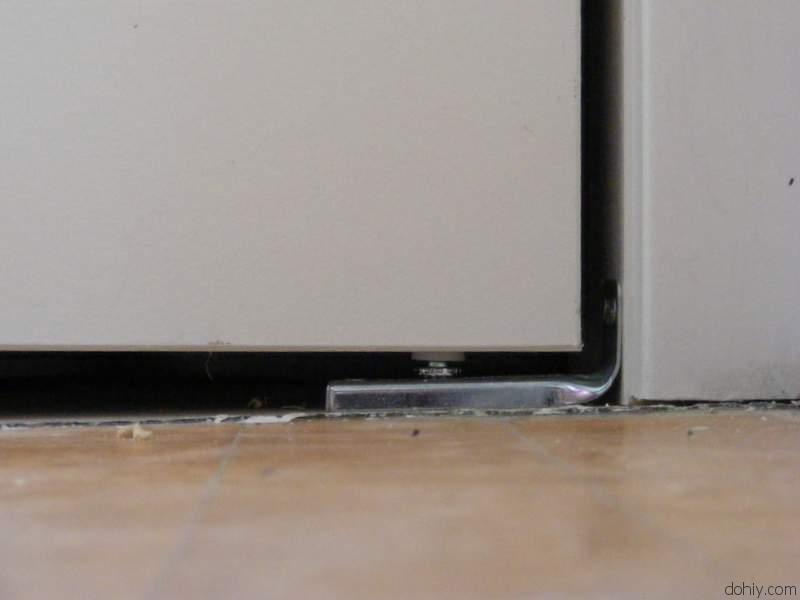
We quickly decided that the doors should be installed level, and that we would deal with an uneven gap at the bottom of the door. The gap under the left side of the door is 1½ inches bigger than the gap under the right side.

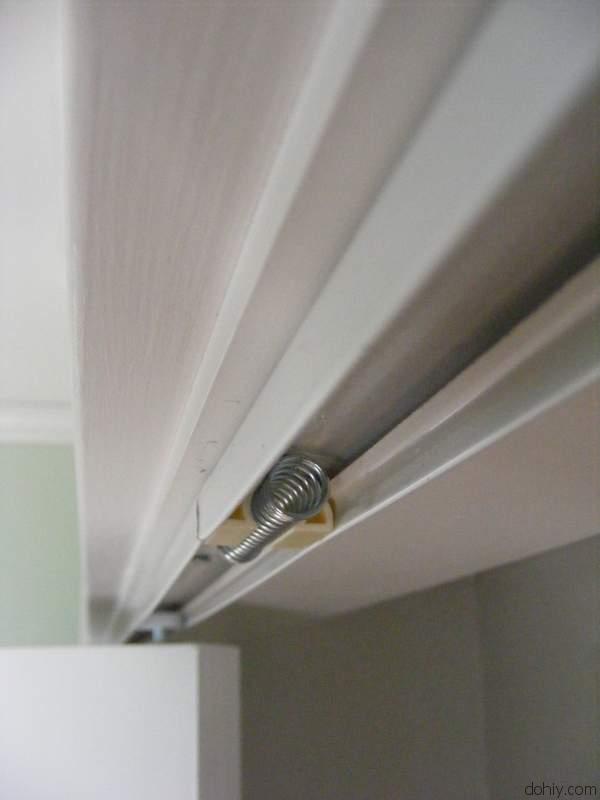
For the most part, the door fittings were installed according to the manufacturer’s instructions. The upper slides were fitted exactly as detailed in the instructions.

The top closet door rail was installed as per instructions.

The top closet door rail was installed as per instructions.

Also, the lower right hinge bracket installation matched the manufacturer’s vision.

Bottom Right Closet Door Hinge Bracket

The bottom right hinge bracket installed as nature intended.

The only deviation from the standard installation was with the lower left hinge bracket.

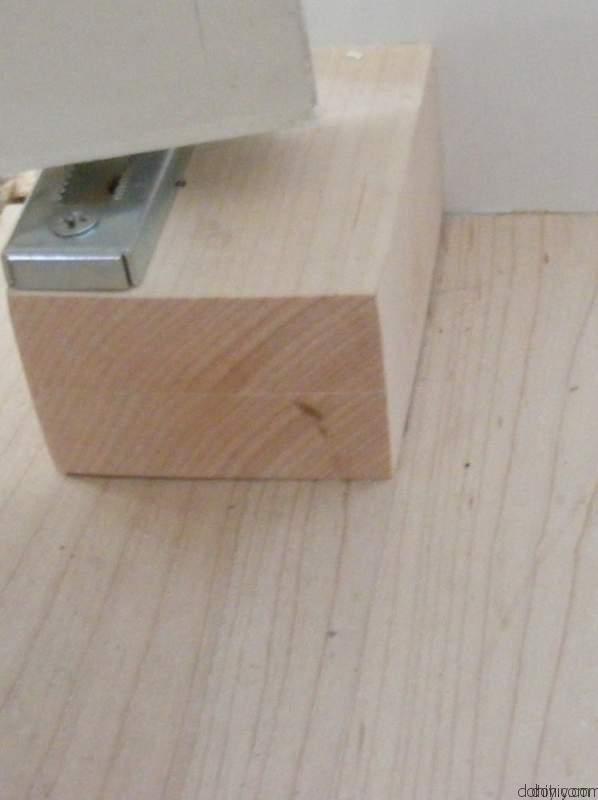
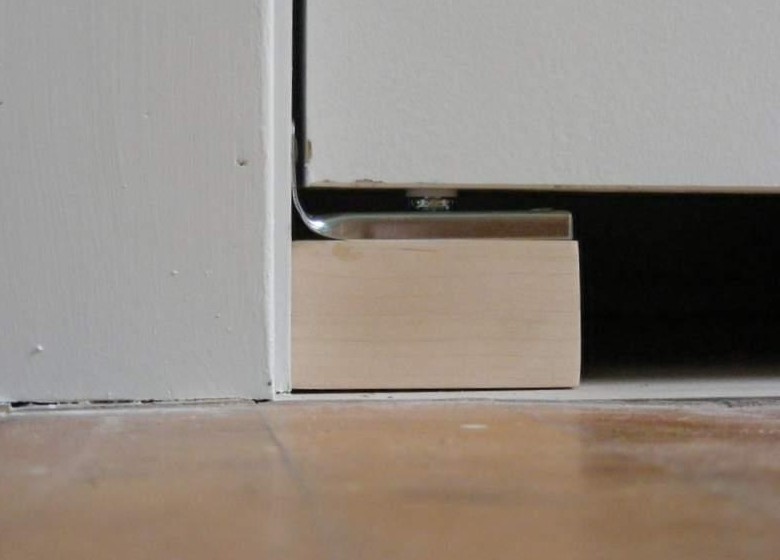
We had to raise the lower left hinge bracket up 1½ inch, so that it would engage with the bottom of the door. Our solution was to put it on a block of wood.

We wanted the wood block to be as unobtrusive as possible. Since the floor is maple, we would use a block of maple. There was a problem, in that, none of the local home improvement outlets had 1½” thick maple. Probably we could have gotten fixed up at a lumber yard. But since we only wanted a piece four inches long, I decided to improvise.

I bought ¾” maple, cut two pieces slightly longer than the hinge bracket, and screwed them together. The outward facing side was sanded to hide the joint. The block was screwed to the floor, with the screws positioned such that they would be hidden under the hinge bracket.

Block of Maple Under Closet Door Hinge Bracket

This is the block of maple under the hinge bracket. If you look through the gap in the hinge bracket, you can see one of the screws that holds the block down.

Finally, the hinge bracket was fitted on top of the block, and the door installed as normal.

Block of Maple Under Closet Door Hinge Bracket

I sanded this side of the block so that the joint wasn’t obvious.

So there it is. Hopefully the gap won’t be too noticeable once the room is functional. I imagine that with a bed in the way, it will be difficult to view the bottom of the doors from across the room; and when that block is finished to match the floor, it will become almost imperceptible. Yes, I know—dream on.

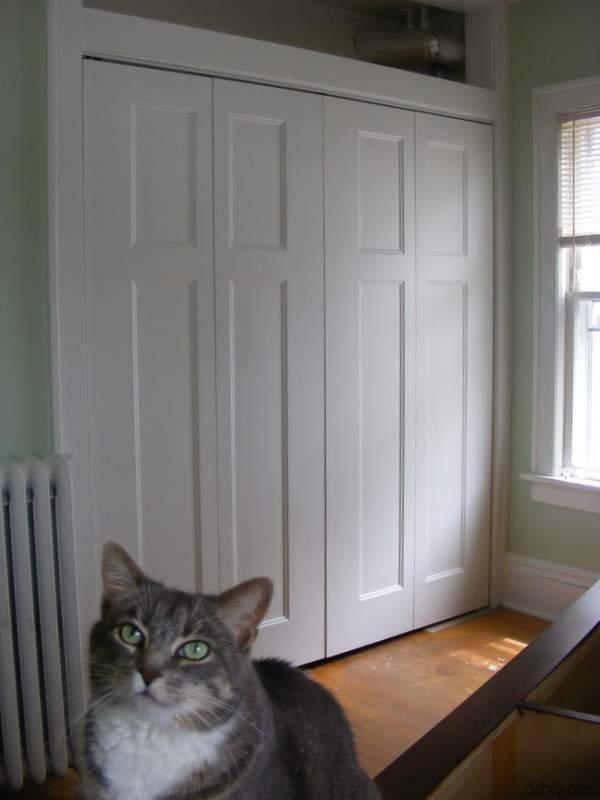
Mayya in front of closet doors

Anyway, as long as Mayya sits right here you can’t even see the gap.

Posted in Construction, D'oh!, Walls & Floors, Windows & Doors | Tagged , , , | Leave a comment

Good Easy Plants: Weigela

Homer: Uh, I’d like some flowers.
Florist: What kind of flowers?
Homer: Uh, you know, pretty ones, not dead.

 – The Simpsons

I haven’t been a gardener all that long. For several years before we got around to landscaping, our house looked like it belonged at Redneck Vista. When I starting planning semi-rationally, I looked for super-hardy stuff that I couldn’t kill.

The first priority was eliminating grass from the tiny strip on the south side of the house. It was hard to mow and full of weeds. We felt terrible that our favorite neighbors had a scrubby mess outside their kitchen window. We wanted to pick a single, repeating shrub to take up the space. My landscaping sister-in-law recommended weigela, which I couldn’t pronounce and had never heard of.

I had to learn to pronounce it because people ask about them. They are off the hook!

West side of the house in bloom

South side of the house in bloom

The dark-leaved variety is Wine and Roses Weigela. They rebloom on and off through the summer, but give us this amazing show in June. And when they aren’t blooming, the dark leaves look great against the house.

DSCF9734-001

Nearer the front of the house, we have a variegated (stripey-leaved) version, sometimes marketed as Pink Splash.

DSCF9733-001

Butterflies, bees and hummingbirds all love these beauties. They are due for a bit of a trim, but I can’t possibly cut them back when they are blooming!

DSCF9732-001

Until recently, weigela was considered an old-fashioned, one-hit wonder, but nurseries bred varieties with showy foliage and rebloom potential. There are dozens of choices: Red Prince is another popular large variety, while Minuet is great for containers and small spaces.

So, yes, they are gorgeous — even plant snobs agree. But easy too? Hell yes!

  • It’s hardy all the way to our quasi-Siberian Zone 4. (What’s your zone? Click for US and world maps.)
  • It isn’t picky about soil acidity.
  • It has no significant pest problems.
  • It isn’t prone to mildew or other fungus or disease issues.
  • Once established, it doesn’t need lots of water.
  • It grows well in sun to part-shade (full sun for best blooming).

Now that I am a serious gardener, I have plants that might plunge me into despair on any given morning, but weigela? Never. They make a difficult planting area into a feature with almost no effort. We can all use plants like that!

(Want more easy plants? Check out how easy clematis is. Or gaillardia. Or nepeta.)

DSCF9735-001

Posted in Yard & Garden | Tagged , | Leave a comment

Mason Bees: No Honey, No Keeping, Just Pollinators

The sun is out, birds are singing, bees are trying to have sex with them — as is my understanding.

– Bart Simpson

Kevin’s Uncle Fred kept bees (selling the results of their labor), and seemingly enjoyed it. But when he was ready to hand off the hives, he had a heck of a time finding anyone willing to take them on! As Eddie Izzard pointed out, you have to really want to keep bees. If you have a vague urge to keep bees but you aren’t so keen on wearing nets or getting stung, have I got a bee for you:

Red Mason Bee (image via bbe-tech.com)

Red Mason Bee (image via bbe-tech.com)

Meet the mason bee (a/k/a orchard bee), a bee that you don’t keep so much as facilitate. These solitary bees are not aggressive because they aren’t protecting a whole community or a queen. The males don’t even have stingers. They are undiscriminating pollinators, going to any flower they fancy, so you don’t have to cultivate specific plants. They make separate homes and then just hang out. They’re the Jeff Lebowski of the insect kingdom.

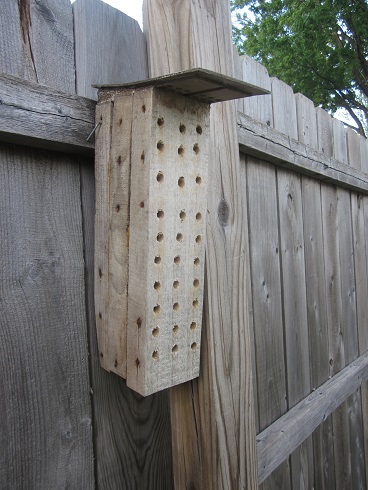
Mason bees like a specific kind of nesting environment, so last year, I made a mason bee house. Basically, all you have to do is drill a series of holes into a piece of wood. Make the holes three to four inches deep, using a 5/16 inch bit (or a few different drill sizes about that gauge). Provide a little cover so they can get out of the rain when coming and going, and that’s it.

Bee House 1

Bee House 1

I made this one out of pallet scraps, and made the porch roof from a vinyl tile. Super-easy to put together, but the bees haven’t liked it all that much. They prefer smooth interior surfaces, and my drill left the insides a little ragged. Before I could get around to cleaning up my handiwork, though, Ben and his girlfriend gave me a bee house:

Bee House 2

Bee House 2

Come on, how awesome is that? It’s got a fancy-pants roof, various suite sizes, and super-smooth walls. Also, it’s sweet-looking hanging in the garden.

I put out both bee houses this spring, and the bees have spoken:

mason bee nesting

Bee House 2 is the Shangri-la of bee accommodation. See how there’s mud packed into the lower right tube? That’s how the females seal in their eggs for the next generation of chilled-out bees. This one is fairly close to the front, which means that there’s a whole series of eggs just in this one tube. Many of the tubes have received this treatment, meaning that a bunch of bees think it’s The Place to Be a Bee (or a Bee-to-Be).

The extent of my effort here? I hung the thing up on a sunny wall in a garden. This winter, I’ll need to do a little clean-up on the house for next season and store the cocoons, but that’s it. Mason bees are where it’s at for the lazy keeper!

Mason bees are spring pollinators, but it’s not too early to plan for next year. Read more about mason/orchard bees here, here and here. Enjoy this fun little bug!

Posted in Yard & Garden | Tagged | Leave a comment

We Took Off to the Great White North

Canada? Why should we leave America to visit America Junior?

– Homer Simpson

The Kev and I just returned from Canada, where we did a little bit of everything from Formula One to whale-watching. We spent most of our holiday outside, and have the rosy cheeks to prove it!  We started in Montreal, then went to Quebec City, and finally a huge loop up to Tadoussac and down through the Cantons de l’Est.

Even though we were in francophone Quebec, there are still many reminders of Britain, such as this seagull doing a creditable Winston Churchill imitation.

We shall eat on the beaches. We shall eat in the parks.

“We shall eat on the beaches. We shall eat in the parks.”

And of course, U.S. culture makes its appearance, being on the same continent and all.

montreal graffiti

I learned two things about myself on the trip. Thing one, despite years of French instruction, I can’t speak it to save my dang life.  Thing two, I never stop taking DIY notes! I took lots and lots of pictures of Quebecois exteriors and could have taken lots and lots more.

The first thing I noticed is that Montreal gardens are gorgeous! They make the most of a short growing season, using the “Parks” and “Explorer” roses (love ‘em) and lots of hardy natives.

montreal garden

Beautiful composition – colors, shapes, textures, all fantastic, right in downtown.

montreal rock garden

Love the plantings tumbling over the rocks.

The houses themselves are also full of character and ideas. With the long, snowy winters, metal is the roofing material of choice. From Chateau Frontenac’s famous copper to zinc and coated steel, metal roofing was much more prevalent than in our current or former neighbourhoods. Since we’re creeping up on a re-roof ourselves, I paid close attention.

montreal metal roof

Metal roofs are hardy and long-lasting. Perhaps not in red, though.

Some homes in the historic districts (and we’re talking European-level historic here – Quebec includes an extant walled city, and both Montreal and Quebec boast districts dating to the 1600s) have metal shingles set at an angle. I don’t know if this is functional (to shed snow, for instance) or simply decorative, but it’s very cool. I only have one picture that shows this feature in detail.

montreal metal roof 2

Angled shingles, funicular station, Vieux Quebec.

I doubt we could find a roofer willing to do this in decidedly un-French Minnesota, but it is definitely eye-catching.

Montreal features many homes with exterior iron staircases, allowing upper-storey residents a separate entrance. These stairs are so distinctive that they were chosen as an emblem of the city over the Olympic Stadium.

montreal steps

Having lived above the ground floor with both interior and exterior stairs, I personally prefer interior. I remember many a drizzle-induced misstep on our outside stairs in East London; with snow and ice, I probably would have broken an ankle! But there’s no denying it was nice to have our own entrance, and it’s hard to fault an architectural feature as pretty as Montreal’s iron steps.

Despite spending so much time out and about, I did have occasion to take one relevant interior shot. Remember my quandary about bifold closet door handle placement? I had not considered this option, selected by one of our temporary landlords.

montreal closet doors

I’m still not considering this option. But I am considering a quick return to lovely Quebec.

Related Posts Plugin for WordPress, Blogger...
Posted in Siding & Roof, Yard & Garden | Tagged , | 2 Comments